You’ve built a legitimate business. You’ve done everything right. Yet every time you apply for a payment gateway, you get the same gut-punch response: declined. No explanation. No appeal. Just a form letter and a closed door.
You’re not alone — and you’re not doing anything wrong.
Thousands of perfectly legal businesses across industries like CBD, nutraceuticals, travel, adult services, firearms, online gaming, and subscription boxes face this same battle every day. Banks and traditional processors label them “high risk” and refuse service — not because these businesses are fraudulent, but because they carry statistical risk profiles that standard payment platforms aren’t built to handle.
That’s exactly where a high-risk payment gateway comes in. And in this complete guide, we’ll walk you through everything you need to know: what it is, why you need it, how to choose the right one, and how to finally get approved.
What Is a High Risk Payment Gateway?
A high risk payment gateway is a specialized payment processing solution designed for businesses that traditional banks and processors refuse to serve. These gateways are built with higher risk tolerance, advanced fraud tools, chargeback management systems, and underwriting teams that understand your industry — rather than fearing it.
Unlike standard gateways (like Stripe, Square, or PayPal), high risk processors don’t terminate your account at the first sign of elevated chargebacks or industry-related flags. They operate within a framework designed for complexity, meaning they can absorb the volatility that comes with certain business models.
Think of a high risk payment gateway as a financial institution that speaks your industry’s language — one that sees your business model as an opportunity, not a liability.
Why Do Merchants Get Labeled “High Risk”?
Understanding why your business has been rejected is the first step toward getting approved. Payment processors assess risk based on several factors:
1. Industry Type
Certain industries are automatically flagged as high risk regardless of how well-run the business is. Common high-risk industries include:
- CBD and hemp products
- Online pharmacies and nutraceuticals
- Adult entertainment and dating platforms
- Travel agencies and timeshares
- Gambling, gaming, and fantasy sports
- Firearms, ammunition, and tactical gear
- Subscription box and negative option billing
- Forex, crypto, and financial trading platforms
- MLM and direct sales
- Debt collection and credit repair
2. High Chargeback Rates
Chargebacks occur when a customer disputes a transaction with their bank. If your chargeback ratio exceeds 1% of monthly transactions, most processors will terminate your account immediately. High risk processors are equipped to manage and mitigate chargebacks without pulling the plug on your business.
3. Poor Credit History
Processors don’t just look at your business — they look at you as the owner. A personal credit score with blemishes, past bankruptcies, or a history of merchant account terminations can trigger automatic rejection with standard processors.
4. International Transactions
If your business serves customers in multiple countries, especially in regions with higher fraud rates, traditional processors often view this as too risky. High risk gateways have the infrastructure to handle international processing securely.
5. New Business or No Processing History
Paradoxically, even being brand new can get you rejected. Without processing history to analyze, standard processors can’t assess your risk — so they don’t. High risk processors are more willing to work with startups and new merchants.
How a High Risk Payment Gateway Works?
A high risk payment gateway works just like a standard gateway at the customer-facing level — your customers enter their card details, a transaction is processed, and funds are deposited into your account. The major differences happen behind the scenes:
- Advanced fraud detection and velocity checks flag suspicious transactions before they become chargebacks
- Dedicated underwriting teams review your application with your specific industry in mind
- Rolling reserves hold a small percentage of your revenue as a buffer against potential chargebacks
- Chargeback alerts give you advance notice of disputes so you can respond before they escalate
- Multiple acquiring banks in the network give you redundancy — if one bank changes its policies, your processing doesn’t stop
DozyPay connects merchants with a global network of high risk acquiring banks, ensuring your processing never goes dark — even in highly scrutinized industries.
The Real Cost of High Risk Payment Processing
Transparency matters — so let’s talk about the costs. High risk payment processing is more expensive than standard processing, and for good reason: the processor is taking on more risk to support your business. Here’s what you can expect:
| Fee Type | Standard Gateway | High Risk Gateway |
| Processing Rate | 1.5% – 2.9% | 2.9% – 4.5% |
| Monthly Fee | $0 – $25 | $25 – $100 |
| Rolling Reserve | None | 5% – 15% for 3–6 months |
| Chargeback Fee | $15 – $25 | $25 – $50 |
| Setup Fee | None | $0 – $500 |
| Contract Length | Month-to-month | 1–3 years (varies) |
While these costs are higher, consider the alternative: zero processing means zero revenue. The right high risk gateway pays for itself from day one.
How to Choose the Right High Risk Payment Gateway?
Not all high risk processors are created equal. Here are the critical factors to evaluate before signing:
✅ Industry Experience
Does the gateway have a proven track record in YOUR specific niche? A processor that specializes in CBD may not have the banking relationships needed to support a firearms retailer. Ask for references or case studies from merchants in your industry.
✅ Multiple Acquiring Bank Relationships
A processor with relationships with only one or two banks is a single point of failure. If that bank exits the high risk space, your account disappears overnight. Look for processors — like DozyPay — that work with a diversified global banking network.
✅ Chargeback Management Tools
Proactive chargeback management is non-negotiable. Look for: chargeback alert integrations (Ethoca, Verifi), dispute resolution support, and real-time transaction monitoring dashboards.
✅ Transparent Pricing
Avoid processors who bury fees in fine print. Request an itemized fee schedule upfront: processing rates, monthly fees, rolling reserve terms, chargeback fees, and any termination fees. If a processor hesitates to share this, walk away.
✅ Customer Support
When a payment issue hits, you need a real person on the phone — not a chatbot or a 48-hour ticket queue. Ensure your gateway offers dedicated account management and 24/7 support.
✅ Integration Flexibility
Your gateway should integrate seamlessly with your shopping cart, CRM, and subscription billing platform. Check for API documentation quality, supported plugins (WooCommerce, Shopify, Magento), and developer resources.
Step-by-Step: How to Get Approved for a High Risk Merchant Account
Applying for a high risk merchant account is more involved than signing up for Stripe — but it’s far from impossible when you come prepared. Here’s exactly what to do:
- Prepare Your Business Documentation — Have your business registration, EIN/tax ID, 3–6 months of bank statements, government-issued ID, and a professional business website ready before applying.
- Clean Up Your Chargeback History — If possible, reduce your chargeback ratio below 1% before applying. Implement clear refund policies, strong customer service, and descriptor clarity to reduce disputes.
- Build a Professional, Compliant Website — Your site needs: a clear product/service description, visible refund and privacy policies, terms and conditions, and working contact information. Processors will review it.
- Be Honest in Your Application — Don’t downplay your industry or transaction volumes. Underwriters will discover the truth during review, and misrepresentation will result in instant rejection and potential blacklisting.
- Partner With an Experienced High Risk Processor — Choose a processor like DozyPay that has existing banking relationships in your niche. Your application passes through the right underwriters who understand your business model.
Common Mistakes That Get High Risk Merchants Rejected (Again)
Even when applying to a high risk processor, merchants make avoidable mistakes. Here’s what NOT to do:
- Applying with an unclear or incomplete business website
- Misrepresenting your monthly processing volume or average ticket size
- Hiding previous merchant account terminations — processors run TMF/MATCH list checks
- Using a personal bank account instead of a dedicated business account
- Ignoring the rolling reserve clause and then disputing it after approval
- Choosing the cheapest option without vetting the processor’s banking relationships
Why DozyPay Is Built for High Risk Merchants?
At DozyPay, we don’t just process payments — we build long-term partnerships with merchants that the rest of the industry has turned away. Our platform is designed from the ground up for high risk businesses, offering:
- Access to a global network of high risk acquiring banks across 50+ countries
- Dedicated industry specialists who understand your business model
- Advanced chargeback prevention tools integrated with Ethoca and Verifi
- Flexible rolling reserve structures that release quickly as you demonstrate stability
- 24/7 merchant support with real human beings
- Seamless API integration with all major shopping carts and billing platforms
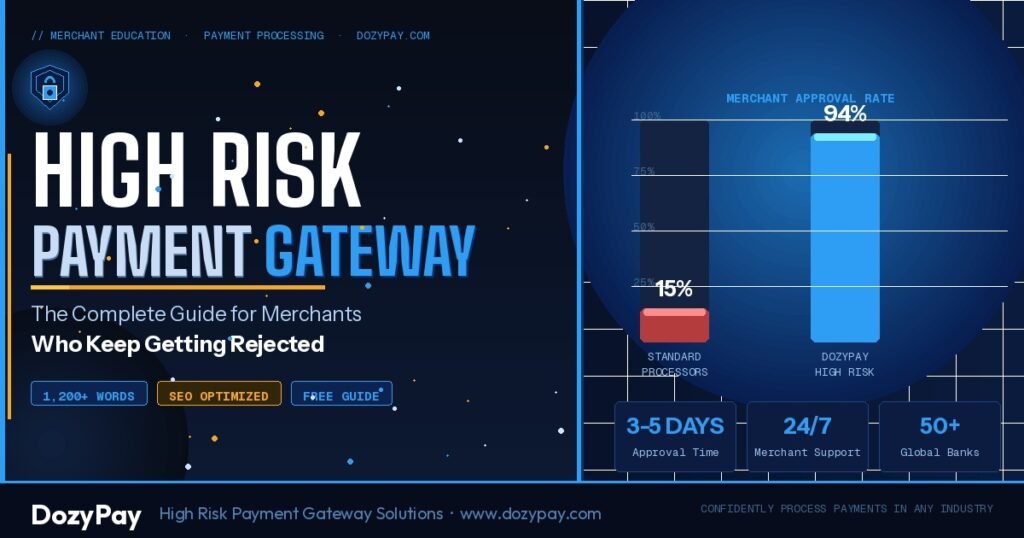
- Fast approval — most merchants get approved within 3–5 business days
“DozyPay helped us get approved in less than a week after being rejected by four other processors. Our chargeback rate dropped 60% in the first 90 days thanks to their alert system.” — DozyPay Merchant, Nutraceuticals Industry
Frequently Asked Questions
How long does approval take for a high risk payment gateway?
Most high risk merchant accounts take between 3 to 7 business days to approve, compared to same-day approvals at standard processors. The timeline depends on your industry, documentation completeness, and processing history. DozyPay expedites this process with pre-screened banking relationships.
Will I have a rolling reserve? Can I avoid it?
For most high risk merchants, a rolling reserve is standard — typically 5–10% of monthly processing volume held for 3 to 6 months. It’s a risk mitigation tool, not a punishment. As you build a clean processing history, reserves are reduced or eliminated entirely.
Can I get a high risk gateway if I’ve been put on the MATCH list?
Being on the TMF/MATCH list is serious but not always permanent. Some processors will still work with MATCH-listed merchants depending on the reason for listing. Full transparency with your processor about your history is essential.
What’s the minimum monthly volume required?
Requirements vary by processor. Some high risk gateways have minimum volume thresholds of $10,000/month; others have no minimums. DozyPay works with businesses at various stages — from startups processing $5,000/month to enterprise merchants processing millions.
Final Thoughts: Stop Getting Rejected. Start Processing.
Repeated rejection from payment processors doesn’t mean your business isn’t viable — it means you’ve been knocking on the wrong doors. The high risk payment space exists specifically for merchants like you: legitimate, driven, and operating in industries that standard processors don’t understand.
The key is finding a processor that has the right banking relationships, the right tools, and the right mindset to support your growth. That means looking beyond the big names and choosing a partner that was built for complexity — not just convenience.
If you’re ready to stop fighting for a merchant account and start scaling your business, DozyPay is ready to help. Our team works with high risk merchants every day, across dozens of industries, and we know exactly how to get you approved and keep you processing.
👉 Apply today at DozyPay.com and get a free consultation with one of our high risk payment specialists. Most merchants receive a decision within 3–5 business days.

DozyPay is a specialist high-risk payment gateway and merchant account provider, helping businesses in 150+ countries accept payments securely and without interruption. Our team includes payment analysts, compliance specialists, and fintech professionals with over a decade of combined experience in high-risk merchant processing — covering industries such as IPTV, adult content, online gaming, forex trading, pharmaceuticals, and travel.
Every article published by DozyPay is researched and written by our in-house payments team, drawing on real underwriting experience, industry data, and direct merchant feedback. Our goal is simple: give high-risk business owners the clear, honest information that banks and mainstream processors won’t.