Introduction
In today’s digital economy, smooth payment processing is vital for business growth. Customers expect fast and secure transactions. However, many businesses face declined payments. This leads to lost sales and poor customer experience.
Payment acceptance rate is a key performance metric. A higher rate means more successful transactions. As a result, revenue increases. Therefore, improving this rate should be a priority for every online business.
This guide explains what payment acceptance rate is, why it matters, common reasons for payment failures, and proven strategies to improve approval rates.
What Is Payment Acceptance Rate?
Payment acceptance rate refers to the percentage of successful transactions out of total payment attempts. It shows how efficiently a payment system works.
For example, if 100 customers attempt to pay and 85 transactions succeed, the acceptance rate is 85%. A low rate signals issues in payment processing, fraud filters, or banking networks.
Why Payment Acceptance Rate Matters?
A high acceptance rate directly impacts revenue. Every declined payment is a missed sale. Moreover, repeated failures frustrate customers. This can damage brand trust.
Better acceptance rates also improve customer retention. Smooth checkout experiences encourage repeat purchases. Additionally, payment processors often evaluate merchants based on approval ratios. Hence, a strong rate helps maintain stable payment partnerships.
Common Reasons for Payment Declines
Several factors can cause failed transactions.
Bank declines: Issuing banks may reject payments due to insufficient funds, daily limits, or suspicious activity.
Technical errors: Payment gateway downtime or slow response can interrupt processing.
Strict fraud filters: Overly aggressive fraud rules may block genuine customers.
Card authentication failures: Incorrect OTP or 3D Secure errors lead to rejection.
High-risk merchant classification: Certain industries face extra scrutiny from banks.
Understanding these issues helps in finding the right solutions.
Effective Strategies to Improve Payment Acceptance Rate
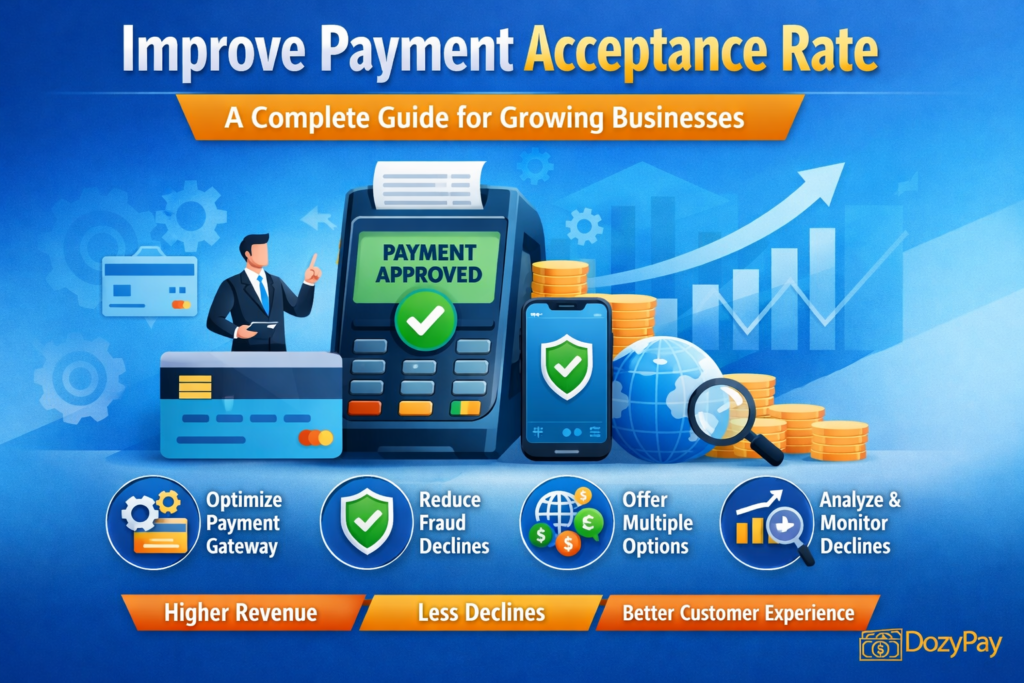
Optimize Payment Gateway Performance
Choose a reliable payment gateway with high uptime. Fast processing reduces timeouts and failures. A multi-gateway setup also ensures backup routing.
Enable Multiple Payment Options
Offer credit cards, debit cards, UPI, net banking, and wallets. More choices mean higher completion rates.
Use Smart Routing
Smart transaction routing sends payments through the best-performing bank or processor. This increases approval probability.
Adjust Fraud Rules
Balance security with customer convenience. Fine-tune fraud filters to reduce false declines while staying protected.
Improve Checkout Experience
Keep checkout simple. Reduce form fields. Support one-click payments. A smooth flow lowers drop-offs.
Support Global Payments
For international customers, enable multi-currency and local payment methods. This prevents cross-border declines.
Monitor and Analyze Declines
Track decline reasons regularly. Use data insights to fix recurring problems.
Benefits of High Payment Acceptance Rate
- Higher revenue and fewer lost sales
- Better customer experience
- Stronger merchant account stability
- Lower cart abandonment
- Improved brand reputation
How Dozypay Helps Businesses Increase Acceptance Rate?
Dozypay offers advanced payment solutions for growing and high-risk businesses. Our platform provides multi-gateway integration, smart routing, fraud management tools, and global payment support.
With Dozypay, businesses achieve higher transaction approvals, secure processing, and uninterrupted payment acceptance.
Conclusion
Payment acceptance rate plays a major role in business success. By optimizing payment systems, reducing technical issues, and improving user experience, businesses can achieve better transaction approvals.
Investing in the right payment partner ensures steady growth and satisfied customers.
FAQ Section – Payment Acceptance Rate
- What is a good payment acceptance rate?
A good payment acceptance rate is usually above 85%. High-performing businesses often achieve 90% or more with optimized payment systems.
- Why do online payments get declined?
Payments may fail due to bank restrictions, insufficient funds, fraud filters, technical errors, or incorrect authentication details.
- How can I reduce false payment declines?
You can reduce false declines by adjusting fraud rules, using smart routing, and selecting reliable payment gateways.
- Does offering multiple payment methods improve acceptance rate?
Yes. Providing cards, UPI, wallets, and net banking increase the chances of successful transactions.
- How does smart routing help payment approval?
Smart routing directs transactions through the best-performing banking network, increasing success rates.
- Can high-risk businesses improve acceptance rates?
Yes. With the right payment partner and risk management tools, high-risk merchants can achieve stable and high approval ratios.
- How often should I monitor payment declines?
You should review decline reports weekly or monthly to identify and fix recurring issues.

DozyPay is a specialist high-risk payment gateway and merchant account provider, helping businesses in 150+ countries accept payments securely and without interruption. Our team includes payment analysts, compliance specialists, and fintech professionals with over a decade of combined experience in high-risk merchant processing — covering industries such as IPTV, adult content, online gaming, forex trading, pharmaceuticals, and travel.
Every article published by DozyPay is researched and written by our in-house payments team, drawing on real underwriting experience, industry data, and direct merchant feedback. Our goal is simple: give high-risk business owners the clear, honest information that banks and mainstream processors won’t.