
If you run an eCommerce business, chargebacks are one of the most frustrating and costly challenges you will face. A single chargeback does not just mean losing a sale — it costs you the product, the shipping fee, a chargeback penalty from your payment processor, and threatens the very survival of your merchant account. For high-risk merchants, this is even more critical.
According to industry estimates, eCommerce businesses lose billions of dollars every year to chargebacks. Worse, for every dollar lost to chargeback fraud, merchants actually lose nearly three dollars once fees, operational costs, and lost merchandise are factored in. And the problem is growing — online chargeback rates have risen sharply since the boom in card-not-present (CNP) transactions.
📊 Stat: Global chargeback losses are projected to exceed $28 billion annually by 2026, with eCommerce merchants bearing the largest share.
The good news? Most chargebacks are preventable. With the right mix of technology, clear policies, and smart customer communication, you can dramatically reduce your chargeback rate and protect your merchant account from being flagged or terminated.
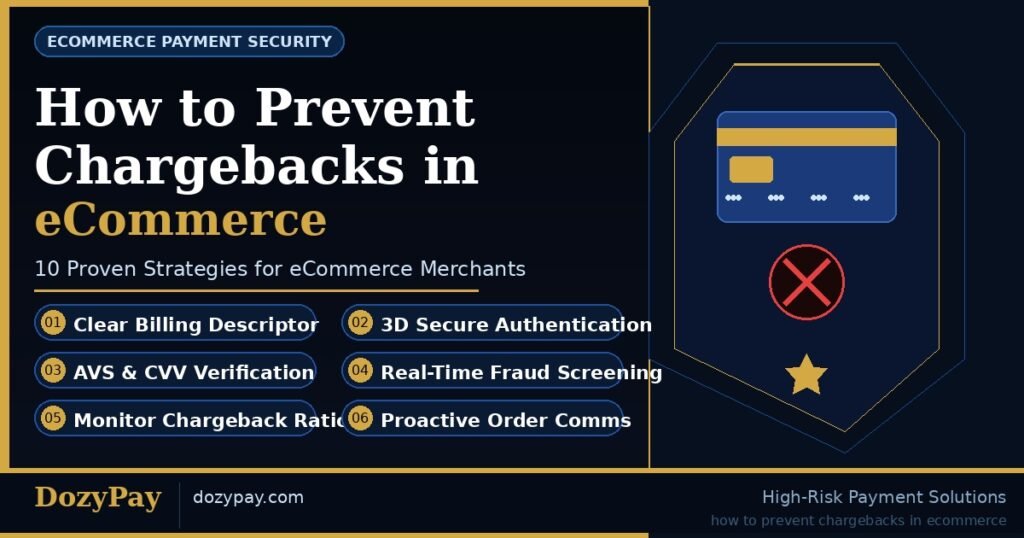
In this guide, DozyPay breaks down 10 battle-tested, proven strategies that eCommerce merchants can implement right now to prevent chargebacks — and keep more of what they earn.
What is a Chargeback — and Why Does It Happen?
A chargeback occurs when a cardholder disputes a transaction with their bank or card issuer rather than contacting the merchant directly for a refund. The bank then reverses the transaction and debits the funds from the merchant’s account — often without giving the merchant an opportunity to respond first.
Chargebacks were originally designed as a consumer protection mechanism. However, they are frequently misused. There are three primary categories of chargebacks merchants face:
- True fraud — a stolen card is used to make a purchase the real cardholder did not authorise
- Friendly fraud — the cardholder made a legitimate purchase but falsely disputes it (claiming non-delivery, not recognising the charge, or buyer’s remorse)
- Merchant error — disputes caused by merchant mistakes such as incorrect billing amounts, failed refunds, or unclear descriptors
📊 Stat: Friendly fraud accounts for approximately 40–80% of all chargebacks depending on the industry, making it the single biggest chargeback threat for eCommerce merchants.
Understanding the root cause of your chargebacks is the first step to preventing them. Now let’s get into the strategies.
10 Proven Strategies to Prevent Chargebacks in eCommerce:
Strategy 1: Use a Clear and Recognisable Billing Descriptor
One of the most common — and easily preventable — causes of chargebacks is a customer not recognising a charge on their bank statement. If your billing descriptor (the name that appears on your customer’s credit card statement) is different from your brand name, customers will dispute the charge assuming it is fraudulent.
For example, if your store is called ‘BlueLight Supplements’ but your payment processor posts charges under a parent company name like ‘BSG Holdings LLC,’ your customers will not recognise the transaction and file a dispute.
Pro Tip: Set your billing descriptor to match your store name exactly, and include a customer service phone number or website in the descriptor where allowed. This alone can reduce confusion-based chargebacks by 20–30%.
- Log in to your payment processor dashboard and verify your current billing descriptor
- Ensure it matches your brand name as customers know it
- Add a short URL or phone number to the descriptor for easy customer contact
- Send post-purchase emails that remind customers what name will appear on their statement
Strategy 2: Implement 3D Secure (3DS2) Authentication
3D Secure 2.0 (3DS2) is a fraud prevention protocol that adds an additional authentication layer to card-not-present transactions. When a customer checks out, 3DS2 sends a real-time risk signal to the card issuer, which may prompt the cardholder to verify their identity via a one-time password, biometric, or banking app push notification.
The key benefit beyond fraud prevention is liability shift. When a transaction is authenticated via 3DS2 and a chargeback is subsequently filed, the liability shifts from you (the merchant) to the card issuer — meaning the chargeback is resolved in your favour automatically.
📊 Stat: Merchants using 3DS2 authentication report up to a 70% reduction in fraudulent chargebacks on authenticated transactions.
Pro Tip: DozyPay’s payment gateway includes built-in 3DS2 support. Make sure it is enabled on all card transactions, especially for high-value orders.
Strategy 3: Maintain Crystal-Clear Refund and Return Policies
Ambiguous or hard-to-find return policies are a major driver of chargebacks. When customers cannot easily find your return policy — or feel it is unfair — they bypass you and go straight to their bank. A chargeback becomes their de facto refund mechanism.
Making your policies transparent, fair, and prominently displayed builds trust and gives customers a reason to contact you first before disputing with their bank.
- Display your return/refund policy clearly on product pages, checkout pages, and order confirmation emails
- Use plain language — avoid legal jargon that confuses customers
- Offer a hassle-free 30-day return window where feasible — this dramatically reduces disputes
- Send a post-purchase email with a direct link to your return policy and customer support contact
- For digital products, clearly state ‘no refund’ policies at checkout and require customers to actively acknowledge them
Pro Tip: A proactive refund is almost always cheaper than a chargeback. If a customer emails you unhappy, issue the refund. The chargeback fee alone ($15–$100) plus the lost merchandise far exceeds the cost of a goodwill refund.
Strategy 4: Collect Compelling Evidence at the Point of Sale
When you do receive a chargeback, your ability to win the dispute depends entirely on the evidence you can present. The stronger your paper trail, the better your chances. This means you need to be collecting evidence at the point of every sale — not scrambling for it after a dispute is filed.
- Collect full billing and shipping addresses and verify they match (AVS — Address Verification System)
- Require CVV/CVC verification on every transaction
- Capture customer IP address and device fingerprint at checkout
- Record timestamps of purchase, shipping, and delivery events
- Obtain signed delivery confirmation for high-value shipments
- Save all customer communication — email threads, chat logs, support tickets
- For digital goods, log IP addresses, login timestamps, and download activity
📊 Stat: Merchants who submit structured, evidence-rich responses to chargebacks win approximately 40% more disputes than those who respond with minimal documentation.
Strategy 5: Use AVS and CVV Verification on Every Transaction
Address Verification System (AVS) and Card Verification Value (CVV) checks are two of the simplest and most effective fraud filters available to eCommerce merchants. AVS compares the billing address provided at checkout against the address on file with the cardholder’s bank. CVV verifies the physical card is present during the transaction.
Enabling both checks filters out a significant percentage of fraudulent transactions before they reach fulfilment — preventing both the fraud chargeback and the associated costs.
Pro Tip: Set your payment gateway to decline transactions where the CVV does not match, and to flag (or decline) transactions with an AVS mismatch. DozyPay’s gateway gives you granular control over these rules so you can fine-tune them for your business risk appetite.
Strategy 6: Send Proactive Order Communication to Customers
Many chargebacks stem from customers simply not knowing what is happening with their order. They see a charge on their statement, do not recall the purchase or cannot find an order confirmation, and file a dispute. A simple, automated communication sequence can eliminate this category of disputes almost entirely.
- Send an immediate order confirmation email with order number, items purchased, and total charged
- Send a shipping notification with a tracking link as soon as the order is dispatched
- Send a delivery confirmation once the order arrives
- For subscriptions, send a reminder email 3–5 days before each billing cycle
- Include your brand name, logo, and customer support details in every communication
Pro Tip: For subscription-based businesses, pre-billing notifications are a regulatory requirement in many regions under Visa and Mastercard rules. Sending them proactively also reduces friendly fraud disputes by up to 35%.
Strategy 7: Make Your Customer Support Genuinely Easy to Reach
The best chargeback prevention strategy is giving customers a reason to contact you instead of their bank. If a customer experiences an issue with their order and cannot reach you quickly, the bank becomes their only option.
Friction in your customer support process is a direct driver of chargebacks. Audit your support channels right now and ask: if a frustrated customer wanted to resolve an issue at 9pm on a Saturday, could they easily reach you?
- Offer live chat on your website — even a chatbot that captures contact details and promises a callback
- Display your customer support email address and phone number prominently on every page
- Set clear response time expectations in your auto-reply emails (‘We respond within 24 hours’)
- Monitor your social media channels — many customers will publicly complain before filing a dispute
- Empower your support team to issue refunds without excessive approval friction
Strategy 8: Use Real-Time Fraud Screening Tools
Modern AI-powered fraud screening tools analyse hundreds of data signals in real time to flag suspicious transactions before they are processed. These tools look at behavioural patterns, device fingerprints, order velocity, email age, IP geolocation, and dozens of other signals to assign a risk score to every order.
Automatically blocking or flagging high-risk orders before fulfilment is one of the most effective ways to eliminate true fraud chargebacks.
Pro Tip: DozyPay’s payment gateway includes integrated real-time fraud screening with customisable risk rules. You can set velocity filters (block more than 3 orders from the same IP in one hour), block high-risk countries, and flag orders where the billing and shipping addresses differ significantly.
📊 Stat: Merchants using AI-powered fraud detection tools reduce fraudulent chargebacks by an average of 60–80% compared to those relying on manual review alone.
Strategy 9: Monitor Your Chargeback Ratio and Act Early
Your chargeback ratio is the percentage of your total monthly transactions that result in chargebacks. Visa and Mastercard set thresholds that, when exceeded, trigger a monitoring programme — and continued violations can result in your merchant account being terminated and your business being placed on the MATCH list (a blacklist that prevents you from obtaining merchant services elsewhere).
Visa’s threshold is 1% chargeback ratio (100+ chargebacks per month). Mastercard’s threshold is 1.5% (100+ chargebacks per month). These may sound generous, but for high-risk merchants processing large volumes, these thresholds are reached faster than you might expect.
- Pull chargeback reports weekly — not monthly — so you can spot rising trends early
- Identify the product lines, traffic sources, or customer segments generating the most disputes
- Take immediate action if your ratio exceeds 0.5% — do not wait until you hit the threshold
- Work with your payment processor to implement proactive alerts when chargeback volume spikes
- Consider pausing high-dispute product lines temporarily while you investigate root causes
Pro Tip: DozyPay provides merchants with a real-time chargeback dashboard showing your rolling ratio, dispute breakdown by reason code, and early-warning alerts. Knowledge is your greatest weapon.
Strategy 10: Work with a High-Risk Payment Processor That Supports You
Perhaps the most overlooked chargeback prevention strategy is simply working with the right payment processor. Many mainstream processors like Stripe or PayPal offer zero support when chargebacks begin to rise — they simply terminate your account. This leaves merchants scrambling for a new provider while the underlying chargeback problem remains unsolved.
A specialist high-risk payment processor like DozyPay offers dedicated chargeback management support, dispute representment services, and proactive account monitoring that generic processors simply do not provide. When you have a team fighting chargebacks alongside you, your win rates improve and your ratio stays manageable.
- Choose a processor with experience in your specific industry and its typical chargeback reasons
- Ensure your processor offers dispute representment — the process of formally fighting chargebacks on your behalf
- Look for processors with a dedicated chargeback management team, not just a generic support line
- Ask about their merchant monitoring tools and whether they provide early-warning alerts
- Partner with a processor who treats chargeback prevention as a shared goal, not just your problem
Quick-Reference Summary: 10 Chargeback Prevention Strategies
| # | Strategy | Primary Benefit |
| 1 | Clear billing descriptor | Eliminates confusion-based disputes |
| 2 | 3D Secure 2.0 authentication | Liability shift + fraud reduction |
| 3 | Transparent refund policy | Customers contact you, not the bank |
| 4 | Collect sale evidence | Win more chargeback disputes |
| 5 | AVS & CVV verification | Blocks fraudulent transactions upfront |
| 6 | Proactive order communication | Prevents ‘I don’t recognise this’ disputes |
| 7 | Accessible customer support | Customers resolve issues with you first |
| 8 | Real-time fraud screening | Stops fraudsters before fulfilment |
| 9 | Monitor chargeback ratio | Stay below card network thresholds |
| 10 | Right payment processor | Expert support and representment |
Conclusion: Prevention is Always Cheaper Than the Cure
Chargebacks are an unavoidable reality of eCommerce — but an unmanageable chargeback rate is a choice. Every strategy in this guide is actionable today, and implementing even a handful of them will produce a measurable reduction in your chargeback rate within 30 to 60 days.
The merchants who win the chargeback battle are the ones who treat prevention as a system, not a reaction. They set up clear communication, use the right technology, collect evidence at every touchpoint, and partner with a payment processor that fights in their corner.
At DozyPay, we specialise in helping eCommerce and high-risk merchants manage, dispute, and prevent chargebacks with purpose-built tools, a dedicated chargeback team, and payment solutions designed specifically for businesses in challenging industries.
Ready to take control of your chargebacks? Visit dozypay.com to explore our chargeback management solutions and apply for a high-risk merchant account built to protect your business.

DozyPay is a specialist high-risk payment gateway and merchant account provider, helping businesses in 150+ countries accept payments securely and without interruption. Our team includes payment analysts, compliance specialists, and fintech professionals with over a decade of combined experience in high-risk merchant processing — covering industries such as IPTV, adult content, online gaming, forex trading, pharmaceuticals, and travel.
Every article published by DozyPay is researched and written by our in-house payments team, drawing on real underwriting experience, industry data, and direct merchant feedback. Our goal is simple: give high-risk business owners the clear, honest information that banks and mainstream processors won’t.