Introduction: Why So Many Casino Applications End in Rejection?
Every year, hundreds of online casino operators submit merchant account applications — and processors reject the majority of them. Some applications receive a decline within 48 hours. Others go through weeks of underwriting, only to hit a one-line rejection with no explanation. In both cases, the cost is the same: a casino that cannot process real-money deposits cannot operate.
Importantly, the rejection rate for online casino merchant accounts is not random. Processors decline the same application types for the same reasons, repeatedly. As a result, operators who understand those reasons — and build their applications around them — secure merchant accounts. Operators who do not, however, cycle through processor after processor, collecting rejections, until they either find the right specialist or exhaust their options.
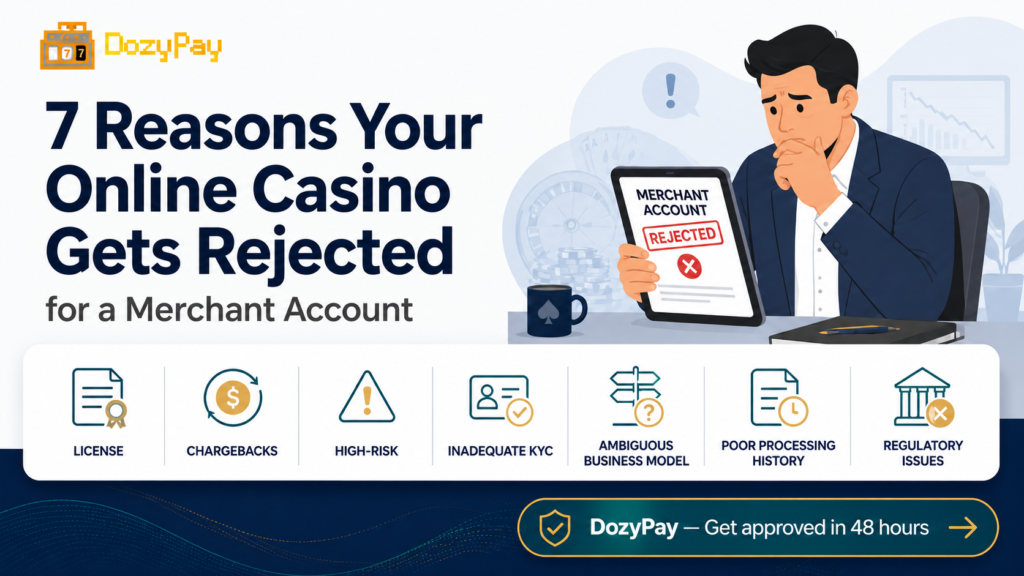
This guide identifies the seven most common reasons online casinos face merchant account rejection. Furthermore, it explains the logic behind each reason and shows exactly how to eliminate each rejection trigger before submitting an application. For operators ready to apply with a processor that has specifically underwritten online casino businesses, DozyPay’s
This guide identifies the seven most common reasons online casinos face merchant account rejection. Furthermore, it explains the logic behind each reason and shows exactly how to eliminate each rejection trigger before submitting an application. Operators ready to apply with a specialist processor should start with DozyPay’s casino merchant account — built for this industry from day one.
Why Casino Applications Fail at a Higher Rate Than Other High-Risk Businesses?
The Regulatory Framework Behind Every Rejection
Before examining the seven reasons, it helps to understand why casino merchant account applications face such high rejection rates in the first place. Payment processors operate within a regulated framework set by Visa, Mastercard, and the acquiring banks that provide their underlying infrastructure. Consequently, gambling — including online casino operations — sits in the highest-risk category in that framework.
Processors that serve online casinos expose themselves to elevated regulatory scrutiny, potential money-laundering liability, and reputational risk from association with non-compliant operators. As a result, most mainstream processors manage this exposure by refusing all gambling applications outright.
What Specialist Processors Require Instead?
Those processors that do accept gambling businesses apply rigorous underwriting standards. In particular, a single documentation gap — one missing licence, one unanswered compliance question — gives the underwriter grounds to decline. Therefore, understanding those grounds is the first step to avoiding them.
| Business Type | Processor Availability | Primary Rejection Risk |
| Standard e-commerce | Open market — wide choice | Minimal — standard processors available |
| Digital goods / SaaS | Broad specialist choice | Low — well-defined product category |
| Social gaming / virtual currency | Specialist required | Moderate — quasi-gambling risk flags |
| Online casino (real-money) | Specialist gambling acquirer only | High — all 7 reasons in this guide apply |
| Casino via wrong processor | Standard processor — ToS violation | Immediate ban — not a considered rejection |
Reason #1 — No Valid Gambling Licence or Incomplete Licence Documentation
Why Licensing Is the First Thing Processors Check?
This is, by a significant margin, the most common reason processors reject online casino applications. Processors simply cannot accept gambling businesses without valid licensing documentation. Specifically, a current licence tells the processor two critical things: first, a regulatory authority has verified the legitimacy of the operation; and second, the business has committed to operating within a defined compliance framework.
What Processors Actually Verify?
Notably, processors do not simply accept a licence number and move on. Instead, their underwriting teams verify all of the following:
- The licence is current and in good standing with the issuing authority
- The licence covers the specific gambling activities the casino offers
- The licensing jurisdiction appears on the processor’s approved list
- The licence covers the player jurisdictions the casino intends to serve
Common Licence-Related Rejection Triggers
In practice, the most frequent licence-related rejection triggers are:
- Applying before the licence is fully issued — pending applications do not satisfy underwriting requirements
- Holding a licence from a jurisdiction the processor does not accept
- Holding a B2B supplier licence rather than a B2C player-facing operator licence
- Serving player jurisdictions outside the licence’s geographic coverage without separate authorisation
- Presenting an expired licence or one currently under regulatory review
The Solution: Confirm Licensing Before Applying
Consequently, the most effective step is to confirm your licensing documentation is complete before applying to any processor. Match your licence type and jurisdiction against the processor’s accepted list in advance. DozyPay works with operators licensed across a broad range of accepted jurisdictions and, moreover, advises on licensing gaps before the formal application — thereby avoiding a rejection that delays your launch timeline entirely.
Reason #2 — Applying Through a Standard Payment Processor
Why Standard Processors Cannot Help Casino Operators?
The second most common rejection trigger is, strictly speaking, not a considered rejection at all — it is a Terms of Service ban. Standard payment processors, including Stripe, PayPal, Braintree, and Adyen’s general-market product, prohibit gambling in their ToS. As a result, operators who apply through these channels never receive an underwriting decision. Instead, the processor identifies the gambling nature of the business and blocks the account immediately.
Why This Approach Wastes Critical Time?
For an online casino startup, every day without payment processing is a day of zero revenue. Furthermore, applying to the wrong processor, waiting for a response, receiving a block, and restarting the specialist search wastes days or weeks. A pattern of rejections can also complicate underwriting — because some specialist processors ask whether previous applications were declined, and multiple rejections consequently raise questions.
Finding the best payment gateway for online casino startup operations, therefore, requires applying exclusively to specialist high-risk processors from the outset. The right specialist combines deep gambling-sector expertise, pre-negotiated acquiring relationships, and an application process specifically designed for the documentation profile gambling businesses carry.
The Solution: Apply Only to Specialist Processors
Apply to specialist processors only. DozyPay’s casino merchant account removes the wrong-processor risk entirely. Additionally, for operators exploring all infrastructure options before applying, DozyPay’s online casino payment gateway guide covers the full landscape of specialist processing solutions available to licensed casino operators.
Reason #3 — Weak or Missing AML and KYC Compliance Framework
Why AML/KYC Matters to Your Processor? — Not Just to Regulators
Anti-Money Laundering (AML) and Know Your Customer (KYC) compliance are non-negotiable for any business handling real-money gambling transactions. Importantly, processors — particularly those with banking relationships in regulated markets — face their own AML obligations before they accept a gambling merchant.
Online casinos without a documented AML/KYC framework present an unacceptable compliance risk. Specifically, the processor’s own licence faces scrutiny if one of its merchants facilitates money laundering through a casino that failed to verify player identities. Therefore, a weak compliance framework is not just the casino’s problem — it becomes the processor’s problem too.
What a Processor’s AML Review Covers?
In practice, a processor’s AML due diligence covers all of the following areas:
- Written AML policy covering customer due diligence, enhanced due diligence for high-value players, and transaction monitoring
- KYC procedures specifying how the casino verifies player identity before processing deposits
- Suspicious Activity Reporting (SAR) procedures with clear escalation paths
- A designated compliance officer with appropriate qualifications
- AML training records for all staff with customer-facing or financial responsibilities
- Technology implementation — KYC verification software, transaction monitoring system, and PEP/sanctions screening
The Solution: Build Compliance Before Applying
Consequently, the right approach is to build and document your AML/KYC framework before applying for a merchant account. DozyPay’s onboarding team reviews compliance documentation and identifies gaps before the formal application goes in. Moreover, operators who arrive with a complete, documented framework move through underwriting significantly faster than those who assemble documentation in response to processor queries.
Reason #4 — No Chargeback Management History or Plan
Why Chargeback Risk Defines the Underwriting Outcome?
Processors evaluate every casino application with one central question in mind: how will this merchant’s chargeback rate behave? Online casinos generate chargebacks at rates significantly above most digital businesses. In particular, disputes from players who regret deposits, fraudulent use of stolen payment credentials, and friendly fraud from players who deny confirmed transactions all contribute to a structural chargeback risk profile that processors treat with extreme caution.
A new casino applying without any chargeback history presents maximum uncertainty to the underwriter. Furthermore, without a documented chargeback management strategy, the application signals that the operator either does not understand the risk or has no plan to control it. In either case, the result is a decline.
What Processors Expect to See in a New Application?
Even for new operators with no transaction history, processors expect the following:
- A documented chargeback management policy with defined thresholds and escalation triggers
- An integration plan for chargeback alert services — Ethoca, Verifi, or equivalent
- A dispute response process with defined ownership and response timelines
- Responsible gambling controls that reduce deposit disputes — deposit limits, cooling-off periods, and player verification
- Fraud detection and prevention measures active at the transaction level
The Solution: Document the Strategy — Even Without History
Therefore, document your chargeback management strategy before applying, even for a new operation with no transaction history. A secure casino payment gateway provider does not treat chargeback management as an afterthought — instead, it builds the infrastructure into the payment setup from day one. DozyPay provides pre-configured chargeback management, including real-time ratio monitoring and alert network integration, active from the first transaction.
Reason #5 — High-Risk Business Registration Jurisdiction Without Risk Mitigation
How Your Registration Country Affects Processor Access?
Where your online casino business registers legally matters enormously during merchant account underwriting. Some jurisdictions generate automatic declines from most processors — not because they are illegal, but rather because the processor’s acquiring bank will not accept businesses registered there. Others, meanwhile, require additional documentation and enhanced due diligence before the application proceeds.
Jurisdictions That Commonly Trigger Processor Flags
Specifically, processors frequently flag businesses registered in the following types of jurisdictions:
- Countries on FATF grey lists or blacklists at the time of application
- Jurisdictions with minimal corporate transparency requirements or opaque beneficial ownership rules
- Countries associated with previous high-profile gambling fraud or money-laundering cases
- Jurisdictions outside the processor’s acquiring bank’s accepted country list
As a result, a legitimate, well-run online casino registered in a flagged jurisdiction can still face automatic rejection — regardless of how strong the application is in every other respect. The acquiring bank restriction, in such cases, overrides the quality of the application entirely.
The Solution: Match Jurisdiction to Processor Before Applying
Consequently, match your registration jurisdiction to the processor’s accepted list before submitting any application. If the registration jurisdiction creates problems, discuss restructuring with legal counsel at the corporate structure stage — not at the application stage, where the options are far more limited. Additionally, DozyPay’s team regularly helps operators understand how their registration structure affects processor access and what structural changes expand their options.
Reason #6 — Misrepresentation on the Merchant Application
How Misrepresentation Differs from the Other Six Reasons?
This reason differs structurally from the others. Reasons 1 through 5 represent preparation failures — documentation gaps or risk profile issues that operators can fix with effort. Reason 6 — misrepresentation — represents a deliberate or accidental choice to describe the business inaccurately on the application. The distinction matters, because the consequences are significantly more severe.
In practice, misrepresentation on a gambling merchant application takes several forms. Some operators describe their business as ‘online entertainment’ or ‘digital gaming’ to avoid the gambling category. Others, meanwhile, understate processing volumes, omit specific game types, or fail to disclose related companies with previous processor terminations.
Why Processors Catch Misrepresentation — Every Time?
Processors perform due diligence on every casino application. Specifically, they review the casino website, app store listings, player reviews, licensing authority records, and company registration documents. They also run principal checks and related-company searches. As a result, any material discrepancy between the application and any of these sources triggers a misrepresentation flag.
The Long-Term Consequences of Misrepresentation
Importantly, misrepresentation terminations carry consequences that extend far beyond the immediate rejection:
- Addition to the MATCH list — blocking merchant account approval from any major processor for up to five years
- Suspicious Activity Report filing by the processor with relevant financial authorities
- Permanent damage to the principals’ ability to obtain merchant accounts for any future business
- Potential regulatory investigation of the casino operation itself
The Solution: Full Disclosure Is the Only Correct Approach
Therefore, full and accurate disclosure during the merchant application process is non-negotiable. A specialist casino payment processor like DozyPay handles accurate gambling merchant applications daily. Furthermore, the application process guides operators through every disclosure requirement — ensuring the application represents the business accurately while presenting it within a complete compliance framework that makes it approvable.
Reason #7 — Insufficient Financial History or Business Documentation
Why Documentation Depth Surprises New Operators
Processors underwriting high-risk gambling merchants perform thorough financial due diligence on the business and its principals. Nevertheless, new operators frequently underestimate the documentation depth that casino merchant account applications require. As a result, missing or incomplete financial documentation sends an immediate negative signal — and most specialist processors will decline rather than chase missing items.
Documents Processors Typically Require
In particular, a complete casino merchant account application package should include:
- Certificate of incorporation and company registration documents
- Proof of registered address — utility bill, lease agreement, or government correspondence
- Full KYC documentation for all beneficial owners with greater than 10–25% ownership
- Business bank statements, typically covering the prior 3–6 months
- Processing history — 3–6 months of statements from any previous processor, if available
- Current gambling licence, as covered in Reason #1
- Written AML/KYC policy documentation, as covered in Reason #3
- A functional casino website or platform in advanced development — processors review the actual product
- Responsible gambling policy published on the platform
- Terms and conditions, privacy policy, and refund policy accessible on the platform
The Solution: Prepare Everything Before Submitting Anything
Consequently, prepare a complete documentation package before submitting any application. An incomplete submission rarely produces a ‘please send additional documents’ response from a gambling processor — instead, it more often produces a straight rejection. Therefore, DozyPay provides operators with a complete documentation checklist during pre-application consultation, ensuring nothing critical is missing when the formal application goes in.
The Common Thread: Preparation Determines the Outcome
What the Seven Reasons Have in Common?
Reading through the seven reasons, a clear pattern emerges. Reasons 1, 3, 4, and 7 are preparation failures — the operator had the right intention but submitted before the business was fully ready. Reasons 2 and 6, on the other hand, are strategic failures — the operator chose the wrong processor or described the business inaccurately. Reason 5, meanwhile, is a structural issue requiring corporate-level decisions before the application stage.
Importantly, every single reason is addressable before submission. None require months of remediation. Most, in fact, require focused preparation over two to four weeks. Therefore, the difference between a rejected casino merchant account application and an approved one is almost always preparation — not business quality.
All 7 Rejection Reasons at a Glance
| Rejection Reason | Risk Triggered | DozyPay Solution |
| #1 No gambling licence | Automatic underwriting decline | Pre-application licence review — gaps identified before submission |
| #2 Wrong processor | ToS ban — no underwriting decision | Specialist acquiring underwritten for online casino |
| #3 No AML/KYC framework | Compliance liability — processor decline | Onboarding team reviews compliance docs before application |
| #4 No chargeback plan | Unquantifiable risk — underwriter decline | Pre-configured chargeback management from day one |
| #5 High-risk jurisdiction | Acquiring bank country restriction | Jurisdiction guidance matched to processor accepted list |
| #6 Misrepresentation | MATCH listing + SAR risk | Full disclosure application guided by specialist team |
| #7 Incomplete documentation | Application rejected without review | Complete documentation checklist at pre-application stage |
How DozyPay Eliminates All 7 Rejection Reasons?
Pre-Application Review — Gaps Surface Before Submission
First, DozyPay’s team reviews your business against all seven rejection triggers before you submit a formal application. As a result, documentation gaps, compliance framework issues, and structural problems surface at the pre-application stage — not during underwriting, where the cost of gaps is a straight rejection.
Specialist Acquiring Relationships — No ToS Ban Risk
Second, DozyPay’s acquiring relationships cover licensed online casino businesses across a broad range of accepted jurisdictions. Consequently, your application reaches acquiring banks that have explicitly underwritten online casino businesses. The ToS rejection risk disappears entirely when the processor was built for your business type.
Integrated Compliance Infrastructure — AML/KYC Built In
Third, for operators who need to strengthen their compliance framework before applying, DozyPay supports integration with leading KYC and AML technology providers. Therefore, operators build their compliance infrastructure as part of the payment setup — not as a separate pre-condition to satisfy before applying.
Online Casino Payment Gateway Integration — One Integration, Full Coverage
Additionally, online casino payment gateway integration with DozyPay covers the complete player payment journey — deposits, withdrawals, multi-currency processing, and a full payment method mix across credit cards, debit cards, bank transfers, and alternative payment methods. In practice, one integration handles the entire gateway layer. Operators do not, therefore, need separate arrangements for each payment type.
Multi-Acquirer Redundancy — No Single Point of Failure
Furthermore, DozyPay routes casino transactions across multiple acquiring relationships, selecting the optimal route for each transaction. As a result, a policy change at one acquiring bank does not interrupt casino payment processing — transactions re-route automatically to the next optimal acquirer.
Payment Gateway for Online Casino Without Restriction
Moreover, DozyPay’s casino merchant account operates without the geographic restrictions, game-type exclusions, or processing volume caps that operators encounter when standard processors are adapted to handle gambling. A payment gateway for online casino without restriction — designed for the full scope of online casino payment processing from the outset — does not add hidden limitations after onboarding.
24–48 Hour Onboarding — No Delay After Approval
Finally, for operators with complete documentation — and DozyPay confirms completeness before submission — onboarding typically completes within 24 to 48 hours. As a result, a launching casino can have live payment processing within two business days of submitting a complete application.
Casino Merchant Account Application Checklist
Before submitting any application, work through this checklist to ensure your submission is complete. In particular, an incomplete submission typically produces a rejection — not a request for additional documents.
Licensing
- Valid gambling licence issued (not pending) by a jurisdiction on the processor’s accepted list
- Licence covers all game types the casino offers
- Licence covers all player jurisdictions the casino plans to serve
Business Structure
- Business registration jurisdiction appears on the processor’s accepted country list
- Certificate of incorporation and registration documents prepared
- Registered address proof available — utility bill, lease, or government correspondence
- All beneficial owners (>10–25% ownership) identified with KYC documentation prepared
Compliance Framework
- Written AML policy document complete — customer due diligence, enhanced due diligence, transaction monitoring
- KYC procedures documented with technology implementation confirmed
- SAR procedures documented with escalation paths defined
- Designated compliance officer appointed with qualifications on record
- Responsible gambling policy published on the casino platform
Platform Readiness
- Casino website functional or in advanced development — processors review the actual product
- Terms and conditions published on the platform
- Privacy policy published on the platform
- Refund and withdrawal policy published on the platform
- Age verification active on the platform before any deposit is processed
Chargeback Management
- Chargeback management policy documented with defined thresholds
- Dispute response process defined with clear ownership and timelines
- Chargeback alert service integration planned — Ethoca, Verifi, or equivalent
- Fraud detection measures active at the transaction level
Financial Documentation
- Business bank statements covering the prior 3–6 months
- Processing history from any previous processor, if available
- Financial projections prepared for new operators without existing processing history
| 🎯 Ready to Apply for a Casino Merchant Account That Gets Approved? |
| ✔ Specialist casino payment processing — built for licensed operators |
| ✔ Pre-application review eliminates all 7 rejection triggers before submission |
| ✔ Onboarding in 24–48 hours with complete documentation |
| ✔ Multi-acquirer routing — no single point of failure |
| ✔ Online casino payment gateway integration — full player payment journey covered |
| 🌐 dozypay.com/casino-merchant-account |
| 📞 DozyPay responds within 2–4 business hours |
Frequently Asked Questions
Q: How long does a casino merchant account application take at DozyPay?
Operators with complete documentation typically complete onboarding within 24 to 48 hours. Each back-and-forth exchange over missing documents, however, adds days to the timeline. Therefore, prepare a complete package before applying to avoid unnecessary delays.
Q: Which gambling licences does DozyPay accept?
DozyPay accepts a broad range of gambling licences, including MGA, UKGC, Curaçao eGaming, Isle of Man, and Gibraltar, among others. Contact DozyPay’s team for a current accepted licence list — the list reflects live acquiring relationships and updates accordingly as those relationships evolve.
Q: Can a new casino with no processing history get approved?
Yes. New operators without processing history apply successfully when their documentation is complete, their compliance framework is in place, and their chargeback management strategy is documented. The absence of processing history is not itself a rejection trigger. Instead, what matters is evidence that the operator understands the risk environment and has controls in place to manage it.
Q: My previous merchant account was terminated. Can I still apply?
It depends on the reason for termination. Terminations for excessive chargebacks are, in many cases, manageable with the right remediation plan and supporting evidence. Terminations for misrepresentation or addition to the MATCH list, on the other hand, create significant barriers that require careful assessment. Contact DozyPay’s team with full details — the team will assess your specific situation honestly before you invest time in an application.
Q: What exactly is a payment gateway for online casino without restriction?
A payment gateway for online casino without restriction operates under acquiring relationships that explicitly cover online casino businesses — specifically, with no game-type exclusions, no geographic player restrictions, and no hidden processing caps. Standard gateways adapted for gambling, by contrast, often carry restrictions they do not disclose upfront: game types excluded, player jurisdictions blocked, or volume caps that trigger account reviews. DozyPay’s casino payment infrastructure, therefore, covers the full scope of online casino payment processing from day one — with no undisclosed limitations added after onboarding.
Q: Does DozyPay support multi-currency processing for international casinos?
Yes. DozyPay’s casino merchant account supports multi-currency processing for international player bases. Contact the DozyPay team for a specific currency list relevant to your player jurisdictions.
Q: How does online casino payment gateway integration work with DozyPay?
Online casino payment gateway integration with DozyPay uses a single API integration that covers the full player payment journey — deposits, withdrawals, multi-currency processing, and the complete payment method mix. Additionally, DozyPay’s integration team provides technical documentation and dedicated support throughout the integration process. In practice, most operators complete the technical integration within the same 24–48 hour onboarding window.
Conclusion: Stop the Rejection Cycle Before It Starts
A rejected online casino merchant account application costs more than processing time. It delays your launch, creates a negative application record, and in the worst cases — where misrepresentation occurs — it permanently restricts your ability to obtain merchant accounts in the future.
Importantly, every rejection reason in this guide is preventable. Prepare complete documentation, build your compliance framework before applying, choose a specialist processor, and represent your business accurately. Follow those four principles and the rejection rate drops sharply. In addition, working with a specialist processor from the outset means you benefit from pre-application guidance that eliminates rejection triggers before they ever reach underwriting.
Ultimately, DozyPay’s casino merchant account eliminates each rejection trigger through specialist acquiring relationships, integrated compliance infrastructure, real-time chargeback management, and an application process designed specifically for online casino businesses. Stop the rejection cycle before it starts — apply with the processor that was built for this industry.

DozyPay is a specialist high-risk payment gateway and merchant account provider, helping businesses in 150+ countries accept payments securely and without interruption. Our team includes payment analysts, compliance specialists, and fintech professionals with over a decade of combined experience in high-risk merchant processing — covering industries such as IPTV, adult content, online gaming, forex trading, pharmaceuticals, and travel.
Every article published by DozyPay is researched and written by our in-house payments team, drawing on real underwriting experience, industry data, and direct merchant feedback. Our goal is simple: give high-risk business owners the clear, honest information that banks and mainstream processors won’t.