Quick Answer:
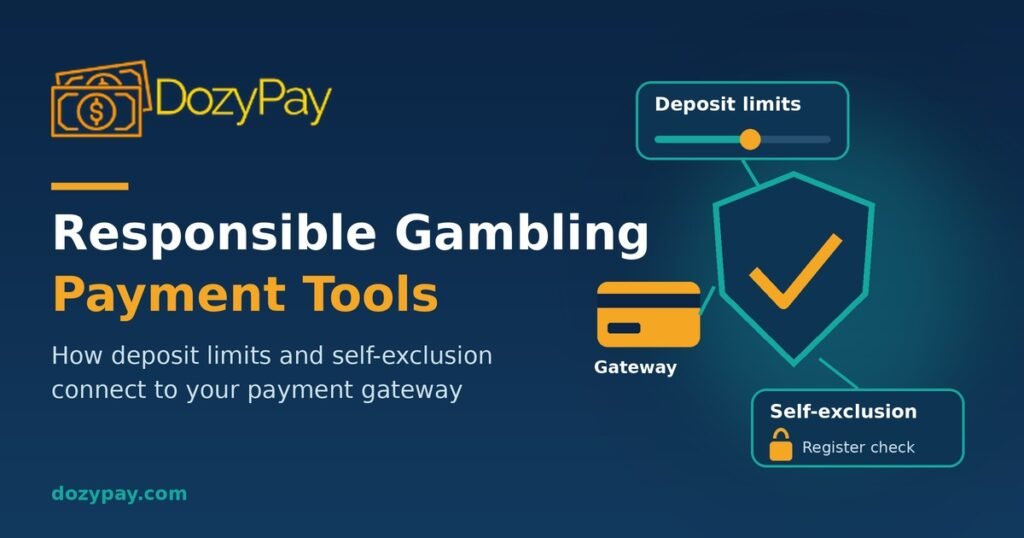
Responsible gambling payment tools link your player account to your payment gateway. Deposit limits cap how much a player can add. Self-exclusion blocks play and payments altogether. Your gateway must honour both in real time. Underwriters also check this link during casino merchant account approval.
Responsible gambling payment tools sit where player protection meets money movement. Every deposit limit, cooling-off period and self-exclusion flag ends up as a payment decision. First, the player taps deposit. Next, your platform checks the rules. Finally, your gateway approves or declines the payment.
Many operators treat these tools as a front-end feature. However, that approach fails quickly. Regulators now expect limits and exclusion checks to hold across every payment route. Likewise, acquirers expect the same. In this guide, you will see how the pieces connect. You will also learn what to build before you apply for a merchant account.
This guide suits operators licensed in the markets they serve. Therefore, match your payment set-up to the laws of each jurisdiction before you take a single deposit.
What responsible gambling tools do at the payment layer?
Responsible gambling tools fall into two groups. Customer-led tools let players control their own activity. Meanwhile, operator-led tools let you step in when behaviour looks risky.
- Deposit limits cap the money a player can add over a day, week or month.
- Loss and wager limits cap what a player can lose or stake.
- Cooling-off periods pause an account for a short, fixed time.
- Self-exclusion locks a player out for months or years.
- Behavioural checks trigger when spend or session patterns shift.
Each tool changes what your gateway should accept. For example, a deposit limit blocks an amount. A cooling-off period blocks a time window. In contrast, self-exclusion blocks a person. This difference matters when you design decline logic.
How deposit limits connect to your payment gateway?
Responsible gambling payment tools only work when the platform and the gateway agree. A deposit limit lives in your player account system, not in the gateway. However, the gateway carries out the result. When a player requests a deposit, your platform checks the limit first. Only permitted amounts reach the gateway as payment requests.
This order protects players and keeps your approval rates clean. For instance, a deposit that your own rules would block should never reach the card network. Otherwise, it creates a decline, hurts your authorisation ratio and confuses the player.
Strong gambling deposit limit payment processing follows four rules.
- Check the limit before you call the gateway, never after.
- Apply limit decreases at once, and delay or confirm increases.
- Return clear decline reasons, so the player sees a limit message instead of a generic error.
- Log every limit change and every blocked deposit for audit.
Next, add a backstop. Gateway-level velocity rules catch edge cases, such as parallel deposits that race past a limit check. Think of the platform limit as the rule and the gateway rule as the safety net.
Deposit limit and self-exclusion rules in key markets
Responsible gambling payment tools differ by market, but the direction is the same. Regulators want limits that are easy to set. They also want exclusion checks that run in real time. The table below summarises three reference markets.
| Market | Limit or key rule | Self-exclusion | What it means for payments? |
| Great Britain | From 31 October 2025, operators prompt new customers to set a limit before the first deposit. From 30 September 2026, gross deposit limits get equal prominence and fixed time frames. | National multi-operator scheme (GAMSTOP) | Credit cards have been banned for gambling since 14 April 2020. Limit prompts sit inside the deposit flow. |
| Germany | A €1,000 monthly baseline applies across licensed operators and is tracked through LUGAS. Up to €10,000 is possible with approval and source-of-funds proof. | OASIS national exclusion system | Deposit checks run against a cross-operator ceiling, not only your own records. |
| Ontario, Canada | Operators keep their own site-level tools and add central checks. | BetGuard, launched 14 May 2026 by iGaming Ontario, covers all regulated sites | Real-time login checks, marketing stops and returns of unused funds. |
Notice the pattern. Each market ties limits and exclusion to operator systems. Each then expects those systems to reach the payment flow. Sweden’s Spelpaus register works on the same principle. Always confirm current rules with your regulator, because dates and thresholds change.
How self-exclusion connects to payments?
Among responsible gambling payment tools, self-exclusion is the strongest control. It removes the person from play. Therefore, every payment route must close too. Registers such as GAMSTOP, OASIS and BetGuard exist to make that happen across operators.
Picture this. A player self-excludes on Monday. Then, on Tuesday, a saved card still works in your app. As a result, that single gap can trigger a regulator complaint and a scheme review. Payments create real leaks here, and these are the common ones:
- Saved cards and tokens let an excluded player deposit in one tap if no one flags the account.
- Alternative methods, such as e-wallets and open banking, open new routes to the same account.
- Delayed webhooks can confirm a deposit seconds after an exclusion lands.
- Marketing and bonus messages can still reach excluded players when lists are out of sync.
To close these gaps, run a register check at login and again at deposit. Ontario’s standards show the benchmark. Operators there must block logins through real-time API checks and stop marketing. They must also return unused funds to excluded players. That refund step is a payments task, so your gateway and settlement flow must support it.
Banks add a second layer. For example, Monzo’s gambling block lets customers stop card payments to merchants that use the gambling category code. Customers choose a cooldown from two days to one year. However, the block relies on the code you send. Therefore, an accurate gambling merchant category code protects the player and your reputation. Some gambling payments are tagged incorrectly and slip through.
Responsible gaming compliance for payment processors
Responsible gaming compliance for payment processors goes beyond card rules. Processors, acquirers and gateways now review your responsible gambling payment tools. In particular, they worry about fines, brand damage and scheme penalties. A weak player protection payment gateway set-up raises all three risks.
For this reason, underwriters read your controls as a risk signal. An operator with strong limits, clean exclusion checks and tidy records poses lower risk. In turn, that can support better terms and fewer surprises after launch.
A casino payment gateway with responsible gaming controls also reduces friction later. Because the checks already run, you can answer audits fast. As a result, you spend less time proving what your system already does.
Social gaming merchant account provider: what player protection looks like?
Social casinos face their own version of this challenge. Players buy virtual coins, not wagers. Even so, spend can still escalate. A good social gaming merchant account provider will expect purchase limits, strong age checks and visible help resources. Industry guidance for sweepstakes and social casinos points to the same core controls:
- Daily, weekly or monthly caps on coin purchases, with defaults that players raise only on purpose.
- One-click cooling-off breaks and self-exclusion that also stops marketing.
- Age checks at sign-up and again at redemption, not a simple tick box.
- A helpline link in the account area and the purchase flow.
- Alerts for fast-rising spend, repeated limit changes and long overnight sessions.
Because social gaming rules vary by state and country, check local law first. Then build your tools to the strictest market you serve.
Casino merchant account approval: what underwriters ask
Strong casino merchant account approval packs prove that limits and exclusion checks work end to end. Instead, underwriters want documents and demos, not promises. Prepare for these questions.
| Underwriter question | Evidence to prepare |
| How do players set limits? | Screenshots of the limit flow, default settings and change logs |
| How do you handle self-exclusion? | Register integration notes, test logs and your refund process |
| How do you spot risky behaviour? | Trigger rules, a review queue and an escalation path |
| How do you control marketing? | Suppression list process and affiliate terms |
Identity checks sit under all of this. Because of that, you cannot apply a limit or exclusion to a person you have not identified. For more detail, read our guide to age verification and KYC for gaming payments.
A practical build checklist for your gateway integration
Use this checklist to test your responsible gambling payment tools before launch.
- Map every payment route, including cards, wallets, open banking and crypto.
- Place limit and exclusion checks before every payment request.
- Sync with the exclusion registers that apply to your licence.
- Revoke saved tokens when an exclusion starts.
- Build a refund path for unused balances.
- Test with simulated exclusions before launch and after each update.
- Keep audit logs for limits, blocks and interventions.
Cooling-off period gambling payments deserve their own test. During a break, deposits and promotions should stay closed. Also, the player should see a clear message about when the break ends.
Common mistakes that weaken responsible gambling payment tools
- Enforcing limits only on the front end, so direct API calls bypass them.
- Letting retries stack above a limit when a first attempt times out.
- Prompting a player to try another card after a limit decline.
- Leaving CRM tools and affiliates out of exclusion syncs.
- Waiting until an underwriter asks before you write the documents.
Fix these early. In short, treat player protection as part of your payment architecture, not a bolt-on.
Next steps with DozyPay
DozyPay supports high-risk merchants, including licensed casino, iGaming and social gaming businesses. Our team can discuss your licence, target markets and player protection set-up before you apply. Get in touch to review your responsible gambling payment tools and merchant account options.
Frequently asked questions
What are responsible gambling payment tools?
Responsible gambling payment tools are the controls that link player protection to payment decisions. They include deposit limits, cooling-off periods, self-exclusion checks and behavioural alerts. Your platform sets the rules, and your gateway enforces the result.
Do deposit limits sit in the gateway or the platform?
They sit in your player account platform. The gateway only receives deposits that pass the limit check. Also, gateway velocity rules can add a second layer.
How does self-exclusion affect payments?
Self-exclusion blocks login, deposits and marketing. You should also revoke saved payment tokens and return unused funds. Register checks must run at login and at deposit.
Can a gateway enforce a player’s deposit limit alone?
Not fully. A gateway can cap velocity and amounts by account. However, player-set limits live in the platform, so both layers must work together.
Do social gaming apps need responsible gaming tools?
In practice, yes. Underwriters and many regulators expect age checks, purchase limits and help resources. Rules vary by market, so confirm local law.
Do these controls affect casino merchant account approval?
Yes. Underwriters treat player protection as a risk signal. Clear evidence of limits, exclusion checks and audit logs supports a stronger application.