
Quick Answer
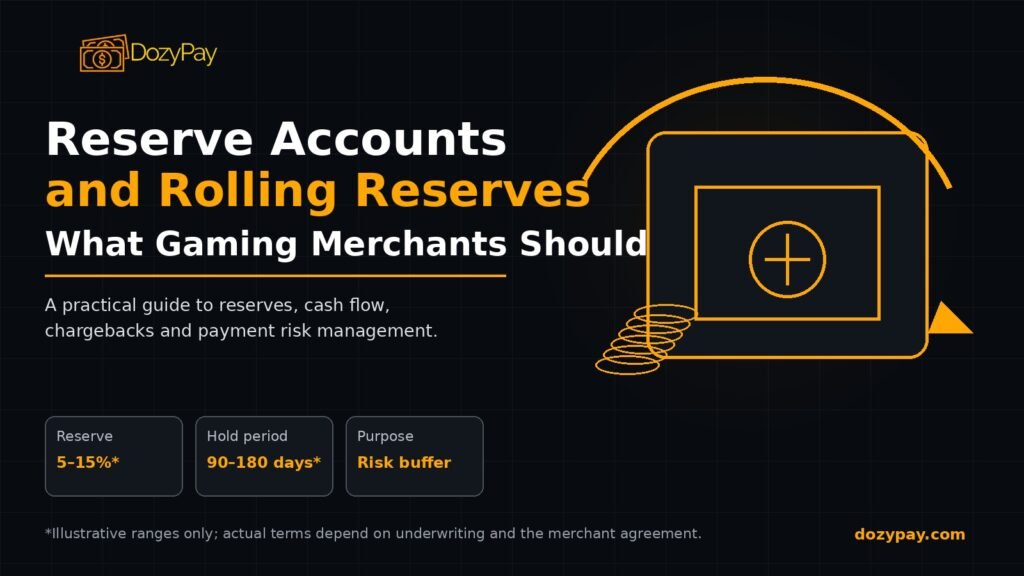
Reserve accounts and rolling reserves are risk controls used in high-risk payment processing. A reserve holds merchant funds as a buffer against future chargebacks, refunds, fraud, or other payment liabilities. A rolling reserve withholds a percentage of new processing volume and releases those funds later on a rolling schedule. Gaming merchants should expect terms to vary by licence, jurisdiction, processing history, chargeback profile, transaction volume, and acquiring-bank risk assessment. There is no universal reserve rate.
Introduction
For online gaming merchants, payment processing is not only about getting transactions approved. It is also about keeping settlement predictable while managing chargebacks, fraud, refunds, regulatory exposure, and changes in transaction volume. That is why reserve accounts and rolling reserves often become a major part of high-risk merchant underwriting.
A reserve is a financial buffer used to cover potential future payment liabilities. A rolling reserve works by withholding a percentage of processed volume and releasing it later according to an agreed schedule. The structure can affect working capital, so merchants should understand the rate, holding period, release rules, review triggers, and account-closure terms before signing a processing agreement.
This guide explains what gaming merchants should expect, how reserves work, what can cause them to change, and how to manage the cash-flow impact. It also answers common questions operators ask when comparing a gaming merchant account or an iGaming payment gateway.
What Is a Reserve Account?
A reserve account is a pool of merchant funds set aside as protection against future payment liabilities. Depending on the agreement, those liabilities may include chargebacks, refunds, reversals, fraud losses, or other obligations linked to transactions.
A reserve is not the same as a processing fee. It is generally a holdback of merchant funds that remains subject to the applicable merchant agreement and acquiring structure. The processor or acquiring side uses the reserve as a risk buffer rather than as ordinary processing revenue.
For gaming businesses, the reserve discussion usually starts during underwriting. The provider may review the business model, licence status, countries served, transaction history, average ticket size, projected volume, refund policy, chargeback performance, and fraud controls. The resulting risk assessment can influence the reserve, settlement cycle, processing limits, and other account conditions.
What Is a Rolling Reserve?
A rolling reserve is a reserve structure in which a percentage of transactions is withheld for a defined period and then released on a rolling basis. For example, a merchant with a 10% rolling reserve and a 90-day release period may have 10% of eligible volume retained and later released as each reserve cohort reaches its release date.
The cycle continues as new transactions create new reserve amounts while older reserve amounts become eligible for release. This makes a rolling reserve different from a one-time security deposit or a fixed reserve balance.
There is no universal reserve percentage or holding period for gaming. Market examples commonly use ranges such as 5% to 15% and 90 to 180 days, but actual terms can be materially different. A licensed operator with strong processing history may receive different terms from a new merchant with limited data. Treat published ranges as planning examples, not guarantees.
Why Do Gaming Merchants Face Reserve Requirements?
Gaming and gambling transactions can carry elevated payment risk. Players may dispute deposits, request refunds, use compromised payment credentials, or challenge transactions after a gaming outcome. Operators can also see sharp volume changes around promotions, sporting events, jackpots, or product launches.
Regulation adds another layer. Visa’s current merchant guidance identifies online gambling transactions under the appropriate gambling classification, while its network-integrity guidance notes that legal gambling businesses can face enhanced safeguards and registration because of elevated risk exposure.
A reserve gives the acquiring side a source of funds if liabilities arise after the original transaction has settled. In other words, the reserve is designed to manage future exposure. It is not automatically a sign that the merchant has done something wrong.
Reserve Account vs. Rolling Reserve: What Is the Difference?
The concepts are related, but they are not identical. A reserve account is the broader concept: money is set aside as security against potential payment liabilities. A rolling reserve is one way to fund that reserve by continually withholding a percentage of new processing volume.
A fixed reserve may require a larger amount upfront. A rolling structure spreads the funding requirement across ongoing transactions. However, the merchant must plan for the fact that part of each settlement cycle can remain unavailable until its release date.
Before approval, ask which structure applies, whether there is a reserve cap, how releases are calculated, and what happens if processing volume falls sharply.
How Much Can a Gaming Merchant Expect to Hold?
There is no single industry-wide number. Reserve terms are set during underwriting and can change with the merchant’s risk profile.
For planning purposes, a provider may quote a percentage reserve and a release period such as 5% to 15% for 90 to 180 days. DozyPay’s published materials state that reserve requirements are discussed during onboarding and can depend on risk and processing history. Its casino payment guidance also recommends negotiating the reserve rate, cap, and release timeline before signing.
The better question is not simply “What is the lowest reserve?” Ask: “What reserve structure is sustainable for this business, and under what conditions can it be reduced?” A predictable reserve with clear review rules can be easier to manage than a lower rate with unclear hold triggers.
What Determines the Reserve Rate?
Underwriters normally consider several variables rather than one simple score.
- Processing history: stable merchants with clean performance can present less uncertainty than new operators.
- Chargebacks and refunds: a rising dispute ratio can increase expected exposure.
- Business model: casino, sportsbook, social gaming, fantasy gaming, virtual currency, and other models can have different risk profiles.
- Licence and jurisdiction: a valid licence and clear geographic controls can strengthen the underwriting case.
- Average transaction size and volume: larger tickets or rapid growth can increase exposure.
- Fraud controls: 3DS2, velocity rules, device intelligence, KYC, AML monitoring, and dispute workflows can improve the overall risk picture.
- Settlement and refund practices: clear operational controls reduce uncertainty around future liabilities.
What Does a Rolling Reserve Do to Cash Flow?
The biggest operational impact is working capital. A merchant can be profitable and still experience a cash-flow squeeze if a large percentage of processed revenue remains unavailable for months.
Consider a simple illustration. A gaming operator processes $500,000 in a month and has a 10% rolling reserve. About $50,000 of that month’s volume may be retained under the reserve terms. If the business grows quickly, the amount tied up can grow as well.
For this reason, merchants should model reserve balances before launch. Include expected monthly processing, reserve percentage, release period, refunds, chargebacks, payroll, marketing spend, player withdrawals where applicable, and other operating costs. Treat the reserve as restricted working capital rather than immediately spendable revenue.
Can a Reserve Increase After Go-Live?
Yes. Reserve terms can be reviewed when risk conditions change. Visa’s payment risk guidance describes merchant reserves as a risk-management mechanism that should be applied using a risk-based approach.
Potential triggers can include higher chargebacks, fraud spikes, significant changes in transaction volume, new markets, material changes to the business model, compliance concerns, or transaction patterns that differ from the original underwriting assumptions.
Ask for the circumstances that allow a reserve to be increased, who approves the change, what notice is provided, whether the merchant can request a review, and how the revised reserve will be released.
How to Reduce the Cash-Flow Impact?
A reserve cannot always be avoided, but merchants can often improve the overall account structure by building a stronger risk profile.
First, keep chargebacks and refunds under control. Use clear billing descriptors, transparent terms, player authentication, fraud screening, and fast dispute response.
Second, avoid unexplained volume spikes. If a campaign or major sporting event is expected to increase deposits, share a forecast with the payment provider in advance.
Third, maintain clean records. Underwriters and account managers need reliable transaction, refund, chargeback, settlement, and compliance data.
Fourth, diversify payment methods where appropriate. A resilient online gaming payment processing strategy can reduce dependence on a single payment rail and improve continuity.
Finally, negotiate performance-based reserve reviews. Ask whether sustained low-risk performance can lead to a lower reserve percentage, shorter release period, or another structure.
What to Ask Before Signing a Gaming Merchant Agreement?
Reserve language should never be an afterthought. Before signing, ask: What is the reserve percentage? Is it fixed, rolling, or capped? Which transactions are included? How long are funds held? When are releases calculated? Is there a minimum reserve balance? Can the rate change after launch? What triggers a review or increase? Can the reserve be reduced after clean processing? What happens to the reserve if the account closes? Which entity holds and controls the reserve? Are all terms written in the agreement?
These questions matter because the headline processing rate does not tell you the full cost of a payment relationship. Settlement speed, reserve requirements, chargeback fees, monthly fees, currency conversion, and payout conditions all affect the economics of a gaming merchant account.
How to Get a Gaming Merchant Account With Sustainable Reserve Terms?
If you are researching how to get a gaming merchant account, start with documentation and risk preparation rather than simply comparing advertised rates.
Prepare business registration, ownership information, a gaming licence where applicable, processing history, bank statements, projected monthly volume, refund policy, AML/KYC procedures, website or product information, and details of the countries you serve. Be ready to explain your player acquisition model and expected transaction patterns.
Next, approach a provider that explicitly understands high-risk gaming and gambling. The goal is not merely approval. You want an account structure that matches your licence, markets, transaction profile, settlement needs, and growth plans.
DozyPay’s published onboarding guidance states that reserve requirements and settlement terms are included in the commercial discussion, with underwriting based on the merchant’s business and risk profile. Before choosing a provider, review the full risk, settlement, and reserve structure rather than focusing on a single advertised rate.
How to Compare the Best Payment Gateway for Online Gaming Business?
The phrase “best payment gateway for online gaming business” can mean different things for different operators. A startup may prioritise approval and integration. A global casino may prioritise multi-currency acquiring, local payment methods, failover, fraud controls, and predictable settlement.
Compare providers across five areas: licensing and compliance fit; payment method coverage; fraud and chargeback management; settlement and reserve terms; and technical reliability. Also check whether the provider understands the operator’s specific business model and target markets.
A strong provider should explain its underwriting requirements clearly and put material reserve and settlement terms in writing. That transparency matters as much as the initial approval.
High-Risk Merchant Account for Gambling Business: What Good Underwriting Looks Like?
A high risk merchant account for gambling business should be underwritten for the actual activity being processed. The merchant should not try to disguise gambling transactions as a lower-risk category. Accurate business descriptions, correct merchant classification, licence verification, and transparent transaction flows are essential.
Good underwriting also means discussing realistic volumes and countries before launch. If the operator expects rapid growth, it should ask how the processor handles volume increases, reserve reviews, and additional acquiring capacity.
The best long-term relationship is one where both sides understand the risk profile from the start. That can reduce the chance of unexpected restrictions after go-live.
Related DozyPay Resources
For a broader provider-selection checklist, read Top 8 Features to Look for in an Online Casino Payment Gateway. For a pre-launch checklist focused on casino accounts, see 5 Features Every Casino Merchant Account Must Have Before You Go Live.
Rolling Reserve Example
| Example input | Illustration | What it means | Planning point |
| Monthly card volume | $500,000 | Eligible volume processed | Use realistic forecasts |
| Reserve rate | 10% | About $50,000 retained from that month’s volume | Model restricted working capital |
| Release period | 90 days | Funds become eligible for release on the agreed rolling schedule | Plan cash needs ahead |
| Risk profile | Variable | Terms depend on underwriting and performance | Ask for review criteria |
This is an illustration, not a quoted DozyPay rate or a universal gaming standard. Actual reserve percentages, release periods, caps, settlement schedules, and triggers are set by the applicable processor/acquirer and merchant agreement.
Frequently Asked Questions
Are rolling reserves normal for gaming merchants?
They are common in high-risk payment processing because processors and acquiring banks need protection against future chargebacks, refunds, fraud, and other liabilities. Terms vary by merchant and risk profile.
What is a typical rolling reserve for a gaming merchant?
There is no universal rate. Planning examples often use 5% to 15% with release periods such as 90 to 180 days, but actual terms depend on underwriting, licence status, processing history, jurisdiction, and risk performance.
Can a rolling reserve be reduced or removed?
Sometimes. Merchants can request performance-based reviews after demonstrating stable volume, low disputes, strong fraud controls, and consistent compliance. Any change should be documented in the merchant agreement.
Does a reserve mean the merchant is charged a fee?
No. A reserve is generally a holdback of merchant funds rather than a processing fee. The exact ownership, control, release, and use of reserve funds depend on the applicable agreement and acquiring structure.
How does a rolling reserve affect cash flow?
It reduces immediately available settlement because part of processed revenue remains restricted until the release date. Fast-growing merchants should model the reserve as working capital that cannot be spent immediately.
What should I compare besides the reserve percentage?
Compare the release period, reserve cap, triggers for increases, review process, settlement frequency, chargeback fees, processing rates, FX costs, fraud tools, compliance support, and account-termination terms.
What is the best payment gateway for online gaming business?
The best provider depends on the operator’s licence, target markets, payment methods, risk profile, settlement needs, and technical requirements. A specialist provider should understand gaming-specific underwriting and provide transparent reserve terms.
Why might a high risk merchant account for gambling business require a reserve?
Gaming and gambling transactions can carry elevated dispute, fraud, regulatory, and future-liability risks. A reserve gives the acquiring side a buffer for potential payment obligations while the merchant continues processing.
