| Quick Answer Sportsbook payment processing is high-risk, high-volume payment infrastructure built for online betting operators. Because deposits and withdrawals can spike 40–55% above daily averages during major fixtures, sportsbooks need a payment gateway and high-risk merchant account engineered for transaction bursts, fast payouts, and heavy fraud and chargeback exposure — not a standard e-commerce processor. |
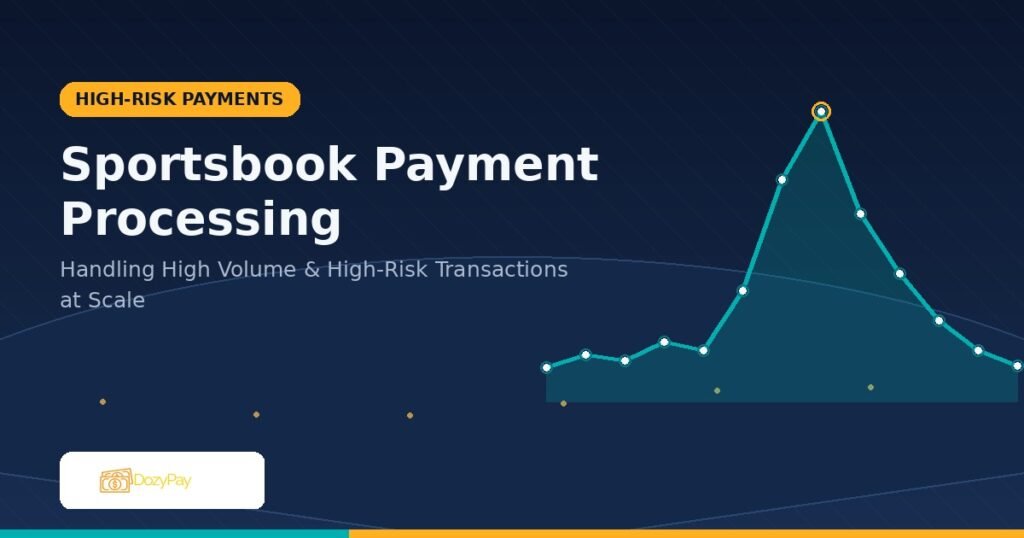
A single quarter-final can push deposit volume 43% above a sportsbook’s daily average. A final can push it past 50%. That’s not a marketing statistic — it’s the operating reality of sportsbook payment processing, where the payment stack has to absorb enormous, unpredictable traffic bursts while still passing every fraud, licensing, and card-network check that comes with running a real-money betting business.
Most payment providers aren’t built for that combination. They’re built for either high volume (retail e-commerce, predictable traffic) or high risk (chargeback-heavy verticals, low volume). Sportsbooks need both, at the same time, every match day. This guide breaks down what that actually requires — from the merchant account underneath your checkout to the gateway routing logic that keeps deposits flowing when 100,000 bettors log in at kickoff.
Why Sportsbooks Sit at the Intersection of High Volume and High Risk?
Card networks and acquiring banks classify online sports betting under high-risk merchant category codes, alongside other regulated real-money verticals. That classification isn’t about the quality of your business — it reflects three structural realities of the sportsbook model:
- Elevated chargeback and friendly-fraud exposure, since bettors who lose sometimes dispute the original deposit
- Heavy regulatory and licensing scrutiny that varies by state, country, and betting product
- Transaction patterns that swing wildly around live events rather than following a stable e-commerce curve
Layer high transaction volume on top of that risk profile, and you get a payments problem that most general-purpose processors simply decline to underwrite. That’s why sportsbook operators end up working with high-risk-specialist acquirers and gateways rather than mainstream payment service providers.
The High-Volume Problem: Payments Don’t Spike Gently
Sportsbook traffic isn’t seasonal in the retail sense — it’s event-driven and near-instant. Data from the 2026 FIFA World Cup illustrates the scale: the tournament final saw deposit volume rise 52% above the daily average, while the semifinal produced a 55% spike in withdrawal volume in a single day. Those aren’t gradual ramps; they arrive in the space of a match. Handling that kind of load without failed authorizations or timeouts is a core part of sportsbook payment gateway design for peak transaction spikes, and it’s usually where undersized gateways fail first.
Three checkpoints tend to buckle first when volume spikes hit an underprepared stack:
- Authorization throughput — the gateway’s capacity to process deposits and withdrawal requests per second without queuing
- Fraud-scoring latency — real-time risk checks that slow down under load instead of scaling with it
- Payout liquidity — enough working capital and settlement flexibility to cover a withdrawal surge right after a big win
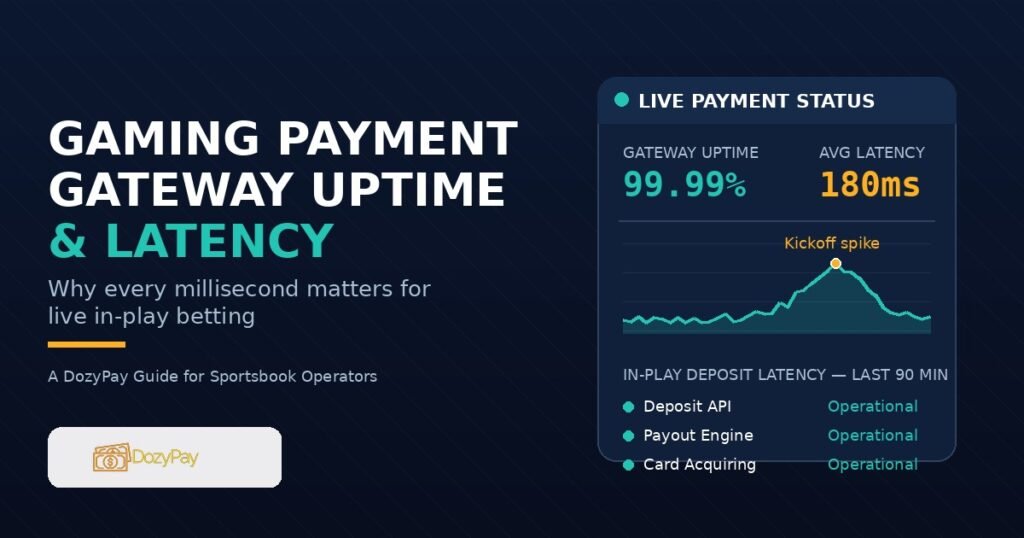
A gateway advertised for “high risk” support isn’t automatically built for high throughput, and vice versa. Before signing with a provider, ask for their peak transactions-per-second benchmark and uptime record during an actual high-demand event, not just their average-day numbers.
What to Look for in a Payment Gateway for a Sportsbook?
If you’re comparing providers, the best payment gateway for online gaming business operations generally shares a specific set of capabilities rather than a single standout feature. Look for:
- Multi-processor / orchestration routing, so a single acquirer outage doesn’t take deposits offline during a live match
- Local payment methods per market — cards alone routinely underperform in regions where bettors expect e-wallets, bank transfers, or mobile money
- Sub-second authorization with real-time, adaptive fraud scoring that doesn’t add friction at checkout
- PCI DSS Level 1 compliance and support for the current PCI DSS v4.0.1 requirements
- Flexible settlement — same-day or near-instant payout rails alongside standard card settlement
- Transparent rolling reserve terms, since most high-risk accounts carry one and it directly affects cash flow
Run through the full checklist in our companion guide on what to check before choosing a gambling payment gateway before you shortlist providers — most of the costly mistakes operators make happen at the vendor-selection stage, not after launch.
How to Get a Gaming Merchant Account?
Knowing how to get a gaming merchant account starts with understanding that you’re applying for high-risk underwriting, not a standard business checking-account-style merchant profile. Acquirers who accept betting operators will typically ask for:
- A valid gambling or sports betting license for every jurisdiction you operate in
- 3–6 months of prior processing statements, or a documented volume forecast for new operators
- A written KYC/AML and responsible-gambling compliance program
- PCI DSS attestation of compliance (SAQ or ROC, depending on your processing volume)
- A clear breakdown of betting verticals offered — sportsbook, casino, or both — since underwriting differs by product
Applications move faster when they go through a broker or specialist that already has relationships with acquiring banks that accept sports betting merchants. Applying blind to a general acquirer almost always ends in a decline, which then shows up on future applications and slows down every subsequent attempt.
High-Risk Merchant Account for Gambling Business: What Underwriters Actually Check?
A high-risk merchant account for gambling business activity is underwritten differently from a standard account, and the difference shows up in three places: pricing, reserves, and ongoing monitoring.
Pricing
Expect processing rates above standard e-commerce pricing, plus a per-transaction fee and, in many cases, a setup or account-review fee. Model the true cost against your actual volume rather than comparing headline percentages across providers.
Reserves
Most high-risk gambling accounts carry a rolling reserve — a percentage of revenue held back for a set period to cover potential chargebacks. This is normal and not a sign of a bad provider; it’s a sign the provider is underwriting the risk correctly.
Ongoing monitoring
Chargeback ratios, transaction velocity, and dispute patterns are monitored continuously. Accounts that stay within agreed thresholds keep favorable terms; accounts that drift toward network chargeback-monitoring programs risk higher reserves or account review.
Reducing Declines and Chargebacks Without Slowing Down Checkout
High volume magnifies small inefficiencies. A 2% false-decline rate is a minor annoyance on a slow day and a meaningful revenue loss during a tournament final. Three levers move the needle without adding friction for legitimate bettors:
- Network tokenization to keep card credentials current and reduce decline rates from expired or reissued cards
- Smart routing that retries a declined transaction through a secondary processor before showing the bettor a failure
- Risk-based authentication (3DS 2.2) that only challenges genuinely suspicious transactions instead of every deposit
These aren’t theoretical optimizations — they’re the difference between a bettor completing a deposit in the seconds before kickoff and abandoning the site for a competitor.
Instant Payouts: The Retention Lever Operators Underuse
Winners who wait 1–3 business days for a payout increasingly move to whichever competitor pays out faster. Bridging that gap without draining working capital usually means blending settlement rails — e-wallets and instant card payouts for smaller withdrawals, and reserved liquidity or stablecoin settlement rails for larger ones — rather than relying on a single, slow default method for every payout.
Compliance Doesn’t Pause During Peak Load
Fraud attempts rise in step with legitimate traffic during major events, which means compliance controls need to hold up under the same load as the payment rails. PCI DSS v4.0.1, jurisdiction-specific licensing requirements, and age/identity verification all still apply at 3 a.m. during a World Cup semifinal — automating these checks, rather than relying on manual review queues, is what keeps them from becoming the bottleneck once volume spikes.
Choosing a Processing Partner Built for This
Sportsbook payment processing rewards specialization. A provider that understands MCC classification for betting operators, has existing acquiring relationships for high-risk gambling accounts, and has demonstrably handled real transaction spikes — not just modeled them — will outperform a generalist processor every time volume actually matters: on match day.
DozyPay works with sportsbook, casino, and social gaming operators on high-risk merchant accounts and payment gateway infrastructure built for exactly this kind of load, from underwriting through live-event traffic spikes.
Frequently Asked Questions
What makes sportsbook payment processing different from standard e-commerce payments?
Sportsbooks combine real-money transfers, extreme transaction spikes tied to live sporting events, and a high chargeback/fraud profile. Card networks classify betting operators under high-risk MCCs, so sportsbooks need specialized gateways, rolling reserves, and underwriting that standard acquirers won’t offer.
How to get a gaming merchant account as a new sportsbook operator?
You’ll typically need a valid gaming or betting license, 3–6 months of processing statements (or projected volume if you’re new), a compliant KYC/AML program, PCI DSS documentation, and a clear description of your betting verticals. A high-risk payment specialist can pre-qualify your application against an acquiring bank that accepts sports betting before you submit.
What is the best payment gateway for online gaming business at scale?
The best fit combines multi-processor routing (so no single point of failure during peak load), local payment methods for each market, sub-second authorization, real-time fraud scoring, and proven uptime during high-traffic events like tournament finals — not just the lowest headline rate.
Do sportsbooks need a separate high-risk merchant account for gambling business operations?
Yes. Standard merchant accounts prohibit real-money gambling in their terms of service and will freeze funds or terminate the account once betting transactions are detected. A dedicated high-risk merchant account for gambling business activity is underwritten specifically for that MCC and chargeback profile.
How do sportsbooks handle instant payouts without hurting cash flow?
Operators typically blend settlement rails — card payouts, ACH/eCheck, e-wallets, and increasingly stablecoin rails — so faster methods absorb withdrawal spikes while reserves and treasury management cover the working-capital gap during 1–3 day card settlement windows.