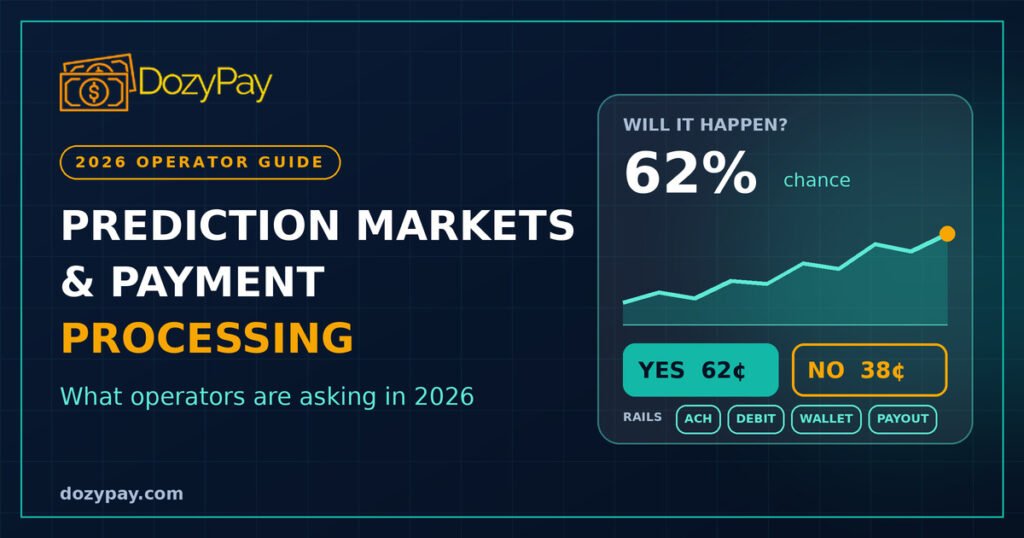
| QUICK ANSWER Prediction market payment processing covers the card, bank, wallet and crypto rails that let an event-contract platform take deposits and send payouts. In 2026, operators mostly ask four things: how acquirers classify the business, why card deposits fail, how state-law disputes affect approval, and how fast payouts can run. Approval usually depends on proof of regulatory status, clean KYC and a backup payment plan. |
Prediction market payment processing has become a boardroom topic in 2026. Industry analysis reports that combined monthly volume on Kalshi and Polymarket grew from about $28 billion to nearly $220 billion in a year. That growth raises a hard question for founders, sportsbooks and casino operators alike. Who will process the money, and on what terms?
However, banks and acquirers are still deciding how to treat event contracts. Meanwhile, courts and regulators keep moving the goalposts. This guide answers the questions operators ask most often, in plain language. It is general information, not legal advice.
What Is Prediction Market Payment Processing?
A prediction market lets people trade contracts on the outcome of real-world events. For example, a contract might pay $1 if an event happens and nothing if it does not. First, traders fund an account. Then they buy contracts and later withdraw their winnings. Each of those steps moves money, so each step needs a payment partner.
Prediction market payment processing is the full chain behind those steps. It includes deposits by card, bank transfer or wallet, the settlement of funds, and payouts back to the trader. It also covers fraud screening, KYC checks and dispute handling.
Therefore, the payment stack looks closer to a high-risk merchant account for online gaming than to a standard retail setup. Underwriters ask about licensing, customer funds, geography and chargebacks in the same breath.
Why Are Operators Asking About Payments Now?
First, legal uncertainty drives most of the questions. Federal and state authorities disagree about who regulates sports event contracts. As a result, anyone planning prediction market payment processing worries about approval risk, product availability and future disputes. For that reason, the timeline below is worth a close look.
| When (2026) | What happened? | Why payment teams care? |
| April | The Third Circuit sided with Kalshi, treating sports contracts as federally regulated swaps | Supports a federal-first view of the product |
| Aug. 28 | The Ninth Circuit ruled 3-0 against Kalshi in a Nevada case | Splits the appeals courts |
| Sept. 2 | New Jersey asked the U.S. Supreme Court to take the dispute (No. 26-299) | A final answer is still months away |
| Sept. 25 | The Sixth Circuit held the contracts are not swaps, so Ohio and Tennessee can enforce gambling laws | More state-by-state exposure |
| Early Oct. | The CFTC issued paired rules: one excludes casino-style gambling from the swap definition, and one proposes to include event contracts | Tries to draw a federal line between the two |
| Late Oct. | Utah filed civil and criminal actions against Kalshi, which Kalshi disputes, and the CFTC sued Utah | Enforcement now reaches operators directly |
Notice the pattern. For example, each ruling changes where a platform can offer a product. Payment partners then ask whether their own exposure changes with it. For a deeper legal view, read DLA Piper’s alert on the legal status of prediction markets and sports betting.
How Do Acquirers Classify Prediction Markets?
There is no single answer yet for prediction market payment processing. Some payment providers say card networks have been ambiguous about merchant category codes for event-contract platforms. In practice, an acquirer may place the business in a gambling-adjacent risk tier, even when the platform holds federal registration.
That matters because the code shapes everything downstream. It affects, for example, issuer approval rates, interchange, reserve terms and which banks will sponsor the account. Our guide to gambling merchant category codes 7995, 7801 and 7802 explains how these codes work for gaming merchants.
Users have also reported that some banks hold or decline deposits to these platforms. One explanation is that issuer fraud systems read the merchant code as gambling-adjacent. However, that explanation is unproven, so treat it as a pattern to monitor rather than a rule.
Which Payment Methods Do Prediction Markets Accept?
Method choice shapes both approval rates and cost. According to a November 2026 CBS Sports roundup of prediction market payment methods, the biggest American platforms lean on bank transfers and debit cards. Kalshi and Polymarket do not allow credit card deposits.
| Method | What the roundup reports? | Operator takeaway |
| Online bank transfer | Offered by Kalshi, Polymarket US, Novig and FanDuel Predicts with no platform fee | Lowest cost and a strong ACH-first option |
| Debit card | Offered by the same platforms; Kalshi charges 2% and Novig 3% | Fast, but fees and issuer declines add friction |
| Wallets | Apple Pay, PayPal and Venmo support varies; Kalshi charges 2% on several | Good for speed, uneven coverage |
| Wire transfer | Minimums of $1,000 at Kalshi and $5,000 at Polymarket US | Suits large traders |
| Crypto | Kalshi and Novig accept it; network fees apply | Adds compliance and volatility questions |
| Credit card | Not allowed at Kalshi or Polymarket | Can reduce chargeback and credit-risk exposure |
Fees and availability change often, so verify them before you build. In short, an ACH-first design keeps costs low and lowers dispute risk. Debit cards then add reach for traders who want speed. Operators who plan event contract deposits should design around that mix.
Why Do Prediction Market Deposits Get Declined?
Declines in prediction market payment processing come from three places: the issuer, the acquirer and the platform itself. Issuers decline when risk scores spike, when a payee is new or when the merchant code looks sensitive. Likewise, acquirers decline when documents are missing. Platforms decline when geolocation or age checks fail.
- Issuer risk scoring on gambling-adjacent or fintech payees.
- First-time payee checks on new accounts.
- Failed geolocation or identity checks at the platform.
- Weak billing descriptors that confuse the cardholder later.
The fixes are practical. First, offer bank transfer. Next, use clear billing descriptors, and add 3D Secure where issuers expect it. Finally, track decline codes in a dashboard so your team can spot patterns early.
How Does State Risk Affect Casino Merchant Account Approval?
Underwriters judge prediction market operators the way they judge casino operators: by evidence. Casino merchant account approval usually depends on license proof, ownership checks, clean financials and a credible compliance plan. Prediction market payment processing adds one extra question to the same file: regulatory status in each state.
State availability also changes quickly. For example, Gambling.com reports that Kalshi, Robinhood and Coinbase have each stepped back from sports contracts in Michigan this year. Each change forces a payment partner to update geofencing, routing and reporting.
Therefore, prepare a one-page regulatory summary for every state you serve. Include, for example, your registration or license, the legal basis for each product line and a counsel contact. If you also run a casino or sportsbook brand, learn how a casino merchant account works for licensed gaming operators.
Where Do Social and Sweepstakes Prediction Games Fit?
Some operators skip real-money contracts and build free-to-play prediction games instead. Players earn virtual coins, make forecasts and win prizes or leaderboard rewards. This route changes prediction market payment processing, because players buy virtual coins rather than contracts. It often needs a social gaming merchant account provider that understands virtual currency, age checks and prize rules.
Be careful, though. A social label does not protect a product that behaves like a wager in practice. Acquirers look at how players buy coins, whether coins can be cashed out and how prizes are funded. Our social gaming merchant account page explains how this vertical is underwritten.
Likewise, sweepstakes-style prediction apps should expect questions about free entry routes and state restrictions. As a result, clear rules and clean records make those conversations much shorter.
How Fast Can Prediction Market Payouts Run?
Traders judge a platform by how fast it pays. CBS Sports reports that Kalshi withdrawals to PayPal or Venmo often arrive in under five minutes. Debit card withdrawals can take anywhere from minutes to three business days, and Polymarket withdrawals can take several days.
Speed has a cost, however. Instant payouts raise fraud, reserve and liquidity questions for the processor. Many operators therefore pair a fast rail for verified traders with a slower rail for new accounts. Read our overview of instant payout rails for iGaming to see how operators approach this trade-off.
Good payout design also protects your merchant account. Fast, predictable withdrawals reduce complaints, and fewer complaints mean fewer disputes. This is why prediction market payment processing teams review payout rules before launch, not after.
What Do Underwriters Ask Prediction Market Operators?
Overall, underwriters want a short, clear file. The table below shows the usual items and why each one matters.
| Item | What underwriters want to see? | Why it matters? |
| Regulatory status | Registration or license evidence and a counsel summary | Shows the product has a lawful basis |
| Product map | A list of contract types and the states you serve | Shows where the risk sits |
| Customer funds | A flow-of-funds diagram and your segregation approach | Protects traders and the acquirer |
| KYC and age checks | Identity, age and geolocation controls | Reduces fraud and underage risk |
| Dispute plan | A chargeback and refund policy | Keeps dispute ratios healthy |
| Backup processing | A second processor or fallback rail | Limits downtime if one partner exits |
What Could Change Next?
Two events could reshape the market soon. First, the Supreme Court may decide whether to hear New Jersey’s petition. Gambling.com reports that Kalshi’s response is due on November 9 and that a decision on review is not expected before December. Second, the CFTC’s proposed rule on event contracts is still open to final action.
Because no one can predict the outcome, build prediction market payment processing that works under either result. Keep processing flexible, and keep your documents current. Above all, avoid depending on a single bank. These three steps help most:
- Map every state where you offer each contract type.
- Keep a second processor approved and ready to take volume.
- Review marketing language and billing descriptors with counsel.
Frequently Asked Questions
What is prediction market payment processing?
Prediction market payment processing is the set of systems that move money for an event-contract platform. It covers deposits, settlement, payouts, fraud checks and dispute handling across cards, bank transfers, wallets and sometimes crypto.
Do prediction markets accept credit cards?
According to CBS Sports, Kalshi and Polymarket do not allow credit card deposits. Most platforms rely on bank transfers, debit cards and wallets. Rules differ by platform, so check each provider’s current terms.
How do acquirers classify prediction markets?
There is no single standard yet. Some providers say card network coding for these platforms has been ambiguous, and acquirers may apply a gambling-adjacent risk tier. Confirm the treatment with your acquirer before launch.
Can a prediction market operator get a casino merchant account?
A casino merchant account is built for licensed gambling businesses. Prediction market operators are underwritten on their own regulatory status, but the process is similar: underwriters ask for license or registration proof, ownership details, KYC controls and a compliance plan. However, approval is never guaranteed.
Is a social gaming merchant account suitable for free-to-play prediction games?
It can be, when the game is genuinely social and coins cannot be cashed out. A social gaming merchant account provider will still review virtual currency rules, age checks and prize funding before approval.
What should operators do while court cases continue?
First, map the states you serve, keep regulatory documents current and line up a backup processor. In addition, review marketing and geofencing with counsel. Overall, flexible payment plans cope better with change than fixed ones.
Final Thoughts: Plan for Both Outcomes
Prediction markets are growing fast, yet the legal map is still moving. Therefore, operators who prepare clean documents, flexible payment rails and a backup processor will be better placed whichever way the courts go. If you are planning a prediction-style product, contact the DozyPay team to talk through how underwriting would look for your model.