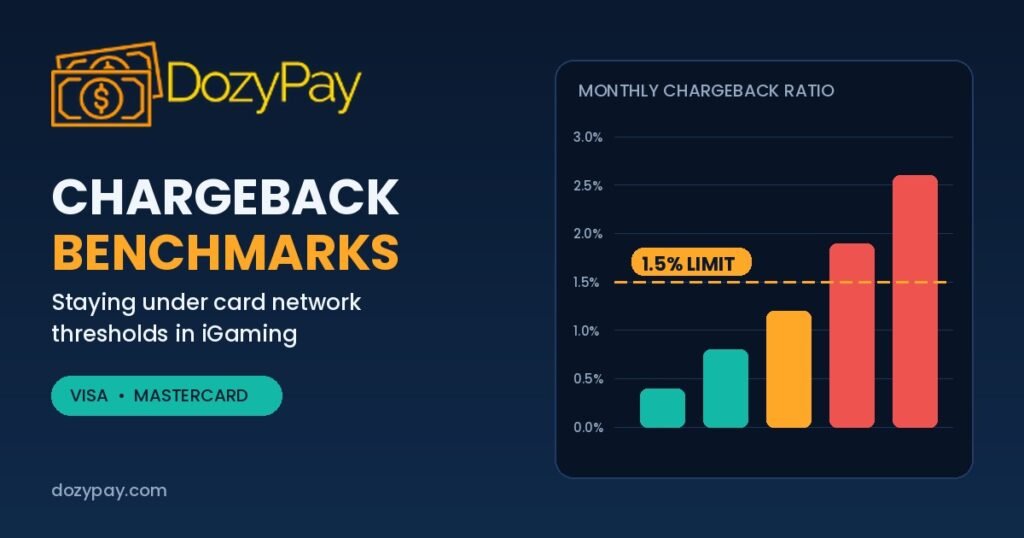
Quick Answer: Visa flags a merchant as Excessive at a 1.5% VAMP ratio. That also needs 1,500 or more fraud reports and disputes in a month. Similarly, Mastercard flags a merchant at a 1.5% chargeback ratio with at least 100 chargebacks. However, industry sources often place iGaming ratios at 2% to 4%. Therefore, a safe internal target is well below 1%, and the ratio should be tracked every week.
iGaming chargeback benchmarks explain why card networks watch gaming merchants so closely. In fact, online casinos and sportsbooks see more disputes than most online sellers. As a result, a few bad weeks can push an operator over a network limit. Therefore, this guide covers the thresholds, shows the maths and sets practical targets.
Why iGaming Chargeback Rates Run Higher Than Other Industries?
Gaming merchants sit in a tougher risk bracket than ordinary online stores. For example, industry sources place iGaming chargeback rates at roughly 2% to 4%, while e-commerce averages about 0.5% to 1%. First, friendly fraud drives much of the gap. In this case, a real player makes a valid deposit and then disputes it after a loss.
Moreover, issuers apply extra scrutiny to gambling spend. For instance, merchant category code 7995 flags these payments at the issuing bank. Consequently, some banks block or question them by default. In addition, shared cards and family use add more disputes. To go deeper on disputes, read our guide on how casinos can reduce chargebacks.
| Metric | Typical e-commerce | iGaming (industry estimates) |
| Chargeback rate | About 0.5% to 1% | About 2% to 4% |
| Friendly fraud share of disputes | 60% to 80% in digital goods | 60% to 70% |
| Loss-driven disputes | Not typical | An estimated 40% to 60% of gaming chargebacks |
Treat these figures as directional, because no card network publishes an official iGaming average. Even so, they show why a strict internal target matters.
iGaming Chargeback Benchmarks: Card Network Thresholds in 2026
Visa and Mastercard run separate monitoring programs. Because each program counts disputes in its own way, operators should track both ratios, not one blended number.
| Network | Program | Trigger | Notes |
| Visa | VAMP: merchant Excessive | 1.5% ratio and 1,500+ fraud reports and disputes a month | In force since 1 April 2026 in the US, Canada, EU and Asia-Pacific. CEMEA stays at 2.2%. Fine: $8 per transaction. |
| Visa | VAMP: acquirer | 0.5% Above Standard, 0.7% Excessive | Applies to the acquirer portfolio since 1 January 2026 and 1 October 2025. |
| Mastercard | ECM | 1.5% to 2.99% ratio and 100 to 299 chargebacks | Measured monthly. Exit needs three months below the limits. |
| Mastercard | HECM | 3% or more and 300+ chargebacks | Higher assessments than ECM. |
First, Visa VAMP replaced the older VDMP and VFMP programs. It also merges fraud reports and chargebacks into one ratio. As a result, older figures such as 0.9% with 100 disputes are now out of date. Our breakdown of Visa VAMP and Mastercard monitoring for gaming merchants covers each program in more detail.
However, Mastercard works differently. It divides this month’s chargebacks by last month’s transactions. Also, represented chargebacks do not change the threshold maths. In other words, winning a dispute does not lower your ratio. Therefore, prevention matters more than representment.
How to Calculate Your iGaming Chargeback Ratio?
First, use the two formulas below. Then run them every week, so a bad trend never surprises you.
- Mastercard: chargebacks this month ÷ transactions last month × 100.
- Visa VAMP: (fraud reports + disputes) ÷ settled transactions this month × 100.
| Scenario | Maths | Ratio | Result |
| Mastercard, steady volume | 130 ÷ 12,000 | 1.08% | Below ECM |
| Mastercard, slow prior month | 130 ÷ 8,000 | 1.63% | ECM range (100+ and 1.5%+) |
| Visa, high volume | 1,800 ÷ 100,000 | 1.8% | Excessive |
| Visa, low volume | 900 ÷ 50,000 | 1.8% | Under the 1,500-event floor |
Notice the second scenario. The chargebacks stayed the same, yet the ratio jumped because volume fell. As a result, a quiet month can push a healthy account over the line. Similarly, a low-volume operator may sit under the count floors. Even so, the acquirer can still act on its own limits.
A Practical Internal Target Ladder for Gaming Operators
Networks set the ceiling, but operators need a buffer below it. So, use these iGaming chargeback benchmarks as operating guidance, not as a network rule. The ladder works because VAMP counts fraud reports on top of disputes. Therefore, the true VAMP ratio runs above a chargeback-only ratio.
| Zone | Combined ratio | Action |
| Green | Below 0.5% | Maintain controls and review monthly. |
| Amber | 0.5% to 1.0% | Review weekly and tighten deposit rules. |
| Red | Above 1.0% | Pause risky segments and brief your acquirer. |
Why Your Online Gaming Merchant Account Sets the Real Limit?
In practice, an online gaming merchant account is the contract that decides how much headroom you really have. However, acquirers often set limits below the network thresholds. Moreover, they may add rolling reserves when ratios rise, typically 5% to 10% held for 90 to 180 days. Therefore, ask for the provider’s internal limits in writing before you sign.
7 Ways to Stay Under Card Network Thresholds
- Add 3D Secure on risky deposits. Because it authenticates the cardholder, it can move fraud liability to the issuer.
- Use clear billing descriptors. Then players recognise the charge and skip the dispute.
- Join pre-dispute alert services. Alerts let you refund before a chargeback posts. Moreover, pre-dispute alerts for gaming merchants also protect your ratio.
- Screen deposits. For example, velocity, device and BIN checks catch stolen cards early.
- Verify age and identity at sign-up. Because KYC cuts minor and family-card disputes, it protects your ratio.
- Refund genuine complaints quickly. Since a refund is cheaper than a chargeback, it never counts toward a ratio.
- Monitor weekly and keep evidence. Track the ratio by BIN, country and payment method. Also, keep session and payment records for at least 540 days.
Choosing the Best Payment Gateway for an Online Gaming Business
First of all, the best payment gateway for an online gaming business does more than move money. It also gives you the data and controls to protect your ratio. Therefore, compare each payment gateway on dispute tooling, not only on price.
- Support for 3D Secure and flexible routing rules.
- Real-time chargeback and fraud ratio reporting.
- Integration with pre-dispute alert services.
- Billing descriptor control for each merchant ID.
- Multi-acquirer routing, so one account does not carry all the risk.
In some cases, spreading volume across merchant IDs can keep any single ratio lower. However, networks may still review related accounts together. So, treat routing as a buffer, not a loophole.
Please note that this guide is for operators licensed in their target markets. DozyPay supports offshore-licensed and international operators, and it does not support real-money gaming in prohibited jurisdictions. Because thresholds change, confirm current rules with your acquirer. This is not legal advice.
iGaming Chargeback Benchmarks: FAQs
What is a good chargeback rate for an iGaming merchant?
In short, a good rate stays well below 1%. Industry sources cite 2% to 4% as common, but that range sits above both network limits. Therefore, aim for under 0.5% and treat 1% as a red line.
What chargeback rate triggers Visa and Mastercard monitoring?
Visa flags a merchant at a 1.5% VAMP ratio with 1,500 or more fraud reports and disputes a month. Mastercard flags a merchant at 1.5% with at least 100 chargebacks. Then its high tier starts at 3% and 300 chargebacks.
Does winning a chargeback dispute lower my ratio?
Not for Mastercard’s ECM program, because represented chargebacks are not used to recalculate thresholds. Therefore, prevention tools such as 3D Secure and alerts matter most.
How long does it take to leave Mastercard’s ECM program?
A merchant needs three consecutive months below the ECM thresholds. Although fines do not apply in clean months, the merchant stays in the program until the third month.
Why do online casinos have more chargebacks than other merchants?
Friendly fraud is the main reason, because players dispute valid deposits after losses. In addition, gambling spend carries category code 7995, so issuers review it closely.
Can a small iGaming operator ignore the thresholds?
No. Although network count floors may protect a small operator from formal programs, acquirers set their own limits and can add reserves or close an account.
Next Steps for Gaming Operators
Strong iGaming chargeback benchmarks start with the right setup. For that reason, DozyPay offers a casino merchant account and a social gaming merchant account built for dispute-heavy verticals. Meanwhile, to review your own ratios, contact the DozyPay team .