Quick answer: An offshore casino merchant account is a payment processing account opened through a bank outside the operator’s home country. It lets online casino and iGaming businesses accept player deposits and settle funds. Operators get more flexible risk and compliance frameworks than most onshore processors offer.
Mainstream banks rarely work with online casinos. They label the entire iGaming sector high-risk and decline most applications on sight.
An offshore casino merchant account solves that problem by routing approval through acquirers who already understand gambling risk.
This guide covers how to get a casino merchant account step by step. It also looks at what changes for a small business, and where a social gaming merchant account provider fits in.
What Is an Offshore Casino Merchant Account?
Operators register an offshore casino merchant account with a bank or acquirer based in a different country. That country is not where the business itself operates.
Popular jurisdictions include Malta, Curaçao, Gibraltar, and the Isle of Man. Each one runs an established licensing framework for online gambling.
Banks in these jurisdictions actively court iGaming clients, instead of avoiding them like most onshore banks do. That difference alone explains why offshore accounts approve casino operators far more often than domestic ones.
Card networks and onshore banks classify online gambling as high-risk. Elevated chargeback rates, regulatory complexity, and reputational concerns drive that classification.
A standard payment processor will decline a casino business outright, regardless of how well the business itself is run. An offshore casino merchant account routes around that blanket policy entirely.
How to Get a Casino Merchant Account?: Step by Step
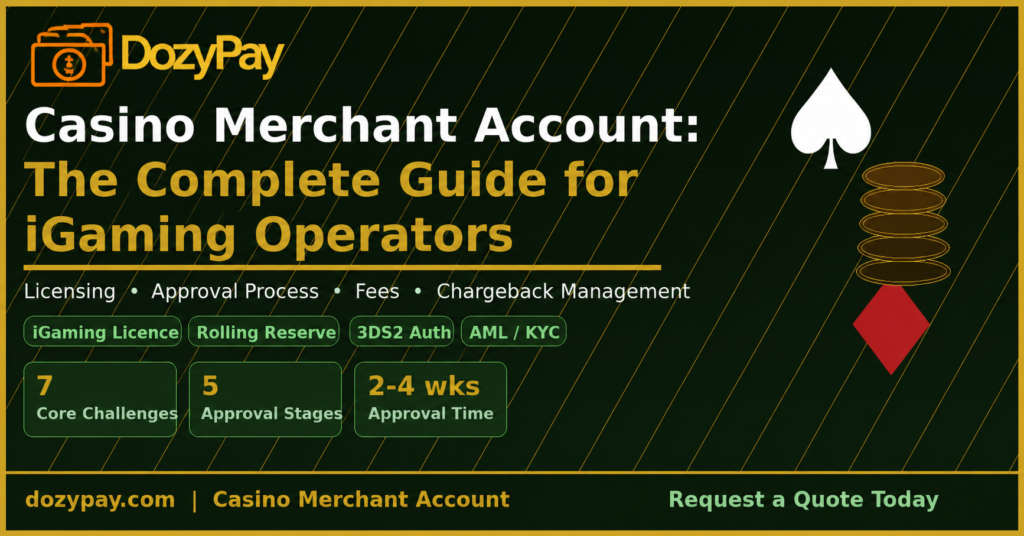
Getting approved comes down to five steps, in this order.
- Choose your licensing jurisdiction first. Decide where the casino platform will hold its gaming licence before approaching any provider. That choice shapes every step that follows.
- Prepare full documentation. Gather the certificate of incorporation, gaming licence, KYC and AML policies, and any prior processing statements. Complete documentation upfront speeds up underwriting significantly.
- Apply through a high-risk specialist, not a mainstream bank. General banks decline most casino applications by policy. A specialist offshore provider evaluates the business model directly instead.
- Go through underwriting and risk review. Underwriters assess licensing status, projected volume, and chargeback controls. They weigh the actual risk profile, not just years in business.
- Integrate and go live. Once approved, connect the merchant account to your casino platform through a gateway API. Most operators complete integration within days, not weeks.
Casino Merchant Account for Small Business: What Changes?
Smaller operators face one extra hurdle: limited or no processing history. Underwriters cannot judge risk from past transaction data that does not exist yet.
They look instead at licensing status, the business plan, and risk controls built into the platform itself.
Reserve requirements often run higher for a new casino merchant account for small business. A typical range is 10–15%, until a track record builds.
That reserve drops over time, as chargeback rates and volume settle into a predictable pattern.
A small business does not need years of history to qualify. It needs a clean licence, a realistic volume estimate, and a willing provider.
That provider underwrites based on the business model, not the balance sheet.
Offshore vs Onshore: Why Operators Choose Offshore Casino Merchant Accounts?
- Approval odds run higher. Offshore acquirers already underwrite gambling risk; onshore banks mostly do not.
- Compliance frameworks flex more. Offshore jurisdictions built their licensing rules around gambling specifically, not around retail banking.
- Currency support broadens. Offshore accounts typically settle in more currencies, which matters for a global player base.
- Fees reflect risk more accurately. Offshore providers price based on the actual business, not a blanket high-risk surcharge.
How to Get a Gaming Merchant Account Beyond Casino Platforms?
Casino accounts are not the only gaming category that needs this setup.
Sports betting, poker rooms, fantasy sports, and lottery platforms all carry similar risk profiles.
The application process to get a gaming merchant account looks nearly identical to a casino one. It still runs through jurisdiction, documentation, specialist underwriting, then integration.
The main difference is provider experience. A processor that understands poker rake structures or daily fantasy entry fees underwrites faster than a generalist.
Social Gaming Merchant Account Provider: A Related but Different Need
Social gaming sits in a different category entirely.
These platforms run on virtual currencies, coin packs, or in-app purchases, not real-money wagers.
Banks still treat the category cautiously, since the line between social gaming and gambling can blur quickly.
A social gaming merchant account provider needs to document that distinction clearly during underwriting. Virtual currency with no cash-out option reads very differently to a bank than real-money betting does.
DozyPay underwrites both categories: real-money casino platforms and social gaming platforms. Each gets a different risk framework, based on how the platform classifies and settles funds.
What Documents Do Offshore Casino Operators Need?
- Certificate of incorporation and business registration documents.
- A valid gaming licence for the jurisdiction of operation.
- KYC and AML policy documentation, plus identity verification for company directors.
- Bank or processing statements, if any prior processing history exists.
- Website terms of service, privacy policy, and responsible gambling policy.
- A realistic projected transaction volume and average ticket size.
Why DozyPay for Your Offshore Casino Merchant Account?
DozyPay built its casino merchant account infrastructure specifically around iGaming risk. The same underwriting team also handles offshore merchant account applications across every high-risk category we serve, not gambling alone.
- Specialist underwriting for iGaming. DozyPay evaluates business model, licensing, and risk controls — not just processing history.
- Multiple offshore jurisdictions. Accounts route through banks already comfortable with gambling risk, across several gambling-friendly jurisdictions.
- Fast turnaround. Most applications get a decision within 24–72 hours, with approval often complete in three to five business days.
- Full payment stack. Cards, ACH, eCheck, crypto, and e-wallets all run through one merchant account relationship instead of several.
- Built-in chargeback protection. Fraud scoring and 3D Secure authentication come standard, not as a paid add-on.
Operators evaluating a full offshore merchant account setup beyond casino payments can review DozyPay’s broader high-risk account options on the same terms.
Frequently Asked Questions
What is the difference between a casino merchant account and a casino payment gateway?
A casino merchant account holds and settles the funds. A casino payment gateway captures and encrypts the payment data at checkout. Most providers, including DozyPay, supply both as a single integrated stack.
How long does approval take for an offshore casino merchant account?
Most applications get a decision within 24 to 72 hours. Full approval, including underwriting, typically completes in three to five business days.
Can a small business get a casino merchant account without prior processing history?
Yes. Underwriters weigh licensing status, business model, and risk controls more heavily than processing history. That holds especially true for a casino merchant account for small business. A higher reserve often applies until a track record builds.
Is a social gaming merchant account the same as a casino merchant account?
No. A social gaming merchant account covers platforms that use virtual currency or in-app purchases, with no real-money payout. A casino merchant account covers real-money wagering and payout, which carries a different risk profile.
Which jurisdictions work best for an offshore casino merchant account?
Malta, Curaçao, Gibraltar, and the Isle of Man are common choices. Each jurisdiction runs an established licensing framework that offshore banks already recognise and trust.
Conclusion
An offshore casino merchant account is not a workaround — it is the standard path for any serious iGaming operator. Mainstream banks were never built for gambling risk, and offshore specialists were.
The right provider matters, whether you’re launching a casino platform, scaling a small business, or running a social gaming product.
Ready to get approved? DozyPay’s offshore casino merchant account team reviews applications fast. We underwrite based on your actual business, not a blanket high-risk label.