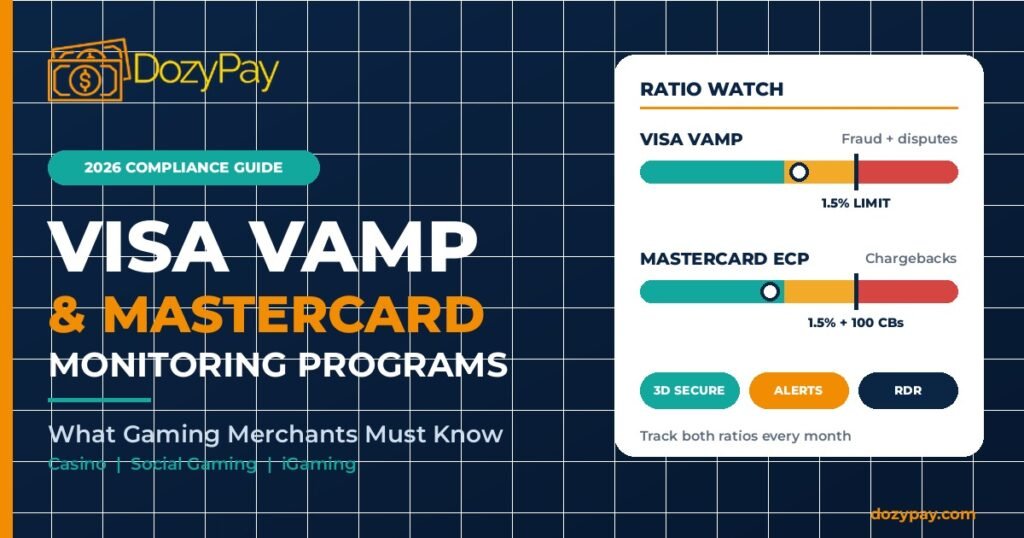
| QUICK ANSWER Visa VAMP for gaming merchants works like this. Visa’s Acquirer Monitoring Program counts fraud reports and disputes against settled card-not-present sales. Since April 1, 2026, a merchant ratio of 1.5% or more is “excessive” in the US, EU, Canada and Asia-Pacific. Mastercard’s Excessive Chargeback Program starts at 100 chargebacks and a 1.5% ratio. Gambling MCCs also face a separate Mastercard check on CVV and 3D Secure use. Gaming merchants should track both ratios monthly, use dispute alerts and 3D Secure, and confirm their exact status with their acquirer. |
Visa VAMP for gaming merchants is no longer a back-office detail. It can decide how much disputes cost you, how your acquirer treats you and whether your account stays open.
Card networks tightened their rules in 2025 and 2026, and more changes arrive in 2027. This guide explains Visa VAMP and Mastercard’s monitoring programs in plain language. It also shows casino and social gaming operators what to do next.
One note before we start. This guide is for operators licensed in the markets they serve. Rules, thresholds and fees can change, so always confirm your status with your acquirer.
Why Card Monitoring Hits Gaming Merchants First?
Gaming brings a mix of risks that card networks watch closely. Deposits are frequent and fast. Players sometimes claim they never authorised a payment. Bonus abuse and account takeover add fraud on top. Industry guides say iGaming often runs high dispute ratios, and they name friendly fraud as a main driver. That is why Visa VAMP for gaming merchants deserves attention early.
That is why acquirers watch a high-risk merchant account for online gaming so closely. Many act well before a network threshold is reached. They may add a rolling reserve, request a remediation plan or end the relationship.
What Is Visa VAMP for Gaming Merchants?
Visa launched the Visa Acquirer Monitoring Program, or VAMP, on April 1, 2025. It merged Visa’s older dispute and fraud monitoring programs into one program. Visa now measures acquirers and merchants with the same core ratio.
The VAMP ratio is simple on paper. Add the fraud reports (TC40) to the disputes (TC15). Then divide by settled card-not-present transactions. Visa counts events, not dollar value, and it calculates the ratio every month.
One detail surprises many operators. A fraud report counts even when no chargeback follows. A single transaction can also count twice if it is reported as fraud and then disputed.
Here is a quick example of Visa VAMP for gaming merchants at work. A casino settles 120,000 card-not-present deposits in a month. It receives 1,100 fraud reports and 900 disputes. That is 2,000 events, so the VAMP ratio is 1.67%. The operator is above the 1.5% merchant line.
Volume matters too. Visa VAMP for gaming merchants also has a volume floor. Industry guides report a monthly floor of about 1,500 combined fraud reports and disputes in the US, EU, Canada and Asia-Pacific. Smaller merchants may sit outside formal Visa identification. However, acquirers often apply stricter internal limits, so a low count is not a safe harbour.
Visa VAMP for Gaming Merchants: Thresholds and Fines in 2026
Thresholds depend on who is measured. The table below summarises the figures reported by PayPal’s Braintree network guidance and other industry sources.
| Level | Threshold | Reported fine |
| Merchant excessive | 1.5% (cut from 2.2% on April 1, 2026) | $8 per fraud or dispute count |
| Acquirer early warning | 0.4% to 0.5% | No fine |
| Acquirer above standard | 0.5% to 0.7% | $4 per count, from January 1, 2026 |
| Acquirer excessive | 0.7% or higher | $8 per count, from October 1, 2025 |
Some regions use different limits, so ask your acquirer which figure applies to you. Public guidance also lists no separate merchant threshold for gambling MCC 7995.
Here is the catch. Braintree notes that merchants at 0.5% or higher can be fined when their acquirer breaches a threshold. In other words, your acquirer’s whole portfolio can cost you money even when you sit below 1.5%.
Grace periods are unclear. One industry source describes a three-month delay for a first breach. Another says enforcement starts in the first month. Assume there is no grace period, and plan accordingly.
How to Lower Your VAMP Ratio with Dispute Tools?
Visa built several tools that stop a dispute before it counts. Used well, they can cut the ratio fast.
- Rapid Dispute Resolution (RDR): Rules you set trigger automatic refunds. Eligible disputes then drop out of the VAMP calculation.
- Chargeback alerts (CDRN and Ethoca): The issuer sends an alert, and you refund the player. The case does not become a chargeback, although a fraud report may still be filed.
- Visa Compelling Evidence 3.0: A successful response to a fraud dispute can remove both the dispute and the linked fraud report from the ratio. It relies on matching earlier transactions, so keep clean player records.
Friendly fraud is the biggest target for Compelling Evidence. Our guide to friendly fraud chargeback disputes in iGaming shows how to build the evidence file.
Mastercard Monitoring Programs Gaming Merchants Face
Mastercard runs several programs, and gaming merchants can meet more than one. Start with the Excessive Chargeback Program.
Excessive Chargeback Program (ECP)
ECP has two tiers. The Excessive Chargeback Merchant (ECM) tier begins at 100 chargebacks in a month and a ratio of 1.5%. The High Excessive Chargeback Merchant (HECM) tier begins at 300 chargebacks and 3%.
Mastercard divides this month’s chargebacks by last month’s sales transactions. So a drop in volume can push your ratio up even when chargebacks stay flat.
Fines grow with time. The first month carries no fine. After that, the cost climbs quickly, as the table shows.
| Consecutive months above threshold | ECM fine | HECM fine |
| 1 | $0 | $0 |
| 2 | $1,000 | $1,000 |
| 3 | $1,000 | $2,000 |
| 4 to 6 | $5,000 | $10,000 |
| 7 to 11 | $25,000 | $50,000 |
| 12 to 18 | $50,000 | $100,000 |
| 19 or more | $100,000 | $200,000 |
Issuers can also claim a recovery fee of $5 for each chargeback above 300. To exit, a merchant must stay below the ECM threshold for three straight months. The status then resets, according to J.P. Morgan’s Mastercard ECP guide.
Excessive Fraud Merchant (EFM)
EFM targets fraud chargebacks instead. Industry guides list four tests. They are 1,000 e-commerce transactions, $50,000 in fraud chargebacks, a 0.5% fraud ratio and low 3D Secure use. Treat these figures as a guide and confirm them with your acquirer.
Mastercard’s Gambling Authentication Monitoring
Gambling merchants face a program most other industries do not. Mastercard introduced it in September 2022 to check whether online transactions use CVV or 3D Secure. It covers MCCs 7800, 7801, 7802, 7995 and 9406.
Assessments for gambling merchants started on February 1, 2025. They begin at $2,500 per month and rise from the ninth month. A gambling payment gateway that supports 3D Secure and tokenised card-on-file payments makes this check much easier to pass.
Mastercard GMAP in 2027
Change is coming. Reports say Mastercard will launch the Global Merchant Audit Program (GMAP) on April 1, 2027. It combines fraud and non-fraud disputes into one assessment, and it replaces the Acquirer Chargeback Monitoring Program.
The ECM floor is also set to fall from 1.5% in 2027 and 2028 to 1.3% in 2029, 1.1% in 2030 and 0.9% in 2031. Two new tiers, High Dispute Merchant and Excessive Dispute Merchant, target extreme ratios. Mastercard has not published the bulletin publicly, so verify every detail with your acquirer.
Visa VAMP vs Mastercard ECP: Side by Side
| Feature | Visa VAMP | Mastercard ECP |
| What is counted | Fraud reports plus disputes | Chargebacks only |
| Divided by | Settled card-not-present sales | Last month’s sales transactions |
| Merchant threshold | 1.5% (excessive) | 1.5% and 100 chargebacks (ECM) |
| Higher tier | None for merchants in the sources reviewed | 3% and 300 chargebacks (HECM) |
| Reported cost | $8 per count | $1,000 to $200,000 per month |
| Exit rule | Confirm with your acquirer | Three months below ECM |
What This Means for Casino and Social Gaming Operators?
For operators, a casino merchant account depends on healthy ratios. Acquirers review VAMP and ECP numbers every month. A rising trend often triggers a call long before a fine appears.
Visa also treats gambling MCC 7995 as a Tier 1 high-integrity-risk category under its Integrity Risk Program. Acquirers must register these merchants and meet control checks. As a result, casino merchant account approval looks closely at your ratios, controls and licences from day one.
Social gaming operators face the same maths with different triggers. Virtual currency top-ups, shared family devices and in-app purchases often lead to “I did not make this payment” claims. A specialist social gaming merchant account provider should know these patterns. Learn how a social gaming merchant account differs from a casino setup.
Operators using an offshore casino merchant account are not exempt either. The same network programs apply to the acquirer and the merchant.
When ratios slip, the first sign is often a higher rolling reserve. A freeze can follow. If that happens, use our 72-hour plan for a frozen or terminated casino merchant account.
A 7-Step Action Plan for 2026
Use this checklist to keep Visa VAMP for gaming merchants under control.
- Pull the raw numbers. Ask your acquirer for monthly fraud reports (TC40), disputes (TC15) and settled card-not-present counts.
- Calculate both ratios. Track the Visa VAMP ratio and the Mastercard chargeback ratio side by side.
- Set early alarms. Trigger action at about 1.0%, well before the 1.5% line.
- Switch on alerts. Enrol in chargeback alerts and Rapid Dispute Resolution so disputes end before they count.
- Use 3D Secure. Authenticate gambling transactions to cut fraud disputes and meet Mastercard’s authentication checks.
- Fix the root causes. Clean up billing descriptors, tighten KYC and bonus rules, and make refunds easy.
- Talk to your acquirer early. Share your trend and your plan before they ask.
How DozyPay Supports Gaming Merchants?
DozyPay builds payment setups for iGaming, online casino and social gaming businesses. The platform supports Ethoca and Verifi chargeback alerts, a 3D Secure payment gateway and high-risk merchant accounts. As a result, operators can work on ratios at the payment layer, not only after a dispute lands.
Want a second opinion on your numbers? Talk to the team through the DozyPay contact page to review your current ratios and options.
Frequently Asked Questions:
What is Visa VAMP for gaming merchants?
VAMP is Visa’s Acquirer Monitoring Program, launched on April 1, 2025. It combines fraud reports and disputes into one ratio and applies it to acquirers and merchants.
What is the Visa VAMP threshold for gaming merchants in 2026?
The excessive merchant threshold is 1.5% in the US, EU, Canada and Asia-Pacific, down from 2.2% on April 1, 2026. The sources reviewed list no separate threshold for gambling MCC 7995, so confirm your figure with your acquirer.
What is the Mastercard Excessive Chargeback Program threshold?
ECM starts at 100 chargebacks and a 1.5% ratio in a month. HECM starts at 300 chargebacks and 3%. Fines begin in the second consecutive month.
Does 3D Secure help with card monitoring programs?
Yes. For gambling MCCs, Mastercard checks whether online transactions use CVV or 3D Secure, with assessments from $2,500 per month. 3D Secure also cuts fraud disputes, which helps lower your ratios.
What happens if a casino exceeds the thresholds?
Expect network fines passed on by your acquirer. You may also face a reserve, a remediation plan or termination. Costs depend on the program and how long the ratio stays high.
Can small social gaming operators ignore VAMP?
No. Formal Visa identification may need around 1,500 monthly events, but acquirers often use stricter internal limits. Acquirer-level breaches can also lead to fines for merchants at 0.5% or higher.
Final Thoughts
Visa VAMP for gaming merchants and Mastercard monitoring are now part of everyday payment operations. Track the ratios monthly, use the dispute tools and keep your acquirer informed. Operators who act early protect their accounts, their cash flow and their players’ trust.