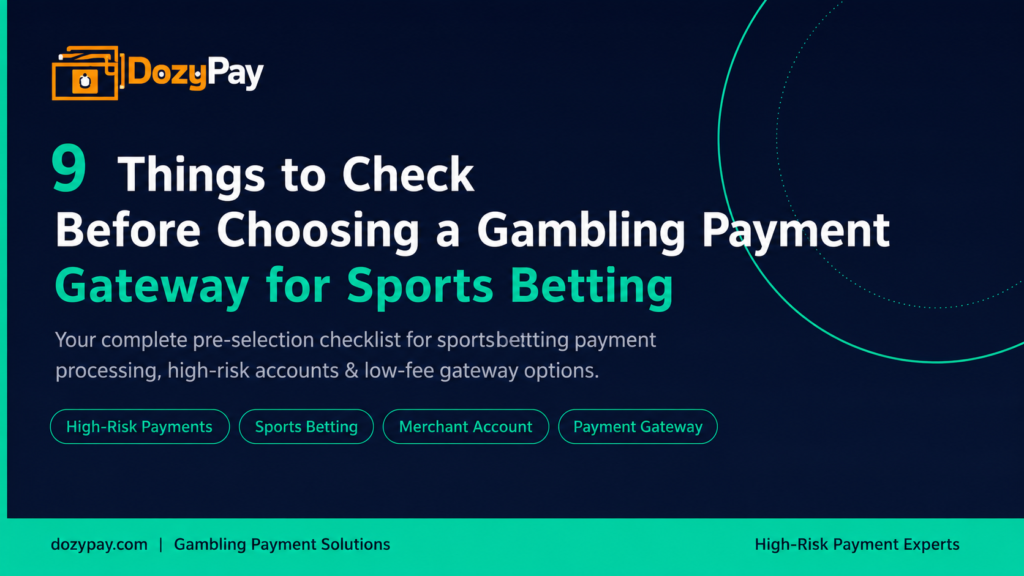
Choosing the right gambling payment gateway for sports betting is one of the most consequential decisions a platform operator will ever make. Get it wrong and you face frozen accounts, sky-high decline rates, angry bettors, and regulators knocking at your door. Get it right and you unlock frictionless deposits, lower chargebacks, and the kind of player trust that keeps retention numbers healthy.
The market is flooded with providers claiming they can handle your volume — but not all of them understand the nuances of payment processing for online casinos and gambling. Before you ink any contract, you need to run every prospective processor through a rigorous checklist. This guide gives you exactly that: nine critical checks, explained in plain language, so you can evaluate any provider with confidence.
| 💡 Quick Note: This checklist applies whether you are launching a new sportsbook, switching processors, or expanding into new regulated markets. Bookmark it — you will need it more than once. |
Check 1 — High-Risk Industry Expertise and Licensing
The very first filter to apply is deceptively simple: does the provider actually specialise in high-risk payment gateways for gambling? Many mainstream acquirers will accept gambling merchants on paper but place them in a generic high-risk bucket with zero sector knowledge. The result is aggressive reserve requirements, random holds, and support staff who have never heard of a rolling reserve or a chargeback-to-transaction ratio.
What to look for:
- Dedicated gambling and sports-betting vertical team — not a shared high-risk desk.
- Licences from relevant financial authorities (FCA, MAS, Malta FSA, etc.) in your target jurisdictions.
- Documented case studies from live sportsbook or iGaming clients.
- Clear understanding of MCC 7995 (the Merchant Category Code for gambling) and how issuing banks treat it differently.
| ⚠️ Red Flag: If the onboarding team cannot explain the difference between a fixed reserve and a rolling reserve without Googling it, walk away. |
Check 2 — Supported Payment Methods and Currencies
A sports bettor in Germany expects to pay by SEPA bank transfer or Sofort. A bettor in Brazil reaches for Pix. A high-volume VIP player in Southeast Asia may prefer crypto. Your payment gateway for online gambling business must match the payment habits of your player base — not force players to adapt to the gateway’s limitations.
Build a minimum viable payment matrix before you go to market:
| Region | Must-Have Payment Methods |
| UK / Europe | Visa, Mastercard, SEPA, Trustly, PaySafeCard, Skrill, Neteller |
| North America | Visa, Mastercard, ACH/eCheck, Play+ cards |
| LATAM | Pix, OXXO, Boleto, local debit networks |
| Asia-Pacific | Alipay, WeChat Pay, FPX, local bank transfers |
| Global (VIP) | Bitcoin, USDT/USDC, Ethereum, other major cryptocurrencies |
Also confirm multi-currency settlement. Processing in a single currency and converting at unfavourable rates is a hidden cost that eats margin fast.
Check 3 — Approval Speed: Online Gaming Merchant Account Fast Approval
Time to revenue matters. Every week spent waiting for an online gaming merchant account fast approval is a week of sportsbook launches, promotional windows, and sporting events you cannot monetise. The best providers in the high-risk space have streamlined KYB (Know Your Business) processes designed specifically for gambling operators.
When evaluating approval timelines, ask:
- What is the average KYB turnaround for a sports betting operator with all documents ready?
- Can you offer a temporary processing limit while full underwriting completes?
- Is there a dedicated relationship manager who shepherds the application?
- What documentation triggers the most delays — and can it be pre-submitted?
Typical timelines from specialist providers range from 3–10 business days. If you are told 4–6 weeks for a standard sports-betting application with clean licensing, that is a strong signal the provider lacks genuine gambling payment expertise.
Check 4 — Fee Structure: Finding a Low Fee Gambling Payment Gateway
Fees in the online gaming merchant account space are notoriously opaque. A provider advertising “competitive rates” might bury a 1.5% rolling reserve, a £0.30 per-transaction fee, a monthly minimum, a PCI compliance fee, and a chargeback administration fee — none of which appeared on the initial rate card.
The real cost of a payment gateway has several layers:
- MDR (Merchant Discount Rate): The core processing percentage — typically 2.5%–4.5% for gambling, depending on risk tier and volume.
- Rolling Reserve: Usually 5%–10% of turnover, held for 90–180 days as a risk buffer.
- Chargeback Fees: Charged per dispute, often £15–£40.
- Refund Fees: Some processors charge a partial fee even on refunds.
- Settlement Currency FX: If you settle in a currency different from your processing currency, spread costs apply.
- Minimum Monthly Volume Fees: A trap for growing platforms that do not yet hit volume thresholds.
Finding a low fee gambling payment gateway is not simply about the lowest headline MDR. Model your full cost across all the tiers above using your projected monthly volume. A provider at 3.2% MDR with no rolling reserve on volume above £500k/month may be far cheaper than a 2.8% provider with a 10% rolling reserve and heavy chargeback fees.
Check 5 — Chargeback Management and Dispute Resolution Tools
Chargebacks are the single biggest operational headache in payment processing for online casinos and gambling. Card networks flag merchants whose chargeback ratios exceed 1% of monthly transactions. Exceed the threshold and you face scheme monitoring programmes, fines, and ultimately account termination.
A robust gateway should offer:
- Real-time chargeback alerts via services like Ethoca or Verifi/CDRN, which intercept disputes before they become chargebacks.
- Automated order-level evidence packaging to reduce time spent on representments.
- Detailed dispute dashboards showing reason codes, win rates, and trends by payment method or country.
- Proactive threshold monitoring with alerts before you hit scheme limits.
| 📊 Benchmark: A well-managed sports betting platform should maintain a chargeback ratio below 0.5% — half the card scheme threshold — to build a buffer against seasonal spikes during major sporting events. |
Check 6 — Regulatory Compliance and Geographic Coverage
Different jurisdictions have wildly different rules for online sports betting payments. The UK requires GAMSTOP integration. Germany’s GlüNeuRStV mandates specific player protection checks. The Netherlands requires BKR verification. Your high-risk payment gateways for gambling provider must not only process across these markets but understand and facilitate the compliance obligations that come with each.
Compliance checks to run:
- Does the gateway support the player affordability and responsible gambling data flows required in regulated markets?
- Can it block transactions from prohibited jurisdictions at the payment layer — not just at the front end?
- Does it comply with PCI DSS Level 1, GDPR, and relevant local data protection laws?
- What is the provider’s own regulatory status — are they themselves licensed as a payment institution in your key markets?
Check 7 — Integration Options and Platform Compatibility
A gateway that cannot speak your platform’s language cleanly will cost you weeks of development time, create bugs at critical moments, and introduce latency into the payment flow. Before committing, your tech team should assess integration depth carefully.
Integration essentials:
- REST API with full sandbox environment — not just a limited test mode with dummy card numbers.
- Webhook infrastructure for real-time payment state changes (authorised, captured, declined, refunded).
- Native SDKs for the platforms you operate on — web, iOS, Android.
- White-label hosted payment pages that can match your brand, or iFrame solutions that keep players in-session.
- 3DS2 support with intelligent exemptions to reduce unnecessary friction on low-risk bets.
For a detailed technical walkthrough of what a best-in-class integration actually looks like, see DozyPay’s guide: How to Integrate a Casino Payment Gateway. It covers API authentication, webhook handling, and the 3DS2 flow end-to-end.
Check 8 — Fraud Prevention and Velocity Controls
Sports betting platforms are high-value fraud targets. Bonus abusers, card testers, money launderers using small bets as layering vehicles, and account takeover attackers all probe sportsbooks continuously. Your payment gateway for online gambling business must arrive with meaningful fraud tooling — not just delegate all fraud liability to you.
Must-have fraud features:
- Device fingerprinting tied to payment sessions.
- Velocity rules — block or review cards used across multiple accounts in a short window.
- BIN analysis — flag prepaid or virtual card BINs that correlate with bonus fraud.
- IP and proxy detection to catch VPN-masked geo-location fraud.
- Machine learning-based scoring that adapts to your transaction profile, not a generic rule set.
- AML transaction monitoring to identify structuring patterns in depositing behaviour.
| 🔒 Pro Tip: Ask providers for their false positive rate on the gambling vertical specifically. Generic fraud engines trained on retail data routinely flag legitimate punters as suspicious, causing unnecessary payment declines that damage UX and player trust. |
Check 9 — Uptime SLA, Redundancy, and Support Quality
Your players do not stop wanting to bet during a payment system outage — they just go to a competitor. Uptime is a revenue metric, not an IT metric. For high-volume sportsbooks processing around major events, 99.9% availability is the minimum acceptable standard. The best online gaming merchant account providers target 99.99% uptime with multi-region failover.
Questions to put in writing before signing:
- What is the contractual uptime SLA, and what are the penalties for breaches?
- What is the failover architecture — are there redundant acquiring banks or just a single acquiring path?
- What is the mean time to resolution (MTTR) for P1 payment incidents?
- Is there a 24/7 dedicated support channel — not a ticketing system — for live incident management?
- What is the communication protocol for planned maintenance windows during off-peak hours?
Support quality is frequently undersold in the evaluation process and overdelivered in the sales process. Request references from existing clients and specifically ask them about a time when the payment infrastructure went down during a live sporting event. Their answer will tell you everything.
Quick-Reference Checklist Summary
| # | Check & What to Verify |
| 1 | High-risk expertise — dedicated gambling vertical team and licences |
| 2 | Payment methods — match your player regions and preferred payment habits |
| 3 | Approval speed — online gaming merchant account fast approval in 3–10 days |
| 4 | Fee structure — model MDR + reserve + chargebacks for true total cost |
| 5 | Chargeback tools — Ethoca/Verifi alerts, dashboards, auto-representment |
| 6 | Compliance & geo — jurisdiction-specific player protection data flows |
| 7 | Integration depth — REST API, webhooks, 3DS2, sandbox environment |
| 8 | Fraud prevention — device fingerprinting, velocity rules, ML scoring |
| 9 | Uptime SLA — 99.99% target, multi-region failover, 24/7 P1 support |
Putting It All Together
Running these nine checks systematically before shortlisting providers will eliminate approximately 70% of vendors from contention. The platforms that survive your checklist are those genuinely built for the rigours of sports betting payment processing — not general e-commerce processors that reluctantly take gambling business.
Ready to find a provider that passes every check above? Explore DozyPay’s gambling payment gateway for online businesses — purpose-built for sports betting operators who need high-risk expertise, fast approval, competitive fees, and enterprise-grade uptime.
If you are also evaluating full merchant account solutions, read the companion guide: Online Casino Payment Gateway — Complete Guide, which covers acquiring bank relationships, reserve structures, and multi-currency settlement in depth.
Frequently Asked Questions
What is the most important factor when choosing a gambling payment gateway?
High-risk industry expertise and direct gambling sector licences top the list. Without genuine sector knowledge, even a technically capable provider will mismanage your reserve, misread your chargeback pattern, and misclassify legitimate transactions as fraud.
How long does it take to get an online gaming merchant account approved?
Specialist providers with a dedicated gambling vertical typically complete online gaming merchant account fast approval in 3–10 business days when all KYB documentation is submitted cleanly. Generic high-risk processors can take 4–8 weeks for the same application.
What fees should I expect from a high-risk gambling payment gateway?
Expect an MDR of 2.5%–4.5%, a rolling reserve of 5%–10%, and per-chargeback fees of £15–£40. The cheapest low fee gambling payment gateway on headline MDR is not always cheapest in practice — model the full cost structure across reserve, chargebacks, and settlement FX.
Can a gambling payment gateway help with chargeback management?
Yes — and it should. The best high-risk payment gateways for gambling integrate Ethoca and Verifi alert networks, provide automated evidence packaging for representments, and offer real-time dashboards to monitor dispute trends before they breach card scheme thresholds.
Is payment processing for online casinos and gambling different from standard e-commerce?
Significantly. Payment processing for online casinos and gambling operates under MCC 7995, which many issuing banks block by default. Transaction patterns — frequent small deposits, irregular refund requests, crypto-to-fiat movements — require fraud engines trained specifically on gambling behaviour, not generic retail models.

DozyPay is a specialist high-risk payment gateway and merchant account provider, helping businesses in 150+ countries accept payments securely and without interruption. Our team includes payment analysts, compliance specialists, and fintech professionals with over a decade of combined experience in high-risk merchant processing — covering industries such as IPTV, adult content, online gaming, forex trading, pharmaceuticals, and travel.
Every article published by DozyPay is researched and written by our in-house payments team, drawing on real underwriting experience, industry data, and direct merchant feedback. Our goal is simple: give high-risk business owners the clear, honest information that banks and mainstream processors won’t.