If you are launching an online casino, expanding an iGaming platform, or building a gambling startup in 2026, one challenge will stop you cold before you acquire your first player: you cannot accept payments.
Standard payment processors — Stripe, PayPal, Square — have, by and large, blanket bans on gambling transactions. Moreover, even when they do not explicitly ban casinos, their fraud thresholds make it virtually impossible for a gambling business to survive. As a result, the online casino payment gateway has become one of the most critical — and most misunderstood — pieces of infrastructure in the entire iGaming ecosystem.
This definitive guide explains everything: how casino payment gateways work, what features matter in 2026, how approval works, how to control chargebacks, and how to choose the right provider. Furthermore, whether you are a seasoned operator or a startup founder building your first platform, this guide gives you the complete picture.
1. What Is an Online Casino Payment Gateway?
An online casino payment gateway is a specialised payment processing infrastructure that securely authorises and routes financial transactions between casino players and casino operators. In essence, it performs the same function as any standard e-commerce gateway — however, it is purpose-built to handle the unique regulatory, technical, and risk characteristics of the gambling industry.
Specifically, when a player deposits funds on a casino platform, the payment gateway captures the card or wallet data, encrypts it, sends it to the acquiring bank or payment processor, receives an approval or decline decision, and returns the result to the player — all within seconds. When a player requests a withdrawal, furthermore, the reverse flow is executed. Throughout this entire process, the gateway manages fraud scoring, currency conversion, and compliance verification simultaneously.
| 💡 Key distinction: A casino payment gateway is not the same as a casino merchant account. The merchant account is the bank account that holds your processed funds. The gateway is the technology layer that connects your platform to that account and to the payment networks. DozyPay provides both — as a complete, integrated solution. |
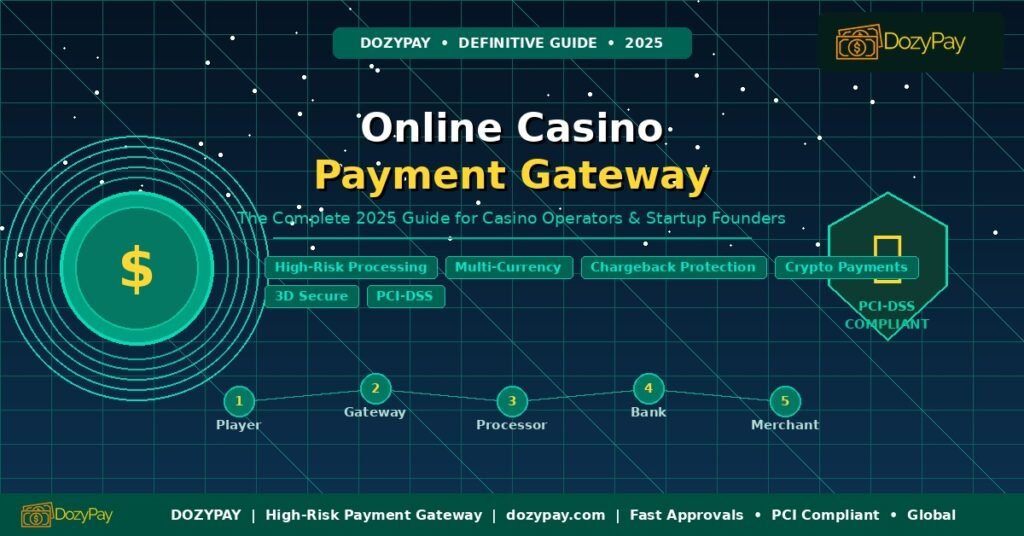
The 5-Step Payment Flow at a Casino
Understanding the underlying flow helps operators configure their platforms correctly. Here, therefore, is a simplified version of what happens when a player deposits:
- Player initiates: Player selects a payment method and enters amount on the casino deposit page.
- Gateway captures: The payment gateway collects and tokenises the payment data using SSL encryption.
- Risk engine fires: Fraud scoring, velocity checks, and 3D Secure authentication occur in real time.
- Acquirer approves: The acquiring bank or payment processor verifies the transaction and authorises the funds.
- Merchant account credited: Funds move to the casino’s merchant account, and the player’s balance is updated instantly.
2. Why Standard Payment Gateways Reject Online Casinos?
This is, without question, the most common frustration new casino operators face. Understanding why standard processors decline gambling merchants is therefore essential before approaching any payment provider.
| Rejection Reason | What It Means for Casino Operators |
| High chargeback risk | Players frequently dispute deposits after losses — a behaviour known as ‘friendly fraud’. Standard processors exit at chargeback ratios above 1%; casinos regularly exceed 2–3%. |
| Regulatory complexity | Gambling is licensed and taxed differently across jurisdictions. Standard processors lack the compliance infrastructure to manage this exposure. |
| Reputational risk | Major card networks classify gambling as a Merchant Category Code (MCC 7995) high-risk vertical. Standard processors avoid the associated liability. |
| Money laundering exposure | Due to the nature of fund movement in casinos, processors face significant AML compliance obligations that standard banking infrastructure does not support. |
| Volume spikes | Casino platforms experience extreme transaction volume peaks — during sporting events, for instance — that standard processors cannot absorb without triggering fraud alerts. |
Consequently, the only viable option for a casino operator is a specialist high-risk payment gateway — one that has pre-established relationships with acquiring banks that explicitly accept gambling merchants, has compliance infrastructure for MCC 7995, and has risk management tools calibrated to the specific chargeback profile of gambling transactions.
This is precisely the infrastructure that online casino payment gateway is designed to provide — including PCI-DSS compliance, 3D Secure authentication, multi-currency support, and dedicated chargeback management.
3. Must-Have Features in an Online Casino Payment Gateway (2026)
Not all high-risk gateways are equal. As the iGaming market has matured, operators now expect a comprehensive feature stack rather than basic card processing. Below, accordingly, are the non-negotiable features every casino gateway must offer in 2026:
PCI-DSS Level 1 Compliance
PCI-DSS (Payment Card Industry Data Security Standard) Level 1 is the highest compliance tier and a baseline requirement for any casino payment processor. In practice, it means cardholder data is encrypted in transit, never stored in its raw form, and protected by regular third-party security audits. Without this, moreover, your platform is exposed to catastrophic data breach liability.
3D Secure 2.0 (3DS2) Authentication
3DS2 adds an authentication layer between the player and their issuing bank at the point of transaction. For casino operators, specifically, this is critical for two reasons: first, it dramatically reduces fraudulent chargebacks because the liability shifts to the issuing bank upon successful 3DS authentication; second, it improves approval rates by reducing false positives that standard 3DS1 produced.
Multi-Currency and Multi-Language Support
Online casinos by their nature serve a global audience. A gateway that processes only USD or GBP, therefore, is a significant competitive disadvantage. The best casino gateways support 100+ currencies with real-time exchange rates and provide a checkout interface in the player’s local language — reducing friction and, consequently, increasing deposit conversion rates.
Cryptocurrency Payment Support
Crypto has become a mainstream deposit and withdrawal method in the iGaming industry. Players increasingly prefer Bitcoin, Ethereum, USDT, and other digital assets — particularly in markets where credit card gambling restrictions apply. As a result, a casino gateway without crypto support in 2026 is leaving a significant portion of potential revenue unreachable.
Real-Time Chargeback Management
Given that chargebacks are the primary reason casino merchant accounts get terminated, real-time chargeback alerts and response tools are not optional extras — they are survival infrastructure. A quality casino gateway provides Visa RDR and Mastercard Ethoca alerts, allowing merchants to refund disputed transactions before they escalate to chargebacks. Additionally, detailed transaction data is critical for evidence submission during disputes.
Cascade Processing and Intelligent Routing
Cascade processing automatically re-routes a declined transaction through an alternative acquiring bank or processor. For casino operators, this feature directly impacts revenue: industry data indicates that intelligent routing can recover 10–20% of initially declined transactions. Furthermore, routing to the optimal acquirer for each card type and jurisdiction also reduces processing fees over time.
4. Payment Methods Every Online Casino Must Support in 2026
The breadth of payment methods a casino supports directly affects player acquisition and retention. Accordingly, here is a complete breakdown of what players expect in 2026 and why each method matters:
| Payment Type | Examples | Why It Matters for Casinos |
| Credit / Debit Cards | Visa, Mastercard | Highest volume method globally. However, some jurisdictions restrict credit card gambling — a compliant gateway navigates these restrictions automatically. |
| E-Wallets | Skrill, Neteller, PayPal | Preferred by experienced players due to instant deposits and faster withdrawals. Moreover, e-wallets reduce chargeback risk since funds are pre-verified. |
| Cryptocurrency | Bitcoin, ETH, USDT, LTC | Rapidly growing segment. Particularly important in markets where card processing for gambling faces regulatory restriction. Transactions are irreversible — eliminating chargebacks entirely. |
| Bank Transfers | SEPA, SWIFT, Faster Payments | Essential for high-value players and VIPs who prefer direct bank movements. In addition, bank transfer deposits carry no chargeback risk. |
| Alternative Payment Methods | Interac, UPI, iDEAL, Sofort | Critical for specific markets — for instance, Interac dominates Canada and UPI is the leading method in India. Supporting local methods significantly increases conversion in those regions. |
| Prepaid / Vouchers | Paysafecard, Neosurf | Popular with players who do not wish to share banking details online. Consequently, they represent a unique segment that would be entirely inaccessible without voucher support. |
5. Understanding Fees: What Online Casino Operators Actually Pay
Fee transparency is, unfortunately, one of the weakest points in the high-risk payment industry. Many providers advertise attractive headline rates while burying significant ancillary charges. Therefore, here is a complete breakdown of every fee type casino operators should scrutinise before signing any agreement:
Fee Structure Breakdown
| Fee Type | Typical Range | What to Watch For |
| MDR (Merchant Discount Rate) | 2.5% – 5.5% | This is the per-transaction percentage. Lower rates typically apply to established operators with strong processing history and low chargeback ratios. |
| Monthly Minimum Fee | £100 – £500 | Charged if your monthly processing volume falls below a threshold. As a result, this is particularly important for startups in early months. |
| Chargeback Fee | £15 – £45 per chargeback | Applied for every chargeback received. Additionally, if your chargeback ratio exceeds the threshold, a rolling reserve may be implemented without notice. |
| Rolling Reserve | 5% – 15% of volume (held 90–180 days) | The acquirer holds a percentage of processed funds as security against future chargebacks. New operators typically face higher reserve percentages — these reduce as trust is established. |
| Setup Fee | £0 – £2,000 | Some providers charge an upfront setup fee. DozyPay’s application process has no hidden setup charges — verify this explicitly with any provider you approach. |
| Currency Conversion Fee | 0.5% – 2.5% | Applied on top of the exchange rate when processing in a non-base currency. For a casino with global players, this fee compounds significantly across high volumes. |
| 💰 DozyPay Tip: When comparing providers, always calculate the effective all-in rate — MDR plus conversion fee plus average chargeback cost at your projected chargeback ratio. A gateway with a 2.5% MDR but 2% conversion fee and £35 chargeback fee may be significantly more expensive than one with a 3.5% MDR and no conversion markup. |
6. The Approval Process: How to Get Your Casino Merchant Account Approved
Getting approved for a casino merchant account is significantly more involved than a standard e-commerce application. Nevertheless, with the right preparation, most legitimate operators can secure approval within 48–72 hours through a specialist provider like DozyPay.
Documents Required for Casino Merchant Account Approval
- Certificate of Incorporation and company registration documents
- Proof of gambling licence — from a recognised jurisdiction such as Malta (MGA), Isle of Man, Gibraltar, Curaçao, or UKGC
- Proof of Director and UBO identities — passport and recent utility bill for each beneficial owner
- 3–6 months of bank statements or prior processing history (if available)
- Website URL with live or staging casino platform — including Terms & Conditions, Privacy Policy, Responsible Gambling page, and AML policy
- Business plan for startups — describing the target market, projected volumes, and marketing approach
- Chargeback history and ratio if you have prior processing history
What Underwriters Look for in Casino Applications?
Once your application is submitted, the acquiring bank’s underwriting team assesses several key risk factors. Understanding these, therefore, allows you to present your application in the strongest possible light:
- Licensing jurisdiction — a reputable licence (MGA, UKGC) significantly increases approval probability compared to unregulated or grey-market operations
- Projected chargeback management plan — underwriters want evidence that you understand chargebacks and have a mitigation strategy
- Geographic reach — operations focused on heavily regulated or restricted markets (US, for instance) carry substantially higher risk and require specialist handling
- Processing history — new operators without history face higher rolling reserves; however, clean history from another processor can substantially reduce this
- Platform quality — a professionally built, compliant platform with Responsible Gambling tools demonstrates operator competence and reduces perceived risk
| ⚡ DozyPay advantage: Because DozyPay specialises exclusively in high-risk verticals — including casino merchant accounts, gambling payment gateways, and social gaming — our underwriting team already understands the nuances of your business model. As a result, our approval process is considerably faster than standard bank underwriting. Most complete applications receive a decision within 48 hours.
→ Apply now: dozypay.com/casino-merchant-account |
7. Chargeback Management: The Most Critical Skill for Casino Operators
Chargebacks are, in practical terms, the single biggest operational risk for online casinos beyond regulatory compliance. A chargeback occurs when a player disputes a transaction with their bank rather than requesting a refund from the casino directly. When the chargeback ratio exceeds the processor’s threshold — typically 1–2% — the merchant account faces suspension or termination.
Why Casino Chargebacks Are Uniquely High?
Unlike a standard e-commerce purchase, a casino transaction has no physical delivery to confirm. Moreover, players who have suffered gambling losses have a psychological incentive to dispute the charge. In addition to genuine fraud, therefore, casinos face ‘friendly fraud’ at a far higher rate than most other industries.
Five Proven Strategies to Reduce Casino Chargebacks
- Implement 3DS2 immediately: Every non-3DS transaction is a liability. 3DS2 shifts chargeback liability to the issuing bank upon successful authentication — eliminating the chargeback risk entirely for those transactions.
- Subscribe to Ethoca and Visa RDR alerts: These services notify you the moment a dispute is opened — usually within hours. Consequently, you can process a refund before the dispute becomes a formal chargeback on your record.
- Use clear billing descriptors: A significant portion of casino chargebacks arise because players do not recognise the merchant name on their bank statement. Use a recognisable, unambiguous descriptor — ideally your casino brand name.
- Enforce deposit limits and self-exclusion tools: Responsible gambling tools reduce the emotional context that drives post-loss chargebacks. Furthermore, they demonstrate regulatory compliance and reduce the risk of regulator-imposed account suspensions.
- Maintain detailed transaction records: When disputing a chargeback, your evidence pack must include transaction logs, login timestamps, IP addresses, and — if applicable — game round history. A well-organised dispute wins significantly more often.
8. Compliance and Licensing: What Casino Operators Must Have in Place
Payment gateway approval and ongoing account maintenance are inextricably linked to regulatory compliance. For that reason, operators who treat compliance as an afterthought consistently face payment processing disruptions.
Key Compliance Requirements
- Gambling licence from a recognised jurisdiction — without this, no reputable gateway will onboard your business
- KYC (Know Your Customer) verification for all registered players — including ID verification and proof of address for withdrawals above defined thresholds
- AML (Anti-Money Laundering) policy — documented, implemented, and applied to all transactions above the reporting threshold
- Responsible Gambling tools — self-exclusion, deposit limits, session limits, and links to support organisations such as GamCare
- Data privacy compliance — GDPR for European players, or applicable local data protection law for other jurisdictions
- PCI-DSS compliance for your entire payment processing environment — not just the gateway itself
Importantly, DozyPay’s onboarding team actively assists new operators with compliance documentation reviews as part of the application process. Rather than simply rejecting incomplete applications, our team works with operators to identify gaps and strengthen submissions. For more context on the broader gambling payment landscape, also refer to DozyPay’s dedicated gambling payment gateway resource page.
9. Online Casino Payment Gateway for Startup Founders: Special Considerations
While established casino operators face relatively straightforward gateway renewal cycles, startup founders face a fundamentally different challenge: securing payment processing before they have transaction history, established chargeback ratios, or processing volume to demonstrate. Fortunately, specialist high-risk providers are specifically structured to accommodate new entrants.
What Startup Casino Founders Should Do First?
- Secure your licence before approaching any payment provider: No reputable gateway will approve an unlicensed casino, regardless of how promising the business plan looks.
- Build a fully compliant platform first: Your website must have complete Terms & Conditions, a Responsible Gambling page, an AML Policy, a Privacy Policy, and functional KYC processes in place — prior to application.
- Prepare for a rolling reserve: As a new operator without processing history, you will almost certainly face a rolling reserve of 10–15%. Plan your cash flow accordingly — this is normal and reduces over time as your history builds.
- Start with a single acquiring relationship: Rather than pursuing multiple gateways simultaneously, focus on establishing clean history with one reliable provider first. Subsequently, adding backup processing is straightforward once your primary account is healthy.
- Ask about social gaming payment processing as a parallel revenue stream: Many startup founders are unaware that social gaming platforms — which offer virtual currency rather than real-money gambling — face considerably easier payment processing approvals. DozyPay’s social gaming merchant account solutions provide a viable adjacent revenue path while your real-money casino operation matures.
10. Why Choose DozyPay as Your Online Casino Payment Gateway?
DozyPay was built from the ground up to serve the specific needs of high-risk businesses — particularly iGaming, online gambling, and casino operators. As a result, unlike general-purpose gateways that occasionally approve gambling merchants, every element of our infrastructure is purpose-built for this vertical.
| Feature | What It Means for Casino Operators | |
| 01 | 48-Hour Approval | Most applications receive a final decision within 48 hours. Consequently, you can move from application to live processing in days rather than weeks. |
| 02 | Global Multi-Currency | Accept payments in 100+ currencies from players across the globe. In addition, our platform handles currency conversion automatically at competitive exchange rates. |
| 03 | PCI-DSS Level 1 | Full PCI-DSS Level 1 compliance protects both your players and your business — meeting the highest security standard in the payment card industry. |
| 04 | Chargeback Mitigation | Real-time fraud scoring, Ethoca/RDR alert integration, and dispute management tools that protect your account from the chargeback ratios that terminate standard merchant accounts. |
| 05 | 2-Minute Integration | DozyPay’s API integrates with your casino platform in minutes. Additionally, we provide pre-built plugins for major iGaming platforms, eliminating lengthy development cycles. |
Related Resources from DozyPay
📄 Casino Merchant Account — Apply for a Dedicated High-Risk Merchant Account
📄 Gambling Payment Gateway — Online Gambling Payment Processing Solutions
📄 Social Gaming Merchant Account — Payment Processing for Social & Skill Gaming Platforms
| Ready to Launch Your Casino Payment Gateway? DozyPay approves high-risk casino merchants in as little as 48 hours. PCI-DSS Compliant • Multi-Currency • Chargeback Protection • Crypto Ready | GET APPROVED NOW dozypay.com/online-casino-payment-gateway ⚡ 48-Hour Approval Process |
| 📌 FAQ Q: What is an online casino payment gateway? A: An online casino payment gateway is specialised payment processing technology that securely routes transactions between casino players and casino operators. Unlike standard gateways, it is purpose-built for the high-risk gambling industry — handling high chargeback volumes, multi-currency processing, PCI-DSS compliance, and fraud management simultaneously. Q: Why can’t online casinos use PayPal or Stripe? A: PayPal and Stripe classify gambling as a prohibited or high-risk activity. As a result, they either ban casino merchants outright or terminate accounts when gambling transactions are detected. Specialist high-risk casino payment gateways like DozyPay are the correct solution — they have pre-approved acquiring relationships and compliance infrastructure specifically for casino businesses. Q: How quickly can a casino operator get approved for a payment gateway? A: With a specialist provider like DozyPay, most complete applications receive approval within 48 hours. This is significantly faster than standard bank underwriting, which can take 2–6 weeks. Q: What documents are needed to apply for a casino merchant account? A: You will typically need: gambling licence, certificate of incorporation, director and UBO identity documents, 3–6 months of bank statements, a live or staging casino website with compliant T&Cs, and an AML policy. Q: How do online casinos reduce chargebacks? A: The most effective methods include 3DS2 authentication, Ethoca and Visa RDR real-time dispute alerts, clear billing descriptors, responsible gambling tools, and maintaining detailed transaction records for evidence submission. |

DozyPay is a specialist high-risk payment gateway and merchant account provider, helping businesses in 150+ countries accept payments securely and without interruption. Our team includes payment analysts, compliance specialists, and fintech professionals with over a decade of combined experience in high-risk merchant processing — covering industries such as IPTV, adult content, online gaming, forex trading, pharmaceuticals, and travel.
Every article published by DozyPay is researched and written by our in-house payments team, drawing on real underwriting experience, industry data, and direct merchant feedback. Our goal is simple: give high-risk business owners the clear, honest information that banks and mainstream processors won’t.