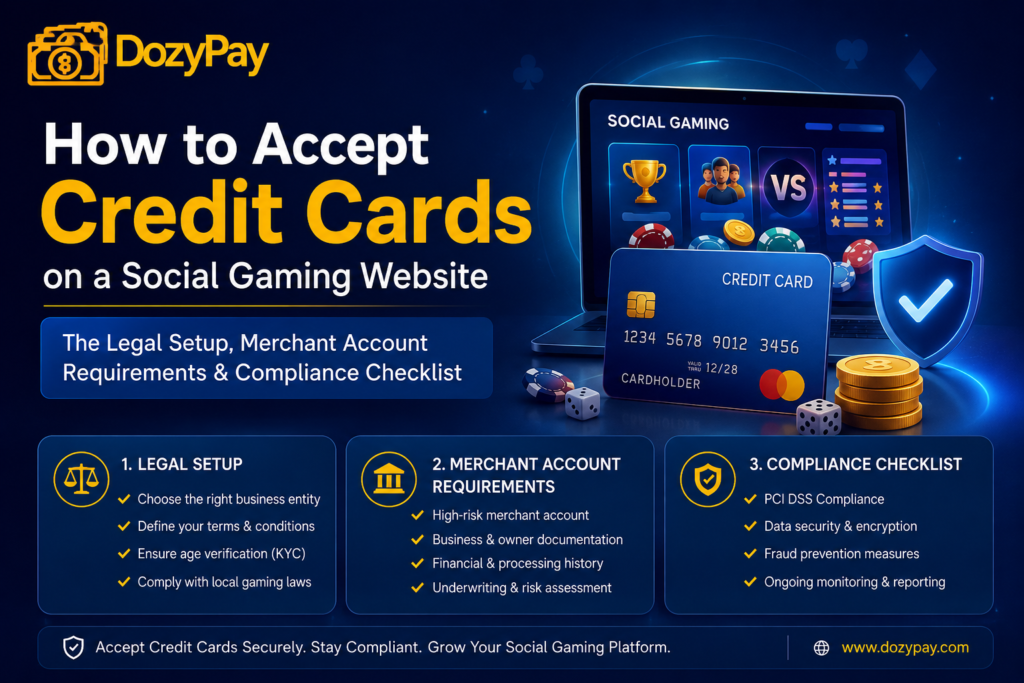
Accepting credit cards on a social gaming website looks simple from the player’s side: they tap “Buy coins”, add a card, and get instant balance. Behind that smooth flow, there is a serious amount of legal, banking, and compliance work that every operator needs to get right. For most studios, switching from ad‑revenue only to in‑app purchases is the first time they face banking risk teams, KYC, and card‑scheme rules that treat social gaming as a high‑risk vertical.
This guide explains, step‑by‑step, how to set up your legal structure, choose a social gaming merchant account provider, and follow a practical compliance checklist so you can accept cards safely without constant account freezes, chargebacks, or declines. It is written for founders and product leads who want a clear path from “no payments” to a stable, scalable social gaming payment solution high risk providers will actually approve.
Step 1: Get the legal foundation of your social gaming business right
Before any bank or processor underwrites a merchant account for social gaming, they look at how your business is structured and whether your game fits into “social gaming” rather than regulated real‑money gambling. That means your legal setup is not just compliance paperwork – it directly affects whether you can get a merchant account at all and on what terms.
At a minimum, you need a properly registered company, clear ownership documents, and up‑to‑date corporate KYC (certificate of incorporation, directors’ IDs, corporate address proof, etc.). On top of that, your game design must keep virtual currencies and items non‑redeemable for cash, avoid cash‑out mechanics, and make sure your terms of service and disclaimers clearly describe the game as entertainment only, not gambling. This is a key line many social casinos cross by accident when they add tournaments, jackpots, or pseudo‑cashout mechanics.
Step 2: Prepare your website, app store listing, and policies
Underwriters do not just read your company documents; they also audit your website, social casino app, and public store listings to check how you present the product. They look for clear separation from real‑money gambling, accurate age‑gating, and mandatory policies such as Terms of Use, Privacy Policy, Refund Policy, and responsible gaming statements.
For payment processing for social gaming apps, you should ensure that:
- All screenshots and marketing copy match the actual in‑app experience.
- Your Privacy Policy explains how card data is handled by a PCI‑compliant processor and not stored directly by you.
- Your refund and chargeback policy is visible, fair, and consistent with how the game actually works.
- Any descriptions of “winnings” or “rewards” clearly refer to virtual goods with no monetary value.
Cleaning up these touchpoints before applying increases your approval chances and reduces long email loops with risk teams later.
Step 3: Choose the right social gaming merchant account provider
Once your legal and front‑end setup looks clean, the next step is choosing a social gaming merchant account provider that understands high‑risk entertainment models. Generic low‑risk PSPs often terminate gaming merchants as soon as chargebacks or complaints rise, while specialist providers design their underwriting, fraud rules, and pricing around the realities of social gaming.
When evaluating providers, look for:
- Experience with social casinos, sweepstakes, and virtual currency models.
- Multi‑currency support (USD, EUR, GBP and key local currencies) so you can scale globally without changing processors.
- Support for card brands and alternative methods popular with gamers.
- A mobile social gaming merchant account flow that works smoothly across web, iOS, Android, and in‑app browsers.
- Clear, written policies on reserves, rolling holds, and chargeback thresholds so there are no surprises after launch.
A specialist partner will also advise you on product tweaks that make approval easier, such as changing wording, adjusting purchase flows, or separating higher‑risk mechanics into a different brand.
Step 4: Understand merchant account underwriting and document requirements
From the bank’s point of view, a merchant account for social gaming is a long‑term risk decision. Underwriting teams need to know: Who owns the business? How does the game make money? What is the refund and dispute pattern likely to be? Are there regulators who might treat this as de‑facto gambling?
Expect to provide a full KYC/AML pack, including corporate documents, shareholder registers, director IDs, bank statements, processing history (if you are migrating), and a detailed business model description. For new projects, providers might ask for projections and a breakdown of expected geographies, ticket sizes, and marketing channels. Having all of this prepared in advance speeds up approvals and positions you as a professional operator instead of a “test” project.
Step 5: Build your social gaming payment flow with compliance in mind
Once your merchant account is approved, the integration stage begins. For payment processing for social gaming apps, the goal is to give players a fast, low‑friction checkout while still collecting the data your provider needs for risk and compliance.
A strong social gaming payment solution high risk processors like to see usually includes:
- Tokenized card payments so returning players can pay with one tap without storing raw card data yourself.
- 3D Secure or similar strong customer authentication in regions that require it, tuned to avoid unnecessary friction for low‑risk transactions.
- Clear purchase receipts and in‑app confirmation screens that match your descriptor on the card statement, reducing friendly fraud and confusion.
- Device fingerprinting and velocity checks to block scripted attacks or bonus abuse in social casino environments.
Done well, this setup protects both you and your players, and reduces the likelihood of sudden risk reviews from your acquirer.
Step 6: Compliance checklist for social gaming credit card acceptance
To keep your mobile social gaming merchant account stable over time, compliance is not a one‑time task. It is ongoing. Below is a practical checklist operators can use internally:
- Keep your corporate KYC documents updated and ready for periodic reviews.
- Track chargeback ratios by brand, geography, and campaign, and respond quickly when thresholds start to climb.
- Maintain accurate, accessible support channels so players can resolve issues before going to their bank.
- Review your game economy regularly to ensure virtual currencies remain non‑redeemable and are not marketed as “investments” or “earnings”.
- Monitor changes in platform rules (for example, app store and ad network policies around gaming and monetization) and update your flows to stay aligned.
Following this checklist not only keeps you compliant but also improves your reputation with card networks and processors over time, opening the door to better rates and easier approvals for future titles.
Step 7: Use data and internal links to strengthen your payment stack
Once the basic stack is live, the best social gaming operators treat payments as a product, not just an infrastructure cost. That means reviewing conversion funnels, authorization rates, and dispute data and using those insights to refine your flows and fraud rules.
It also means educating your team. Product, marketing, and compliance should all understand the basics of social gaming merchant account provider requirements so they do not launch features or campaigns that break card‑scheme rules. Over time, this discipline lets you experiment with new monetization models, geographies, and price points without constantly worrying about losing your merchant account for social gaming at the worst possible moment.
Frequently Asked Questions
1. Is social gaming considered gambling for payment processors?
Most payment processors treat social gaming as a distinct category from real‑money gambling, but still as a high‑risk vertical. The key difference is that players cannot cash out their virtual currency or items for real money, and the game is positioned as entertainment only, not a way to win monetary prizes. If your game allows any form of cash‑out, sweepstakes, or prize with real‑world value, many underwriters will reclassify it closer to gambling, which changes the licensing and merchant account requirements.
2. Do I need a special merchant account for social gaming?
Yes. Generic, low‑risk merchant accounts are usually not suitable for social casinos and similar apps. You need a merchant account that is explicitly approved for social gaming or high‑risk entertainment. This allows your provider to set appropriate risk rules, chargeback thresholds, and reserves. Using a low‑risk account for a high‑risk use case often leads to sudden freezes, terminated accounts, or withheld funds once volume grows or disputes start to appear.
3. What documents are required to get a social gaming merchant account?
While exact requirements vary by provider and jurisdiction, you can expect to provide full company registration documents, shareholder and director IDs, proof of address, recent bank statements, and sometimes processing history if you are already live elsewhere. In addition, underwriters may ask for a detailed business description, game flow diagrams, screenshots, links to live apps or beta versions, and your terms of service, privacy policy, and refund policy. Having all of this ready makes approval faster and shows you are serious about compliance.
4. Can I accept credit cards on both web and mobile apps with the same account?
In most cases, yes. A well‑structured social gaming merchant account will support both web‑based checkouts and in‑app flows under the same MID or a set of related MIDs. However, the way you integrate may differ between platforms: web might use hosted payment pages or direct API, while mobile apps may rely on SDKs, tokenization, or in‑app browser flows. The important part is to keep your branding, descriptors, and messaging consistent across all channels so players recognize charges on their statements.
5. How do I reduce chargebacks for social gaming payments?
The most effective way to reduce chargebacks is to remove confusion and friction at every step. Make sure your game clearly explains what players are buying, shows prices in local currency, and provides instant receipts and in‑app confirmations. Use descriptors on card statements that match your brand name and URL. Offer accessible support (chat or email) to handle refund requests quickly before players contact their bank. Finally, work with your provider to implement risk rules, 3D Secure where appropriate, and velocity checks to block obvious fraud and abuse.
6. What are the biggest compliance mistakes social gaming sites make?
Common mistakes include mixing real‑money elements into a game that is supposed to be “social only,” using misleading language like “win real cash” when rewards are just virtual, hiding or neglecting refund and support policies, and failing to keep KYC documents and company details up to date. Another frequent issue is running aggressive user acquisition campaigns on platforms whose policies around online gaming and games of chance are stricter than the operator expects. These missteps can trigger reviews from both platforms and payment providers.
7. How is a mobile social gaming merchant account different from a standard app payment setup?
A typical low‑risk app payment setup assumes low chargeback rates, simple digital content, and minimal regulatory complexity. A mobile social gaming merchant account, by contrast, is designed with higher‑risk profiles in mind. It usually comes with more advanced fraud tools, closer monitoring, and specific expectations about game design, virtual currencies, and marketing. The upside is that you get a payment stack that can handle higher volumes, more complex economies, and international traffic without constant fear of instant termination.
Conclusion
Accepting credit cards on a social gaming website is not just a technical integration problem; it is a legal, banking, and compliance project that touches every part of your product. When you approach it in the right order—start with a clean legal structure, prepare your website and policies, choose a specialist social gaming merchant account provider, and build a compliant payment flow—you set yourself up for stable processing instead of endless firefighting.
By treating payments as part of your core product, aligning your game design with non‑gambling rules, and following a simple ongoing compliance checklist, you can unlock predictable, scalable revenue from virtual purchases without inviting constant scrutiny from banks, card schemes, or regulators. This is the foundation that allows your social gaming brand to grow across new regions, launch new titles, and experiment with new monetization models while keeping your merchant account relationships strong.
Related Posts
- How to Integrate a Casino Payment Gateway ?
- 9 Things to Check Before Choosing a Gambling Payment Gateway
- Why Your Online Casino Merchant Account Was Rejected ?
- Top 8 Features of an Online Casino Payment Gateway
-
5 Features Every Casino Merchant Account Must Have Before You Go Live in 2026

DozyPay is a specialist high-risk payment gateway and merchant account provider, helping businesses in 150+ countries accept payments securely and without interruption. Our team includes payment analysts, compliance specialists, and fintech professionals with over a decade of combined experience in high-risk merchant processing — covering industries such as IPTV, adult content, online gaming, forex trading, pharmaceuticals, and travel.
Every article published by DozyPay is researched and written by our in-house payments team, drawing on real underwriting experience, industry data, and direct merchant feedback. Our goal is simple: give high-risk business owners the clear, honest information that banks and mainstream processors won’t.