If you operate a platform that sells virtual coins, token packs, in-game credits, or NFT-based assets, you have probably run into a wall with payment processors. Standard merchant accounts do not handle virtual currency transactions well. Banks flag them as high-risk, compliance teams reject applications on sight, and generic payment gateways terminate accounts without warning the moment transaction patterns look unfamiliar.
However, this does not mean your platform cannot get approved. In fact, thousands of GameFi operators, social casino developers, and mobile in-app purchase platforms process payments every day — because they chose the right type of account from the start. Specifically, they applied for a virtual currency merchant account rather than a standard e-commerce account.
This guide explains exactly what a virtual currency merchant account is, why mainstream processors decline these platforms, and how your platform can get approved and stay approved.
What Is a Virtual Currency Merchant Account?
A virtual currency merchant account is a high-risk merchant account that a specialist acquiring bank has specifically underwritten and approved for platforms where the primary transaction involves the purchase of non-cash digital assets — coins, tokens, gems, credits, NFTs, or similar virtual goods.
Consequently, it differs from a standard e-commerce merchant account in three key ways:
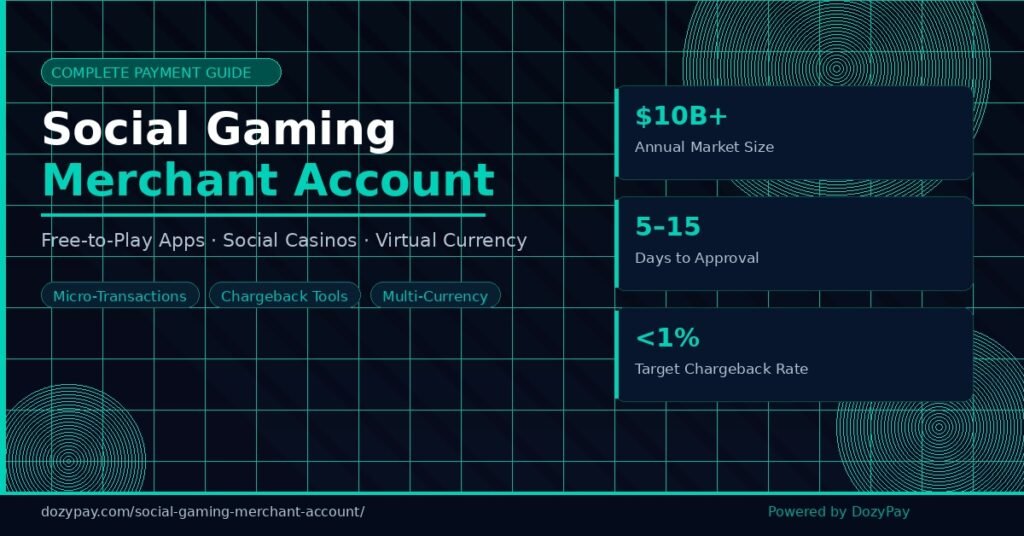
Specifically, DozyPay’s social gaming merchant account handles virtual currency transactions across social casinos, GameFi platforms, and mobile in-app purchase environments.
Which Platforms Need a Virtual Currency Merchant Account?
In short, any platform where players or users spend real money to receive digital assets that they cannot directly convert back to cash needs this type of account. Moreover, this covers a broader range of businesses than most operators realise.
GameFi and Blockchain Gaming Platforms
GameFi platforms — games that incorporate blockchain assets, play-to-earn mechanics, or NFT economies — operate in a particularly complex payment processing environment. Even when in-game assets carry a real-money secondary market value, most acquiring banks treat the primary purchase of tokens or NFTs using fiat currency as a virtual goods transaction. Additionally, the decentralised nature of the asset, the volatility of token values, and regulatory uncertainty around NFTs all push the risk classification higher.
Social Casino Apps
Social casino platforms occupy a grey zone that most standard payment processors refuse to underwrite. Specifically, players purchase virtual coins to play slot, poker, or blackjack games without wagering real money on regulated gambling outcomes. Although courts in most jurisdictions do not classify them as gambling, they share the same transaction risk profile: high emotional spending, impulse purchases, and elevated chargeback rates from players who overspend.
Mobile In-App Purchase Platforms
Free-to-play mobile games with in-app purchases represent the largest single category of virtual currency transactions globally. For the most part, app stores handle their own payment rails for IAP. However, direct payment processing outside Apple and Google’s ecosystems — for example on web-based or cross-platform games — requires a dedicated high-risk merchant account
Sweepstakes Casinos
Sweepstakes casinos sell virtual coin bundles and distribute sweepstakes currency for free. Importantly, players cannot directly purchase sweepstakes currency to exchange for prizes — but they can purchase virtual coin bundles. This model has earned legal validation in most US states. Nevertheless, acquiring banks still classify it as high-risk, which means it requires specialist underwriting.
| Platform Type | Account Needed | Risk Level | Chargeback Risk |
| Social casino (play money) | Social gaming merchant account | Low-Medium | Medium |
| GameFi / NFT gaming | Virtual currency merchant account | Medium | Medium-High |
| In-app purchases (mobile F2P) | Social gaming merchant account | Medium | High |
| Sweepstakes casino | Social gaming merchant account | Medium | Medium |
| Online casino (real money) | Casino merchant account | High | High |
| Sports betting | Gambling payment gateway | High | High |
| Important If your platform involves real-money wagering or regulated gambling, you need a casino merchant account or a gambling payment gateway — not a social gaming account. DozyPay offers all three and will advise on the correct structure for your specific model. |
Why Mainstream Payment Processors Decline Virtual Currency Platforms?
Understanding why mainstream processors refuse virtual currency businesses is essential — because it directly informs what you need to prove to a specialist provider like DozyPay. There are five core reasons.
1. High Chargeback Rates and Friendly Fraud
First and foremost, players frequently dispute virtual currency purchases — particularly after spending large sums in short periods. Unlike physical goods, merchants cannot ‘return’ virtual items, which makes disputes harder to defend. Industry chargeback rates for virtual goods routinely exceed 1.5%, well above the 0.9% threshold that triggers risk reviews at most acquiring banks.
Moreover, a significant share of these chargebacks are not genuine fraud but rather friendly fraud — cardholders disputing legitimate charges because they feel guilty about spending, want to recoup a purchase, or face a family member who contests the charge. Standard processors have no risk models that account for this pattern. As a result, their automated systems cannot distinguish between actual fraud and a player who overspent on a coin bundle.
2. Regulatory Ambiguity
In addition to chargeback risk, the line between virtual currency gaming and regulated gambling is not always clear. In jurisdictions where regulators actively debate the status of social casino mechanics or loot box purchases, acquiring banks treat these platforms as potential compliance liabilities. Consequently, they refuse to underwrite them regardless of the platform’s actual legal standing.
3. Micro-Transaction Velocity Patterns
Furthermore, high-frequency, low-value transactions — the standard pattern for virtual coin purchases — trigger automated risk systems that processors design for standard retail. For example, a player who buys five coin bundles in ten minutes looks identical to a card-testing attack to a generic fraud engine. Therefore, processors flag and suspend accounts without manual review.
4. Reputational Risk Posture
Finally, many major banks simply do not want association with gaming-adjacent platforms, regardless of legal classification. This is a compliance posture rather than a legal requirement. Nevertheless, it effectively closes the door on social gaming platforms at most traditional financial institutions.
How the Approval Process Works: What Underwriters Evaluate?
Getting a virtual currency merchant account approved requires a structured application. Specifically, underwriters at high-risk acquiring banks evaluate several factors simultaneously.
Platform Legitimacy and Compliance
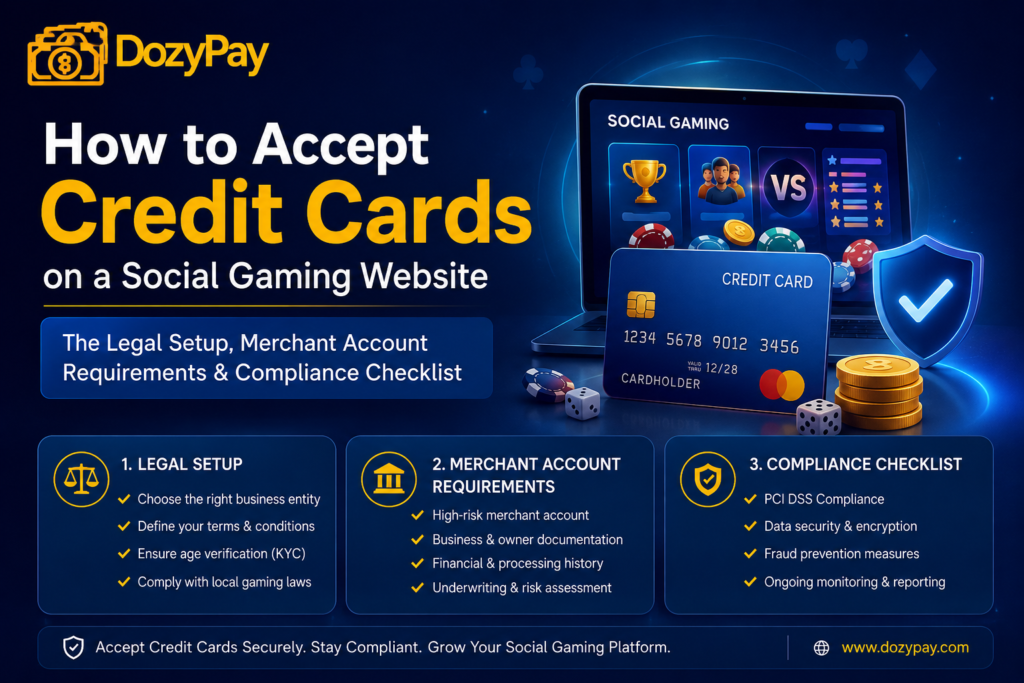
First, every underwriter evaluates whether the platform operates legally and compliantly in the jurisdictions it serves. This means a registered business entity, clear terms of service, a visible privacy policy, and — for social casino or sweepstakes models in particular — a responsible gaming policy with spending controls and age verification.
Chargeback History and Risk Controls
If the platform already has processing history, underwriters will examine the chargeback ratio closely. Anything above 1% raises concerns. Consequently, platforms with ratios above 2% must demonstrate active chargeback mitigation — tools like Ethoca or Verifi alerts, pre-charge purchase confirmation flows, or spend-limit notifications — before underwriters will issue an approval.
Transaction Volume and Ticket Size
Underwriters also need to understand the expected monthly processing volume and the average transaction value. Virtual currency platforms typically process high volumes of low-value transactions. Therefore, operators must clearly document this pattern upfront, because it directly affects the reserve structure the acquiring bank will require.
Business Model Clarity
Above all, the clearer the business model, the faster the approval. Underwriters need to understand exactly what players purchase, whether any real-money prizes change hands, and how the platform handles refunds or disputes. As a result, ambiguity in any of these areas will slow or block approval.
| Key insight The fastest approvals happen when operators submit a complete application with all documents pre-organised. Incomplete applications typically require two or three rounds of follow-up — adding 2–4 weeks to the process. |
Pre-Application Checklist: What to Have Ready Before Applying
| # | Required Document / Item | Why Underwriters Need It |
| 1 | Business registration documents | Articles of incorporation, registered address, director IDs |
| 2 | Platform terms of service | Must explicitly state virtual currency non-refundability and age requirements |
| 3 | Privacy policy | GDPR/CCPA-compliant; must describe data handling for payment information |
| 4 | Responsible gaming policy | Required for social casino and sweepstakes; spend limits, self-exclusion |
| 5 | 3 months of processing history | If available — shows transaction volume and chargeback rate |
| 6 | KYC/AML procedures | Document how you verify player identity and flag suspicious spend patterns |
| 7 | Refund / dispute policy | A clear written policy pre-emptively reduces chargeback disputes |
| 8 | Platform screenshots or demo access | Underwriters need to see the actual purchase flow and UI |
| 9 | Projected monthly volume | Required so the acquiring bank can size the reserve requirement correctly |
| 10 | Chargeback mitigation tools | Ethoca, Verifi alerts, or equivalent — reduces underwriter risk perception |
The Role of Chargeback Management in Ongoing Approval
Getting approved is the first milestone. However, staying approved — and retaining access to processing — depends on keeping chargebacks under control. This is particularly challenging for virtual currency platforms because of the friendly fraud dynamics discussed above.
Effective chargeback management for virtual currency platforms involves four layers:
As a result, DozyPay builds chargeback alert integration and real-time fraud scoring into its virtual currency payment infrastructure as standard features — not add-ons.
What to Look for in a Virtual Currency Payment Processor?
Not every high-risk payment processor understands virtual currency platforms well enough to serve them effectively. Therefore, when you evaluate a processor, look specifically for these capabilities:
- A high-risk acquiring bank network with specific experience in virtual goods and gaming verticals
- Fraud scoring models that the provider calibrates for micro-transaction and virtual goods purchase patterns — not generic retail models
- Chargeback alert integration (Ethoca / Verifi) built into the platform rather than bolted on
- A mobile SDK for iOS and Android in-app payment processing without redirects
- Multi-currency support for global virtual currency platforms
- Transparent rolling reserve terms — reserve rates, hold periods, and release schedules must appear clearly defined upfront
- A dedicated account manager with gaming and virtual currency experience — not a generic support queue
- Compliance support — help with terms of service review, responsible gaming policies, and KYC implementation
Specifically, DozyPay’s social gaming merchant account covers all of the above for virtual currency platforms in the social gaming, GameFi, and mobile in-app purchase verticals. In addition, for platforms that involve real-money casino gaming, DozyPay’s casino merchant account and gambling payment gateway provide purpose-built infrastructure for regulated gambling operators.
Common Mistakes Virtual Currency Platforms Make With Payment Processing
Operators new to high-risk payment processing often make the same mistakes. Fortunately, each one is avoidable — provided you understand what to watch out for.
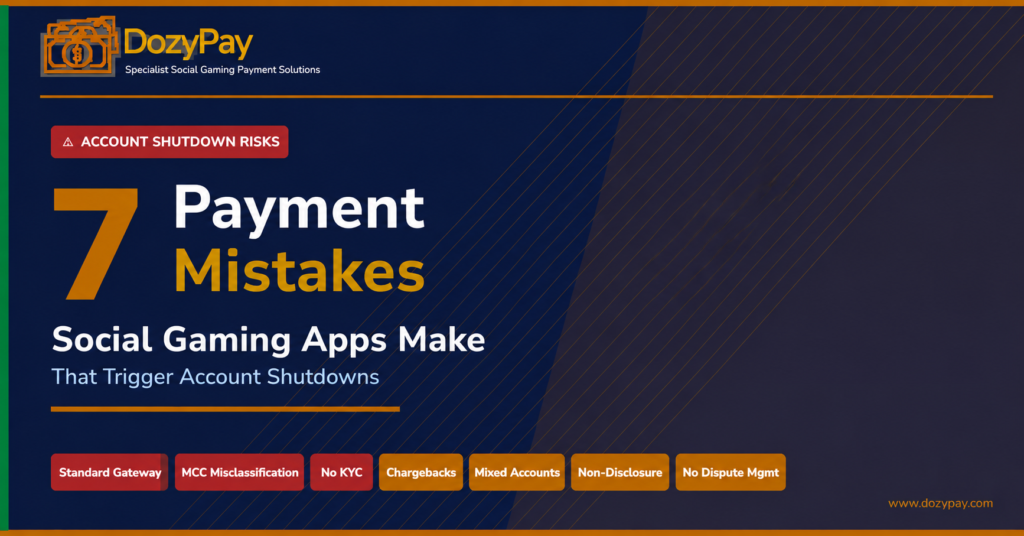
- Applying for a standard e-commerce account. Standard accounts will face termination — often without warning — the moment the processor identifies the nature of the platform. Consequently, the processor may hold funds for 180 or more days.
- Underestimating chargeback risk. Platforms that have not implemented purchase confirmation flows, spend alerts, or dispute management processes see chargeback ratios that trigger terminations quickly after approval. As a result, operators lose their processing ability just as revenue starts to grow.
- Submitting incomplete applications. Missing documents — especially terms of service and refund policies — are the most common cause of approval delays. Therefore, prepare all documentation before you start the application.
- Misclassifying the platform type. Applying for a social gaming account when your platform actually involves real-money prizes, sweepstakes redemptions, or regulated gambling outcomes will result in account termination and potential legal exposure. In other words, get the classification right from the start.
- Not disclosing full processing volume. Underwriters size reserve requirements based on projected volume. Accordingly, underestimating volume leads to reserve disputes and potential account holds when actual volumes exceed the approved limit.
Frequently Asked Questions
Q: What is the difference between a virtual currency merchant account and a social gaming merchant account?
They are closely related. A social gaming merchant account is the broader category — it covers all social gaming platforms including social casinos, mobile games, and sweepstakes. A virtual currency merchant account, however, applies specifically when the primary transaction involves purchasing digital tokens, coins, or NFT-based assets. In practice, most social gaming platforms require both capabilities from the same provider.
Q: How long does approval take for a virtual currency merchant account?
With a complete application — all documents ready, the platform clearly defined, and processing history available — a specialist high-risk processor like DozyPay typically completes approval within 5 to 10 business days. Incomplete applications, however, take significantly longer. DozyPay offers fast-track processing for qualified platforms.
Q: Do I need a virtual currency merchant account if I only sell in-app purchases through the App Store or Google Play?
No — if your platform routes 100% of purchases through Apple or Google’s payment systems, those platforms handle the merchant account on your behalf. You only need an independent merchant account if you process direct payments on your own web platform, accept payments outside the app store environment, or operate on platforms that app store payment systems do not cover.
Q: What chargeback ratio is acceptable for a virtual currency merchant account?
Most acquiring banks require a chargeback ratio below 1% (chargebacks as a percentage of total transactions). Ratios above 1.5% typically trigger a review; consequently, ratios above 2% put the account at risk of termination. DozyPay’s fraud and chargeback tools help platforms maintain ratios well below these thresholds.
Q: Can GameFi and NFT gaming platforms get payment processing approved?
Yes, though GameFi platforms carry additional underwriting complexity. Specifically, underwriters scrutinise the volatility of token values, the regulatory ambiguity around NFTs in certain jurisdictions, and the play-to-earn mechanics that can blur the line between virtual goods and financial instruments. Nevertheless, DozyPay works with GameFi operators to structure accounts that satisfy acquiring bank requirements for this category.
Q: What is a rolling reserve and do virtual currency merchant accounts require one?
A rolling reserve is a percentage of processed revenue that the acquiring bank holds as a risk buffer — typically 5 to 10% for high-risk merchants, held for 90 to 180 days before release. Most virtual currency merchant accounts carry a rolling reserve requirement, particularly for new platforms without processing history. However, the reserve rate and hold period are negotiable based on chargeback history and business profile.
Get Your Virtual Currency Merchant Account Approved
DozyPay specialises in payment processing for virtual currency platforms, social gaming operators, and GameFi businesses. Specifically, we handle the acquiring bank relationships, compliance infrastructure, and chargeback management tools — so you can focus on building your platform.
To get started, apply for a social gaming merchant account today, or contact our team at contact@dozypay.com for a pre-application consultation.

DozyPay is a specialist high-risk payment gateway and merchant account provider, helping businesses in 150+ countries accept payments securely and without interruption. Our team includes payment analysts, compliance specialists, and fintech professionals with over a decade of combined experience in high-risk merchant processing — covering industries such as IPTV, adult content, online gaming, forex trading, pharmaceuticals, and travel.
Every article published by DozyPay is researched and written by our in-house payments team, drawing on real underwriting experience, industry data, and direct merchant feedback. Our goal is simple: give high-risk business owners the clear, honest information that banks and mainstream processors won’t.