If you run or plan to launch an online casino, you have almost certainly heard both terms — payment gateway and merchant account. However, many operators use them interchangeably, and that confusion costs them time, money, and failed transactions. Specifically, mixing up these two components leads to poor provider selection, avoidable compliance gaps, and payment infrastructure that breaks at exactly the wrong moment.
In this guide, we break down the fundamental difference between the two, explain how they work together, and show you precisely why a properly configured online casino payment gateway integration combined with the right merchant account is the foundation of every high-performing iGaming business.
Furthermore, whether you are a new operator looking for the best payment gateway for online casino startup or an established platform upgrading your infrastructure, this post gives you the clearest possible picture of what you actually need — and why cutting corners on either component will hurt your business.
The Core Difference: What Each Component Actually Does
First, let us establish a simple mental model. Think of your payment infrastructure as a physical bank branch. The merchant account is the business bank account — the place that actually holds and processes the funds you receive from players. The payment gateway, on the other hand, is the secure channel through which card data, transaction instructions, and authorisation messages travel between your platform, the player’s bank, and the merchant account.
In other words, one stores and manages money. The other moves the data that authorises the money to move. Both are essential, and moreover, neither works in isolation for a live iGaming platform.
| Feature | Payment Gateway | Merchant Account |
| Primary Role | Encrypts & transmits transaction data | Holds & settles player funds |
| Who Provides It | Payment technology company / PSP | Acquiring bank or high-risk payment provider |
| What It Processes | Card data, 3DS checks, fraud signals | Approved transactions, chargebacks, refunds |
| Player-Facing? | Yes — embedded in your checkout flow | No — entirely back-end |
| Approval Required? | Technical integration + compliance review | Underwriting by acquiring bank |
| Risk Assessment | Fraud & transaction risk | Business & financial risk |
| Speed of Setup | Days to weeks (technical) | Weeks to months (underwriting) |
| Recurring Cost | Per-transaction fee + monthly fee | Rolling reserve + settlement fee + MDR |
Consequently, when operators say they are looking for a casino merchant account, they often mean they need both components together — a bundled solution from a provider experienced in high-risk iGaming payment processing. Therefore, understanding the distinction helps you ask the right questions and evaluate providers accurately from the start.
Related: Casino Merchant Account – Complete Guide
What Is an Online Casino Merchant Account?
A casino merchant account is a specialised type of business bank account that an acquiring bank or payment processor holds on behalf of an online casino. It functions as an intermediary — funds from player deposits settle into this account before the operator receives them in their business bank account.
Importantly, online casinos fall into the high-risk merchant category, which means standard merchant accounts from mainstream providers do not apply. Instead, online casinos need accounts specifically underwritten for iGaming, and as a result, the underwriting process is more stringent and the associated costs are higher than for low-risk industries.
Why iGaming Merchants Are Classified as High-Risk?
- High chargeback rates — players dispute transactions more frequently than in most other verticals
- Heavy regulatory complexity — licencing requirements vary by jurisdiction and acquiring bank
- Reputational risk — many acquiring banks avoid iGaming entirely due to regulatory exposure
- High average transaction values — larger ticket sizes increase financial exposure per transaction
- Rolling reserve requirements — processors hold a percentage of funds as a security buffer
Therefore, securing a casino merchant account requires working with a provider that specifically understands iGaming underwriting. In addition, the terms of the account — including rolling reserves, MDR rates, and settlement frequencies — differ significantly from standard merchant accounts.
What Underwriting Examines?
When an acquiring bank or PSP reviews your application for a casino merchant account, they specifically assess the following factors:
| Underwriting Factor | What the Processor Evaluates |
| iGaming Licence | Jurisdiction, scope, and current regulatory standing |
| Business Model | RNG games, live dealer, sports betting, social gaming — each carries different risk profiles |
| Chargeback History | Historical ratio — ideally below 1%; above 2% raises flags |
| Processing Volume | Monthly projected volume and ticket size distribution |
| Website & Compliance | AML policy, KYC process, responsible gambling tools, terms of service |
| Director Background | Financial and criminal background checks on beneficial owners |
| Bank Statements | 3–6 months of business banking history to demonstrate financial stability |
Related: Casino Merchant Account – Features Every Operator Needs
What Is an Online Casino Payment Gateway?
A payment gateway is the technology layer that sits between your casino platform and the global payment networks — Visa, Mastercard, and the issuing banks that hold your players’ money. Every time a player makes a deposit, the gateway performs a rapid sequence of tasks: it encrypts the card data, sends an authorisation request to the issuing bank, receives an approval or decline decision, and returns the result to your platform — typically in under three seconds.
Furthermore, a gateway built specifically for iGaming does considerably more than basic data transmission. Consequently, the gateway you choose determines not just whether transactions go through, but how many, how reliably, and at what cost.
Core Functions of an iGaming Payment Gateway
- 3D Secure (3DS2) authentication — adds a frictionless fraud layer that shifts liability away from the operator while preserving conversion rates
- Multi-currency processing — accepts player deposits in local currencies and settles in your preferred currency
- Alternative payment method (APM) support — routes e-wallets, bank transfers, and crypto alongside card payments
- Real-time fraud scoring — analyses transaction patterns and velocity to block suspicious activity before it reaches settlement
- Dynamic descriptor management — controls how the charge appears on player bank statements, reducing friendly fraud chargebacks
- Cascading and intelligent routing — automatically retries declined transactions through backup acquiring routes to recover revenue
- Tokenisation — stores player payment credentials securely so returning players can deposit without re-entering card data
In addition, online casino payment gateway integration with your platform needs to handle the specific transaction patterns that define iGaming — multiple small deposits per session, rapid withdrawal requests, and high transaction volumes during peak events such as major sporting fixtures.
| Why Standard Payment Gateways Fail for iGaming? Standard gateways from Stripe, Square, or PayPal explicitly prohibit real-money gambling in their terms of service. Even where not prohibited, standard gateways lack the MCC codes, acquiring relationships, and fraud models needed for iGaming. As a result, using a non-specialist gateway leads to account termination, withheld funds, and zero recourse. Therefore, every online casino must use a gateway from a provider that specifically serves regulated iGaming operators. |
Related: Top 8 Features Every Online Casino Payment Gateway Must Have
How the Gateway and Merchant Account Work Together?
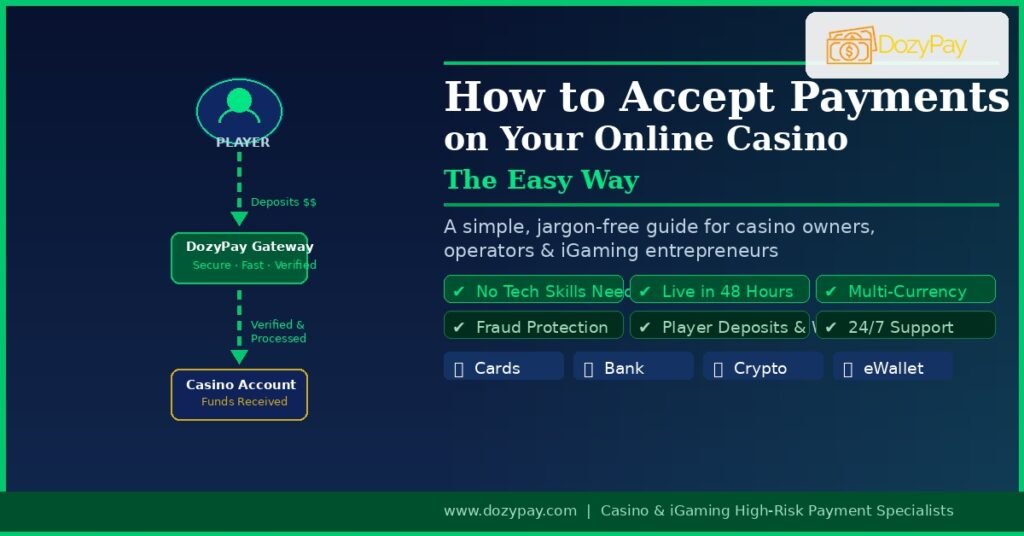
Understanding how these two components interact in real time clarifies why both are non-negotiable. Here is the step-by-step flow of a single player deposit on a regulated online casino:
| Step | Component | What Happens |
| 1 | Player | Enters deposit amount and card details on your casino cashier |
| 2 | Payment Gateway | Encrypts card data using TLS/SSL and tokenises credentials |
| 3 | Payment Gateway | Sends authorisation request to card network (Visa/MC) |
| 4 | Issuing Bank | Approves or declines based on available funds, fraud signals, and 3DS result |
| 5 | Payment Gateway | Returns approval/decline to your platform in real time |
| 6 | Casino Platform | Credits player’s account (on approval) and displays confirmation |
| 7 | Card Network | Batches approved transactions for settlement overnight |
| 8 | Merchant Account | Receives settled funds, net of processing fees |
| 9 | Acquiring Bank | Releases funds to operator’s business account per agreed schedule |
Consequently, if either component fails, the entire transaction fails. Furthermore, a poorly configured merchant account with a mismatched gateway creates reconciliation gaps, settlement delays, and chargeback exposure that compounds over time. Therefore, the two components must come from providers that have established integration relationships and experience working together in iGaming environments.
| The Cost of Mismatched Infrastructure A gateway without an iGaming-compatible merchant account produces approval rates of 40–60% — far below the 85–92% benchmarks that well-configured setups achieve. A merchant account without a smart gateway generates excessive friendly fraud chargebacks because the gateway lacks the dynamic descriptor and 3DS tools needed to prevent them. Additionally, mismatched setups create duplicate KYC friction, player drop-off at checkout, and settlement reconciliation errors. |
Choosing a Secure Casino Payment Gateway Provider: What to Evaluate?
Finding a secure casino payment gateway provider requires more than checking a feature list. Specifically, the provider’s acquiring relationships, their history with iGaming clients, and the robustness of their fraud and chargeback tools determine whether your platform runs smoothly or struggles with approvals and disputes.
Therefore, when you evaluate gateway providers, prioritise the following criteria:
1. iGaming-Specific Acquiring Relationships
Your gateway provider must hold established relationships with acquiring banks that accept iGaming MCC codes — specifically 7995 (gambling) and 7801 (online gambling). Furthermore, providers with multiple acquiring relationships can route transactions to the bank most likely to approve them, which directly improves your overall approval rate.
2. Regulatory Compliance and Licencing Support
A secure casino payment gateway provider must demonstrate compliance with PCI DSS Level 1, GDPR, and the specific AML and KYC requirements of the jurisdictions where you operate. In addition, they should actively help you maintain compliance as regulations evolve, rather than leaving you to manage it independently.
3. Uptime SLA and Redundancy Architecture
iGaming platforms run 24/7, and consequently any gateway downtime directly translates to lost deposits and player attrition. Therefore, look specifically for providers offering 99.95%+ uptime SLAs, active failover routing, and geographic redundancy across multiple data centres.
4. Chargeback and Fraud Management Tools
High chargeback ratios are the single most common reason acquiring banks terminate casino merchant accounts. Therefore, your gateway must include dynamic descriptor management, 3DS2 integration, real-time velocity monitoring, and ideally access to Visa’s CDRN and Mastercard’s Ethoca alert networks to resolve disputes before they escalate to formal chargebacks.
Related: How to Reduce Chargebacks on a Casino Merchant Account
5. Alternative Payment Method Coverage
Players in different markets rely on different payment methods. Consequently, a gateway that only processes Visa and Mastercard will cost you conversions in markets where e-wallets, bank transfers, or crypto carry higher adoption. In addition, look for a provider that supports SEPA, Neteller, Skrill, and cryptocurrency alongside card payments.
Related: Casino Payment Gateway: Cryptocurrency, Bitcoin & Stablecoins
Payment Gateway for Online Casino Without Restriction: What That Actually Means?
When operators search for a payment gateway for online casino without restriction, they are typically looking for one of two things: a gateway that processes real-money gambling transactions without the MCC-level blocks that mainstream providers impose, or a gateway that serves operators in jurisdictions where other providers decline to work.
However, it is important to be specific about what ‘without restriction’ realistically means in a regulated context. No legitimate provider operates entirely without compliance requirements — and moreover, you should be wary of any provider that claims otherwise. What ‘without restriction’ actually means, therefore, is this:
| What It Means? | What It Does NOT Mean? |
| Processes iGaming MCCs 7995 and 7801 | Zero KYC or AML compliance requirements |
| Accepts operators with valid licences from recognised jurisdictions | Accepts unlicensed or grey-market operators without due diligence |
| Works with operators in multiple regulated markets, not just Tier 1 only | Operates outside all regulatory frameworks |
| Provides multi-currency and APM support without arbitrary payment type blocks | Accepts all payment methods regardless of fraud risk |
| Does not impose blanket country-level declines without due consideration | Bypasses card network rules or OFAC/sanctions screening |
Consequently, the best approach for operators is to partner with a provider that has built specific acquiring relationships and compliance frameworks for iGaming, rather than seeking workarounds that introduce regulatory or financial risk. In other words, the right provider gives you broad processing capability within a compliant, sustainable structure — not a loophole.
| DozyPay’s Approach to Restriction-Free iGaming Processing DozyPay holds direct acquiring relationships with iGaming-specialist banks across multiple jurisdictions. Furthermore, we support operators in regulated markets including MGA, UKGC, Curaçao, and Isle of Man licensed platforms. Our infrastructure processes iGaming MCCs with no blanket blocks on card brands, e-wallets, or crypto. Additionally, we provide full compliance support — AML monitoring, 3DS2, PCI DSS Level 1 — so your platform processes confidently within regulatory requirements. |
Related: Online Casino Payment Gateway – Complete Guide
Best Payment Gateway for Online Casino Startup: What New Operators Need to Know
For new operators, finding the best payment gateway for online casino startup is particularly challenging because most established gateway providers require a track record before approving accounts. Furthermore, startups face tighter rolling reserve requirements and higher MDR rates until they demonstrate consistent processing volume and a controlled chargeback ratio.
Therefore, here is a realistic framework for new operators approaching payment infrastructure for the first time:
Step 1: Secure Your Licence Before Approaching Payment Providers
Almost every legitimate iGaming payment provider requires a valid gambling licence as a prerequisite for onboarding. Consequently, applying for payment accounts before your licence is issued wastes time and creates an adverse application history. Therefore, begin payment conversations in parallel with your final licencing stages, not before.
Step 2: Prepare a Complete Compliance Package
Specifically, you need to prepare: your AML policy, KYC procedures, responsible gambling tools, terms and conditions, privacy policy, and business bank statements. Furthermore, a professionally presented compliance package shortens the underwriting timeline significantly and demonstrates the operational maturity that providers look for in startup operators.
Related: Best Payment Gateway for Online Casino Startup 2026
Step 3: Start with a PSP That Bundles Gateway and Merchant Account
For startups specifically, working with a payment service provider (PSP) that bundles both the gateway and the merchant account is the most practical approach. In addition, a bundled solution reduces the complexity of managing two separate provider relationships, simplifies reconciliation, and accelerates your time to live. As you grow and your processing volume increases, you can then add direct acquiring relationships for additional capacity and improved rates.
Step 4: Understand Rolling Reserves and Plan Your Cash Flow Accordingly
Rolling reserves — typically 5–15% of monthly processing volume held for 90–180 days — are standard for new casino merchant accounts. Consequently, operators who do not factor this into their launch cash flow run into liquidity problems within the first three months. Therefore, model your cash flow with rolling reserves built in from day one, and negotiate the reserve percentage during your onboarding discussions.
Related: Casino Merchant Account for Startups and New Operators
Online Casino Payment Gateway Integration: Technical and Operational Requirements
Properly executing online casino payment gateway integration requires attention at both the technical and operational levels. Furthermore, a technically correct integration that lacks proper operational configuration — such as descriptor settings, webhook handling, or 3DS2 exemption logic — will still underperform relative to its potential.
Technical Integration Checklist
- API vs hosted payment page — determine which integration type fits your platform architecture and security posture
- Webhook and IPN configuration — ensure your platform receives and correctly processes real-time payment status notifications
- 3DS2 frictionless flow — configure authentication to request frictionless exemptions for low-risk transactions while applying full challenge flow only when required
- Tokenisation implementation — store returning player credentials securely to reduce deposit friction on subsequent sessions
- Multi-currency routing — configure currency conversion rules and settlement currency preferences
- Sandbox testing — thoroughly test approval, decline, 3DS challenge, refund, and chargeback flows before go-live
- Fallback routing rules — define the cascade sequence your gateway uses when the primary acquirer declines a transaction
Operational Configuration Checklist
- Dynamic descriptor — set a clear, recognisable descriptor that matches your brand to prevent friendly fraud chargebacks
- Velocity rules — configure per-player deposit limits, time-window restrictions, and card-use rules aligned with your responsible gambling policy
- Fraud scoring thresholds — set decline thresholds calibrated to your player demographics and risk appetite
- Chargeback alert subscriptions — enrol in Visa CDRN and Mastercard Ethoca for pre-chargeback dispute resolution
- Reporting and reconciliation — connect your gateway’s reporting API to your back-office for automated daily reconciliation
Consequently, operators who invest in a complete integration — covering both technical configuration and operational setup — consistently achieve 15–25% higher approval rates and 30–40% lower chargeback ratios than those who deploy a basic integration and leave the rest as default settings.
Related: How to Integrate a Casino Payment Gateway
Cost Comparison: Gateway Fees vs Merchant Account Fees
One of the most common areas of confusion for new operators is understanding which costs come from the gateway and which come from the merchant account. Therefore, here is a clear breakdown of the typical fee structure:
| Fee Type | Charged By | Typical Range | Notes |
| MDR (Merchant Discount Rate) | Merchant Account / Acquirer | 2.5%–5.0% | Higher for high-risk; varies by card type and region |
| Gateway Transaction Fee | Payment Gateway | $0.10–$0.35 per txn | Applied to all transactions including declines |
| Monthly Gateway Fee | Payment Gateway | $100–$500/month | Covers access, support, reporting |
| Rolling Reserve | Merchant Account / Acquirer | 5%–15% of volume | Held for 90–180 days; released on schedule |
| Chargeback Fee | Merchant Account / Acquirer | $25–$75 per dispute | Plus MDR reversal on disputed amount |
| Refund Fee | Merchant Account / Acquirer | $0.50–$2.00 | Some providers waive; negotiate upfront |
| Setup / Onboarding Fee | Gateway or PSP | $500–$3,000 one-time | Often waived for volume commitments |
| 3DS / Fraud Tool Fee | Payment Gateway | Included or $0.05/txn | Check whether bundled into gateway fee |
In addition, operators should factor in the cost of PCI DSS compliance, which may run $1,000–$15,000 annually depending on your compliance level and whether your gateway provides a hosted payment page that reduces your PCI scope. Furthermore, currency conversion fees apply whenever player deposits arrive in a currency different from your settlement currency, typically adding 0.5%–1.5% per transaction.
Related: How to Get a Low-Fee Gambling Payment Gateway
Common Mistakes Operators Make With Their Payment Infrastructure
Based on our experience working with iGaming operators across multiple jurisdictions, the same infrastructure mistakes appear repeatedly. Consequently, understanding these patterns helps you avoid the most expensive errors before they occur.
Mistake 1: Choosing a Single Provider for Everything Without Backup
Relying on a single gateway and a single merchant account creates catastrophic single points of failure. Therefore, every platform should have at least one backup gateway and, ideally, two acquiring relationships. Furthermore, intelligent routing between acquirers typically improves approval rates by 8–15% in addition to providing failover coverage.
Mistake 2: Neglecting the Merchant Account Application Process
Operators frequently invest heavily in platform development but treat the merchant account application as a quick administrative step. As a result, they arrive at launch week without an approved account, miss their launch date, and lose early player acquisition momentum. Therefore, start your merchant account application at least three months before your intended launch date.
Mistake 3: Not Configuring 3DS2 Correctly
3DS2 frictionless flow reduces player drop-off on low-risk transactions while providing liability shift on authenticated transactions. However, many operators deploy 3DS2 in challenge-only mode, which adds friction to every deposit. Consequently, they see 12–18% checkout abandonment that proper frictionless configuration would have prevented entirely.
Related: 6 Reasons Your Casino Payment Gateway Is Killing Player Retention
Mistake 4: Ignoring Chargeback Management Until It Is Too Late
Chargeback ratios above 1% trigger monitoring programmes from Visa and Mastercard, and ratios above 2% lead to account termination. Furthermore, once you enter a card network monitoring programme, remediation is expensive, time-consuming, and not guaranteed to succeed. Therefore, implement chargeback alert subscriptions and velocity rules from day one, rather than responding reactively after the problem develops.
Why You Need Both? — A Final Summary
To summarise the core argument of this guide: a payment gateway and a merchant account are not interchangeable, nor is one a substitute for the other. They serve different functions, carry different risk profiles, and require different evaluation criteria. Moreover, both are essential components of any online casino payment infrastructure that aims to deliver high approval rates, low chargebacks, and a frictionless player experience.
| You Need a Casino Merchant Account For… | You Need a Payment Gateway For… |
| Legally holding and settling player deposits | Securely transmitting card data and receiving authorisations |
| Managing chargebacks and disputes with acquiring banks | Real-time fraud scoring and 3DS2 authentication |
| Receiving multi-currency settlements | Multi-currency acceptance and APM routing |
| Maintaining your acquiring relationships and MDR rates | Intelligent routing, fallback acquiring, and tokenisation |
| Compliance with financial regulations in your jurisdiction | PCI DSS scope reduction and technical security |
Therefore, the most effective approach is to work with a provider — such as DozyPay — that combines both components in a single, iGaming-optimised stack, rather than assembling mismatched infrastructure from providers that lack experience with the specific demands of regulated gambling operations.
Get Both Components Right With DozyPay
At DozyPay, we provide iGaming operators with fully integrated online casino payment gateway integration and high-risk casino merchant account solutions built specifically for the demands of regulated gambling. Furthermore, we work with operators at every stage — from startup platforms applying for their first merchant account to established casinos optimising their approval rates and chargeback management.
Specifically, our infrastructure delivers:
- Direct acquiring relationships with iGaming-specialist banks across multiple jurisdictions
- 3DS2 frictionless flow with Visa CDRN and Mastercard Ethoca chargeback alert subscriptions
- Multi-currency processing across 100+ currencies with APM support including e-wallets and crypto
- Intelligent cascade routing to maximise approval rates across primary and backup acquirers
- PCI DSS Level 1 certified infrastructure with full AML and KYC compliance tooling
- Dedicated iGaming account management — not a generic support queue
Whether you need a secure casino payment gateway provider for a new launch or a payment gateway for online casino without restriction that works across your target markets, DozyPay gives you the infrastructure and the iGaming expertise to build a payment stack that performs.
| Ready to Set Up Your Casino Payment Infrastructure? Talk to a DozyPay iGaming payment specialist today. We work with operators on casino merchant accounts, online casino payment gateway integration, and full-stack iGaming payment solutions. Visit: dozypay.com/casino-merchant-account Visit: dozypay.com/online-casino-payment-gateway DozyPay — Built for iGaming. Proven in High-Risk. |