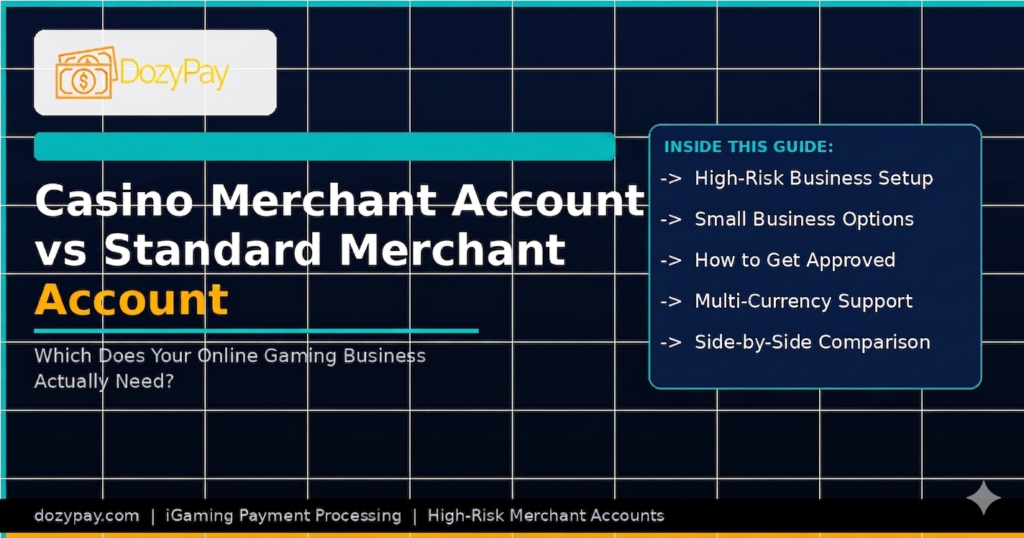
Every online gaming business eventually reaches the same critical decision point: do you try to process payments through a standard merchant account, or do you invest in a dedicated casino merchant account? On the surface, both accounts process card payments and settle funds to your bank. However, the moment a standard account acquirer discovers your business operates in iGaming, your account gets terminated — often without warning, and sometimes with funds frozen mid-cycle.
This comparison guide breaks down exactly what separates these two account types, who each one is built for, and how to choose the right structure for your online gaming business — whether you are a large-scale operator, a casino merchant account for high risk business, or a new entrant looking for a casino merchant account for small business.
Additionally, this guide covers the multi-currency question in depth — because for global gaming operators, a casino merchant account multiple currencies capability is not a premium feature; it is a baseline requirement.
What Is a Standard Merchant Account and Why Does It Fail iGaming Operators?
A standard merchant account is a payment processing facility provided by a bank or acquiring institution to businesses operating in low-risk sectors — retail, software, subscriptions, and general e-commerce. Consequently, the underwriting criteria for standard accounts assume predictable customer behaviour, low chargeback rates, and products or services that are not subject to heavy regulatory scrutiny.
iGaming businesses fail this underwriting profile on every dimension. Specifically, standard acquirers flag gaming businesses for the following reasons:
- Elevated chargeback rates: players often dispute transactions they do not recognise on bank statements or regret after losing sessions, pushing dispute rates well above the 1% threshold that triggers standard account termination
- Regulatory complexity: gaming licensing requirements vary dramatically by jurisdiction, creating compliance burdens that standard acquirers are not equipped to assess
- Reputational risk: banks are wary of association with gambling operators due to anti-money laundering exposure and negative press risk
- Revenue model mismatch: gaming platforms often process large, irregular transaction volumes with a player base in multiple jurisdictions — a risk profile standard underwriting models are not designed to handle
Moreover, operators who hide their gaming activity from standard acquirers — sometimes by miscoding their merchant category — face account freezes, permanent bans, and legal exposure for misrepresentation. Therefore, the only viable long-term path for an iGaming business is a properly structured casino merchant account.
Side-by-Side Comparison: Casino Merchant Account vs Standard Merchant Account
The table below provides a comprehensive feature-by-feature comparison across every dimension that matters for an online gaming business. Use this as your reference checklist when evaluating your current payment setup or assessing a new processor.
| Feature | Standard Merchant Account | Casino Merchant Account |
| Risk Classification | Low risk — standard underwriting | High risk — specialist underwriting required |
| Who Approves It | High street banks, PayPal, Stripe, Square | Specialist high-risk payment processors and offshore acquirers |
| Approval Timeline | 24–72 hours in most cases | 5–15 business days with full underwriting review |
| Rolling Reserve | None or minimal (0–1%) | 5–10% held for 90–180 days as chargeback buffer |
| Processing Fees | 1.5–2.9% + fixed per-transaction fee | 3.5–8% depending on jurisdiction and chargeback history |
| Chargeback Tolerance | 1% threshold before account termination risk | Structured tolerance up to 2–3% with dispute management |
| Currencies Supported | Typically 1–5 major currencies | Casino merchant account multiple currencies — 20–50+ currencies supported |
| Crypto Support | Rarely supported | Bitcoin, Ethereum, USDT and other stablecoins routinely supported |
| High Volume Processing | Low monthly cap — often USD 10k–50k | High monthly caps — USD 500k–10M+ negotiable |
| Jurisdiction Access | Domestic and select tier-1 markets only | Global — Curacao, Malta, Gibraltar, Isle of Man and more |
| Industry Lock-out | Gaming, gambling, adult content all blocked | Built for iGaming — all verticals processed |
| Fraud Tools | Basic AVS and CVV checks | AI fraud scoring, velocity checks, 3DS2, device fingerprinting |
| Recurring Billing | Limited subscription support | Full recurring billing, deposit wallets, and player-level tokenisation |
| Regulatory Compliance | KYC/AML for standard commerce | iGaming-specific AML, responsible gambling tools, licence-aware routing |
As the comparison shows, the differences extend far beyond pricing. Furthermore, the structural design of a casino merchant account specifically addresses the risk patterns and operational demands of gaming businesses — which a standard account was never built to handle.
Casino Merchant Account for High Risk Business: What Underwriters Actually Evaluate
The phrase high risk in payment processing does not simply mean risky in the conventional sense. Instead, it is a technical classification used by acquiring banks and payment processors to indicate a business category that requires specialised underwriting, higher reserves, and enhanced compliance monitoring.
For operators seeking a casino merchant account for high risk business, understanding the underwriting criteria helps you prepare a stronger application and improves your approval probability significantly. Specifically, underwriters assess the following during a casino merchant account application:
1. Gaming Licence Validity
Every serious casino merchant account provider requires a valid gaming licence from a recognised jurisdiction. Curacao eGaming, Malta Gaming Authority (MGA), Gibraltar Regulatory Authority, Isle of Man Gambling Supervision Commission, and UKGC licences are the most commonly accepted. Moreover, the jurisdiction of your licence directly affects which payment processors are available to you and what rolling reserve they require.
2. Chargeback History and Dispute Management
If your business has processed payments before — whether through a standard account or a previous casino processor — your historical chargeback ratio is reviewed carefully. Consequently, operators with chargeback ratios above 2% typically face higher reserve requirements, steeper processing fees, or outright rejection until the ratio is brought under control.
For guidance on reducing your chargeback exposure, read our detailed breakdown on reducing chargebacks for casino merchant accounts
3. Ownership and Financial Transparency
High-risk underwriting requires full ultimate beneficial owner (UBO) disclosure. Therefore, operators must provide identity documentation, source of funds evidence, and corporate structure charts for all entities involved in the business. Additionally, three to twelve months of bank statements are typically required to demonstrate financial stability.
4. Player Responsible Gambling Infrastructure
Modern casino merchant account underwriters increasingly require evidence of responsible gambling controls. Specifically, they want to see self-exclusion tools, deposit limits, loss limits, and AML/KYC procedures built into the platform before processing approval is granted. As a result, operators who launch without these controls in place face delays or conditional approvals.
5. Technology and Security Compliance
PCI DSS compliance is a baseline requirement for any card processing account. However, casino merchant account providers typically go further, requiring 3D Secure 2.0 implementation, device fingerprinting, IP geolocation checks, and velocity limits on player transactions. Therefore, operators must ensure their payment stack is technically aligned before applying.
Casino Merchant Account for Small Business: Is Approval Realistic for New Operators?
One of the most common questions from early-stage iGaming operators is whether a casino merchant account for small business is achievable before reaching meaningful transaction volume. The straightforward answer is yes — but the approval process and account terms are structured differently for new operators compared to established platforms.
Specifically, small and startup gaming operators should expect the following when applying for their first casino merchant account:
- Higher rolling reserve: without processing history, underwriters mitigate their risk through a higher rolling reserve — typically 8 to 10% held for 180 days, compared to 5% for established operators
- Volume cap on launch: initial monthly processing caps of USD 50,000 to USD 200,000 are common for new accounts, with caps raised as positive processing history builds
- Shorter initial contract: many processors offer 6-month initial terms for small operators, allowing both parties to review the relationship before committing to long-term contract terms
- Business plan and financial projections required: in the absence of historical bank statements, underwriters rely heavily on your business plan, funding evidence, and projected player acquisition timeline
Furthermore, smaller operators benefit from working with specialist brokers who maintain relationships with multiple casino-friendly acquirers. Consequently, a broker can match your specific risk profile to the most suitable processor rather than requiring you to approach acquirers individually — saving time and reducing the impact of rejection on your credit profile.
For a detailed walkthrough of the approval process for new and startup operators, read our guide: how casino merchant account startups and new operators get approved
How to Get a Casino Merchant Account?: The Step-by-Step Approval Process
Understanding how to get a casino merchant account in the right sequence dramatically reduces the time from application to live processing. Moreover, operators who approach the process without preparation frequently experience delays, rejections, or suboptimal account terms that could have been avoided.
Follow this sequence for the strongest possible application outcome:
- Secure your gaming licence first: no reputable casino merchant account provider will process an unlicensed gaming operator. Therefore, your licence application and payment processor application should run in parallel — but your licence must be in place before live processing begins
- Prepare your KYC documentation package: gather passport copies, proof of address, company registration documents, shareholder register, UBO declaration, and source of funds evidence for all directors and major shareholders
- Achieve PCI DSS compliance: complete your Self-Assessment Questionnaire (SAQ) or full PCI audit depending on your processing volume. Additionally, ensure your platform has 3DS2 integration in place before submitting your application
- Build your responsible gambling infrastructure: implement deposit limits, loss limits, self-exclusion, and session reminders. Document these controls in a Responsible Gambling Policy and make them visible in your application
- Prepare 3 to 6 months of bank statements: if you have prior processing history, compile this alongside your dispute logs. For new operators, business account statements showing funding and operating capital are required instead
- Write a detailed processing narrative: underwriters want to understand your business model, player acquisition strategy, expected average transaction size, and projected monthly volume. Consequently, a well-written processing narrative significantly accelerates underwriting
- Submit to multiple appropriate processors simultaneously: applying to one processor at a time is inefficient. Instead, work with a broker or processor with multiple acquiring relationships to run parallel applications, giving you options to compare terms
- Negotiate your terms before signing: rolling reserve percentage, reserve release schedule, processing rates, and monthly minimums are all negotiable — particularly for operators with strong documentation and clear revenue projections
Casino Merchant Account Multiple Currencies: Why Global Operators Cannot Compromise on This?
For any online gaming operator targeting players across more than one country, casino merchant account multiple currencies support is not optional — it is a fundamental commercial requirement. Specifically, players convert at significantly higher rates when they can deposit and withdraw in their local currency. Moreover, cross-border currency conversion imposed on players creates friction, erodes trust, and directly increases chargeback rates.
A properly structured casino merchant account multiple currencies setup should cover the following capabilities:
Multi-Currency Acceptance
Your casino merchant account should be able to accept card payments in the player’s local currency at the point of transaction. Therefore, rather than converting EUR deposits to USD and back again, the account settles in the original transaction currency — reducing FX costs and improving player experience simultaneously.
Settlement Currency Flexibility
Beyond acceptance, you need flexibility in how funds are settled to your business bank account. Additionally, operators running multiple brands across different jurisdictions benefit from routing settlements to specific bank accounts by currency — for example, EUR settlements to a Malta-based account and GBP settlements to a UK entity.
Key Currencies for iGaming Operations
The following currency coverage is typically expected from a full-service casino merchant account for a globally operating iGaming platform:
- Tier 1 core: USD, EUR, GBP, CAD, AUD
- European expansion: SEK, NOK, DKK, CHF, PLN, CZK, HUF
- Asia-Pacific: JPY, SGD, HKD, INR, MYR, THB, PHP
- Latin America: BRL, MXN, CLP, PEN, ARS
- Crypto: BTC, ETH, USDT, USDC — increasingly standard for offshore-licensed operators
Moreover, processors who offer dynamic currency conversion (DCC) at the player level — presenting the exact amount in the player’s home currency before transaction confirmation — consistently report conversion rate improvements of 8 to 15% compared to operators who force single-currency transactions.
For cryptocurrency payment integration as part of your multi-currency stack, explore DozyPay’s full guide: https://dozypay.com/casino-payment-gateway-cryptocurrency-bitcoin-ethereum-stablecoins/
Decision Matrix: Which Account Type Does Your Business Actually Need?
Use the table below to determine with certainty which account structure is appropriate for your specific business model. Additionally, use this matrix when auditing your current setup to identify whether you are operating with inappropriate account infrastructure that puts your processing continuity at risk.
| Your Situation | Standard Account Viable? | Casino Account Needed? |
| Real-money online casino | No — will be terminated on discovery | Yes — mandatory |
| Sports betting operator | No — classified as gambling | Yes — mandatory |
| Social casino (free-to-play + IAP) | Possibly for small IAP volume | Yes for scale — avoids sudden shutdowns |
| Casino affiliate / lead gen site | Yes — no direct payment processing | Not required |
| Poker platform with rake | No — gaming revenue triggers closure | Yes — mandatory |
| Game studio licensing B2B only | Yes — invoice-based B2B payments fine | Not required |
| iGaming SaaS (platform fees only) | Possible if no direct player payments | Recommended for security and scale |
| Casino startup launching within 90 days | No | Yes — apply now, approval takes time |
As the matrix makes clear, any business that directly touches real-money gaming transactions — regardless of jurisdiction or scale — requires a dedicated casino merchant account. Furthermore, operators who attempt to use standard accounts for gaming purposes are not saving money; they are accepting the risk of sudden account termination, fund freezes, and the significant operational disruption that follows.
The True Cost Comparison: What You Actually Pay Across Both Account Types?
Operators frequently compare processing rates in isolation — seeing casino merchant account fees of 4 to 6% against standard account rates of 1.5 to 2.9% and concluding that the standard account is more cost-effective. However, this comparison ignores the total cost of operating with the wrong account type. Consequently, the following cost breakdown presents the full picture:
| Cost Component | Standard Account | Casino Merchant Account |
| Setup / Application Fee | None to USD 100 | USD 500 – 2,500 (one-time) |
| Monthly Minimum Fee | None to USD 25 | USD 100 – 500 |
| Transaction Rate (cards) | 1.5 – 2.9% | 3.5 – 8% |
| Chargeback Fee | USD 15 – 25 per dispute | USD 25 – 60 per dispute |
| Rolling Reserve | None | 5 – 10% held 90–180 days |
| Currency Conversion | 1.5 – 2% FX markup | 0.5 – 1.5% (volume-negotiated) |
| Fraud & Compliance Tools | Included (basic) | USD 50 – 300/month (advanced) |
| Effective Cost at USD 500k/month volume | Approx. 2.5% | Approx. 4.5 – 6% (all-in) |
Additionally, when you factor in the cost of a single account termination — lost processing days, emergency processor onboarding fees, player churn during payment downtime, and potential fund freeze costs — the apparent savings from a standard account disappear entirely. Therefore, the correct cost comparison is not rate vs rate; it is total risk-adjusted operating cost over a 12-month horizon.
For strategies to reduce your effective processing cost without compromising account security, see our guide on how to get a low-fee gambling payment gateway at: https://dozypay.com/how-to-get-low-fee-gambling-payment-gateway/
The Edge Case: When a Standard Merchant Account Can Legitimately Work Alongside Gaming?
There are narrow but real scenarios where a standard merchant account can legitimately coexist with a gaming business. Specifically, these are cases where the standard account is not being used for player-facing payment processing.
- B2B software licensing fees: if your gaming company also sells software licences to other businesses, a separate standard account for those B2B invoices is entirely appropriate — provided it is clearly separated from player payment flows
- Marketing and affiliate payments: paying affiliates through a standard business account or payment platform is common and carries no acquirer risk, since these are outbound payments, not gaming revenue receipts
- SaaS fees for non-gambling products: if your iGaming company also operates non-gambling software products, those revenues can legitimately flow through standard accounts — again, provided the accounts are clearly separated from any gaming activity
Nevertheless, the moment any player deposit, rake, or real-money gaming transaction passes through a standard account — even temporarily — the account is at risk of immediate termination. Therefore, maintaining complete operational separation between gaming and non-gaming payment flows is non-negotiable.
How DozyPay Structures Casino Merchant Accounts for iGaming Operators?
DozyPay specialises exclusively in high-risk payment processing for iGaming operators — which means every casino merchant account DozyPay facilitates is designed from the ground up for the specific demands of online gaming rather than adapted from a standard commercial template.
Specifically, DozyPay’s casino merchant account structure includes:
- Multiple acquiring relationships: access to a network of casino-friendly acquirers across EU, offshore, and Asia-Pacific jurisdictions, enabling the best terms match for your specific business profile
- Casino merchant account multiple currencies: support for 40+ currencies with local acquiring where available, reducing FX costs and improving player conversion rates
- Structured onboarding for new operators: dedicated support for casino merchant account for small business and startup operators, including documentation guidance, application preparation, and parallel processor applications
- Chargeback management tools: built-in dispute management, alert systems, and representment support to keep your ratio within acceptable thresholds
- Transparent fee structure: all-in pricing with no hidden per-statement fees, annual fees, or undisclosed currency conversion markups
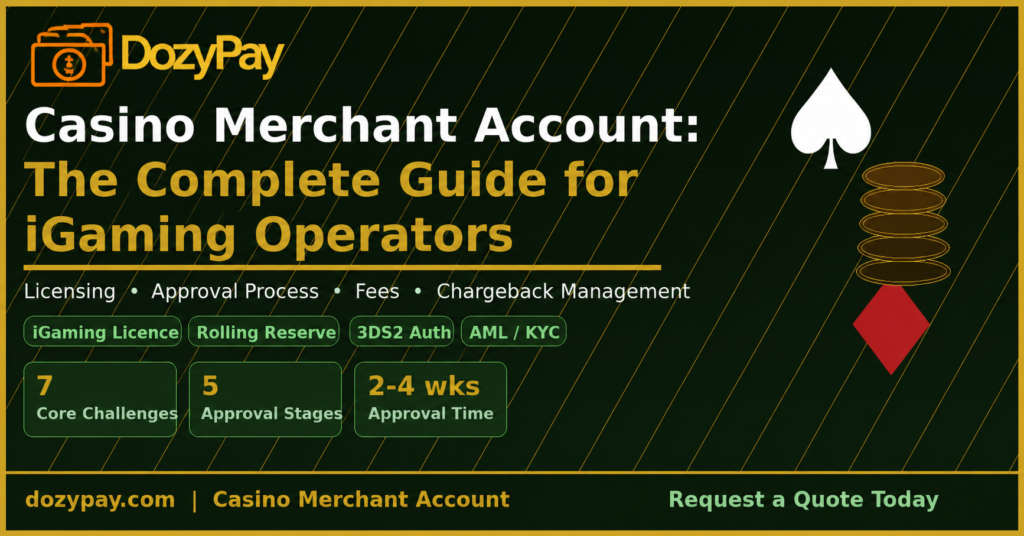
To explore DozyPay’s casino merchant account options for your business, visit: https://dozypay.com/casino-merchant-account
For a complete overview of the features to look for in any casino merchant account, see: casino merchant account features explained
Frequently Asked Questions
Can I use Stripe or PayPal for my online casino?
No. Stripe, PayPal, Square, and virtually all standard payment processors explicitly prohibit gambling, casino, and real-money gaming transactions in their terms of service. Additionally, these platforms have automated monitoring systems that detect gaming transaction patterns and terminate accounts without prior notice. Therefore, no online casino or sports betting operator should attempt to process player payments through these platforms.
How long does it take to get a casino merchant account approved?
Approval timelines vary depending on your jurisdiction, licence status, documentation completeness, and the specific processor you apply with. However, operators who submit complete documentation packages typically receive underwriting decisions within 5 to 15 business days. Consequently, operators who are preparing to launch should begin their casino merchant account application at least 6 to 8 weeks before their intended go-live date to accommodate underwriting, integration, and testing time.
What is a rolling reserve and how does it affect my cash flow?
A rolling reserve is a percentage of your gross processing volume that your acquiring bank holds in reserve as a buffer against potential chargebacks and fraud losses. Typically, casino merchant accounts hold 5 to 10% of monthly processing volume for 90 to 180 days before releasing it. Therefore, a business processing USD 500,000 per month at a 7% reserve rate will have approximately USD 35,000 per month held, with funds releasing on a rolling 180-day cycle. Planning your working capital requirements around this reserve structure is essential for cash flow management.
Does a casino merchant account for small business have lower processing limits?
Yes — new and small operators typically start with monthly processing caps set by the acquiring bank as a risk management measure. However, these caps are raised systematically as you build a positive processing history. Moreover, working with a broker or specialist processor who can advocate on your behalf with the acquiring bank typically accelerates the cap increase timeline compared to a direct application.
Is casino merchant account multiple currencies support available for all operators?
Multi-currency support depends on your acquiring bank and the jurisdictions your gaming licence covers. However, most full-service casino merchant account providers support at least 20 to 30 currencies, with premium-tier processors supporting 40 to 50 or more. Additionally, for markets where local card acquiring is available — such as EUR in the EU, GBP in the UK, or SEK in Scandinavia — local acquiring eliminates cross-border processing fees entirely, which meaningfully reduces your effective processing cost at scale.
What happens if my casino merchant account gets terminated?
Account termination is a serious operational event for any gaming operator. In addition to the immediate loss of payment processing capability, terminated accounts are sometimes reported to industry databases — such as MATCH (Member Alert to Control High-Risk Merchants) — which can make future account applications more difficult. Therefore, maintaining chargeback ratios below threshold, complying with all acquirer policies, and working with your processor proactively when issues arise is the most effective way to protect your processing continuity.
Related Reading from DozyPay
For further depth on connected topics in your casino merchant account strategy:
- Payment gateway vs merchant account — what online casinos need to understand
- Casino merchant account complete guide
- How to accept credit cards on a social gaming website?
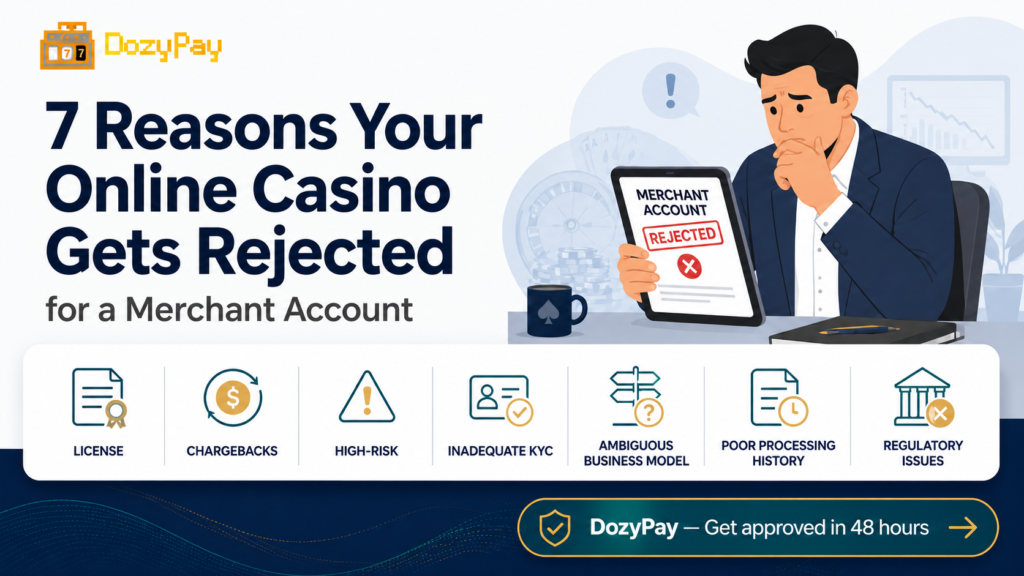
- Online casino merchant account rejected — what to do next?
- Casino merchant account features your processing setup must include
Conclusion: Stop Using the Wrong Account — Start Processing Like a Gaming Business
The comparison between a casino merchant account and a standard merchant account is not really a choice between two options. For any iGaming operator processing real-money transactions — regardless of size, stage, or jurisdiction — a dedicated casino merchant account is the only viable structure. The alternative is not a cheaper option; it is a ticking clock before termination.
Moreover, the right casino merchant account delivers far more than basic payment processing. It provides multi-currency reach, chargeback management infrastructure, fraud protection tools, and the regulatory compliance framework that your iGaming business needs to operate sustainably. Whether you are a casino merchant account for high risk business managing six-figure monthly volumes, or a casino merchant account for small business preparing for your first player deposits, the pathway is the same: structured documentation, the right acquiring partner, and a payment setup built for your industry.
DozyPay works exclusively with iGaming operators. Consequently, every casino merchant account we facilitate is matched to your specific business profile, jurisdictional requirements, and volume expectations — with multi-currency support, transparent pricing, and dedicated onboarding from day one.
Apply for your casino merchant account at DozyPay: https://dozypay.com/casino-merchant-account