A bettor opens the app in the 88th minute, odds shifting every few seconds as the match heads into stoppage time. They tap deposit, enter their amount, and wait. If the confirmation takes four seconds instead of one, the odds have already moved — or the window to bet has closed entirely. This is the moment payment gateway uptime and latency stop being backend metrics and start being the product. For sportsbooks and betting platforms, a slow or unstable payment gateway does not just cost a transaction; it costs the bet itself.
Most operators researching how to get a gaming merchant account focus on approval odds, fees, and documentation. Those matter. But the providers that keep sportsbooks profitable during marquee events are the ones whose infrastructure holds up when 50,000 people try to deposit in the same ninety seconds. This guide breaks down what uptime and latency actually mean for a betting payment stack, why live wagering raises the stakes, and what separates a merchant account that merely gets approved from one that performs when it matters.
| Quick Answer Payment gateway uptime and latency directly control whether a bettor can complete a deposit before live odds move or a betting window closes. Even a 99.9% uptime SLA still permits close to nine hours of downtime a year, and every extra second of API latency during a live event increases abandoned deposits and delayed cash-outs. When evaluating the best payment gateway for online gaming business needs, operators should weigh documented uptime SLAs and real-world latency benchmarks as heavily as approval speed or pricing. |
What “Uptime” and “Latency” Actually Mean for a Betting Payment Stack?
Uptime measures how often a payment gateway is available and responding within its committed service levels. It is usually expressed as a percentage over a rolling period — 99.9%, 99.99%, and so on. Latency measures how long a single request takes to complete: the time between a player tapping “deposit” and the gateway returning a confirmed or declined response. For a sportsbook, both numbers translate directly into revenue, because a deposit that arrives too late is functionally the same as a deposit that never arrived.
The gap between uptime tiers looks small on paper but is significant in practice. Here is what each SLA tier actually permits in annual downtime:
| Uptime SLA | Downtime / Year | Downtime / Month |
| 99.9% | ~8 hours 46 minutes | ~43 minutes |
| 99.95% | ~4 hours 23 minutes | ~21 minutes |
| 99.99% | ~52 minutes | ~4 minutes 23 seconds |
| 99.999% | ~5 minutes | ~26 seconds |
On a normal Tuesday afternoon, 43 minutes of downtime in a month might pass unnoticed. During a World Cup final, an IPL playoff, or a heavyweight title fight, that same 43-minute window landing at the wrong moment can wipe out a night’s worth of deposit revenue and send bettors straight to a competitor’s app.
Why Live and In-Play Betting Raises the Stakes?
Pre-match betting gives a payment gateway some breathing room — a player who deposits an hour before kickoff barely notices a one-second delay. In-play betting removes that buffer entirely. Odds recalculate after every point, goal, card, or serve, and the deposit-to-bet window can close in seconds.
- Kickoff and full-time spikes: transaction volume can surge 5–10x in the ten minutes surrounding a major match’s start, half-time, and final whistle.
- Micro-betting windows: next-point or next-goal markets often stay open for less than 30 seconds, leaving almost no margin for a slow deposit confirmation.
- Cash-out expectations: players expect a cash-out request to settle in near real time, not queue behind a batch job.
- Concurrent peak events: a single global fixture can create simultaneous load spikes across every region a sportsbook operates in, which is why static, single-acquirer routing struggles under live-betting traffic.
This is the same dynamic covered in our breakdown of sportsbook payment infrastructure under sudden traffic surges — the difference between a platform that scales cleanly through a spike and one that buckles is almost always the underlying payment architecture, not the front-end app.
The Real Cost of Downtime During Peak Events
Downtime cost is not abstract. A mid-sized sportsbook processing meaningful monthly volume can lose thousands of dollars in direct gross gaming revenue for every hour its deposit flow is degraded during a peak event — before accounting for player churn, refund handling, and support load. The damage compounds in a few predictable ways:
- Abandoned deposits: players who see a spinner or an error during a live match rarely retry — they close the app.
- Delayed payouts: a slow or failed cash-out during a live event is one of the fastest ways to trigger a support ticket, a public complaint, or a chargeback.
- Competitive churn: bettors in most markets have two or three sportsbook apps installed; a failed deposit during a big match is often the moment they switch allegiance.
- Reputational spillover: outages during high-visibility fixtures get noticed and shared, which is disproportionately damaging compared to an outage on a quiet weekday.
This is why uptime should be treated as a revenue-protection metric during contract negotiations, not a line item buried in a service agreement.
Latency: The Silent Killer of In-Play Conversions
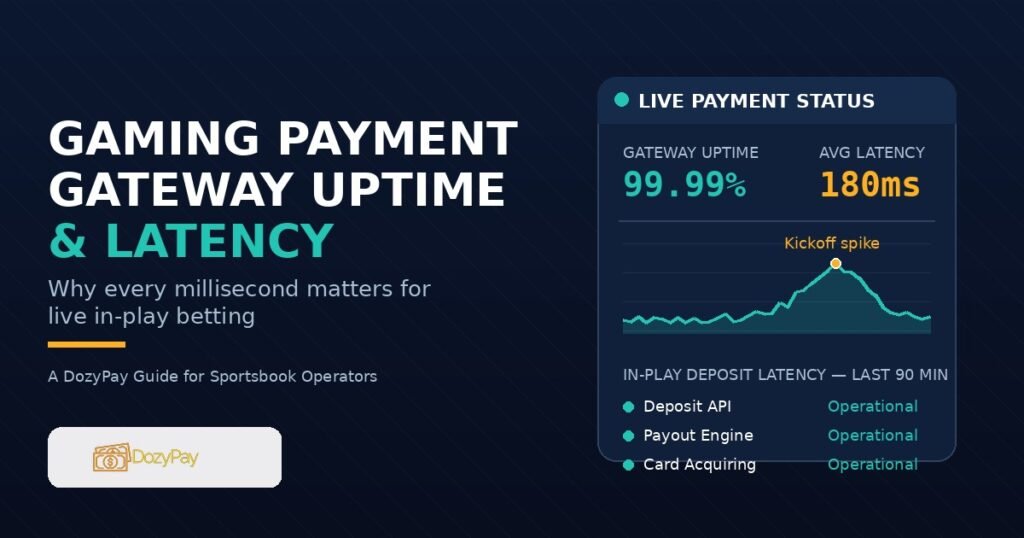
Uptime failures are visible — an outage is an outage. Latency problems are quieter but just as costly, because a gateway can report healthy uptime while still feeling sluggish to every player mid-match. Industry benchmarks generally treat end-to-end checkout response under roughly 300 milliseconds as the threshold between a deposit that feels instant and one that feels broken.
Common sources of latency in a gaming payment stack include:
- Static routing: sending every transaction through a single acquirer regardless of card type, geography, or issuer, instead of dynamically routing to the fastest available path.
- Regional distance: a server region mismatched to the player’s location adds round-trip “handshake” delay before the request even reaches the card network.
- Heavy synchronous processing: performing fraud checks, 3D Secure steps, and ledger writes sequentially instead of in parallel or asynchronously.
- Unoptimized connection handling: opening a fresh connection for every API call instead of reusing pooled connections.
For an online gaming business, shaving even 200–300 milliseconds off average deposit latency has a measurable effect on completed-bet rates during live windows — which is exactly why latency benchmarks deserve the same scrutiny as approval turnaround time when comparing providers.
How to Get a Gaming Merchant Account Built for Reliability, Not Just Approval?
Most guides on how to get a gaming merchant account focus almost entirely on getting approved: business documentation, licensing proof, processing history, and projected volume. Those steps are necessary, but approval is only the starting line. A merchant account that clears underwriting quickly but sits on thin, single-acquirer infrastructure will still struggle the first time a marquee fixture drives a traffic spike.
When preparing your application and comparing providers, ask specifically about:
- Documented uptime SLA — not a marketing claim, but a contractual number with defined penalties or credits.
- Multi-acquirer redundancy — whether transactions automatically fail over to a backup processor if the primary route degrades.
- Published or shareable latency benchmarks — average and peak response times, ideally under real load.
- A live status page or real-time monitoring dashboard your team can check independently.
- Settlement speed, separate from authorization speed — how quickly approved funds actually reach your operating account.
A gaming merchant account that is fast to approve but slow to perform under load is a short-term win and a long-term liability.
What Makes the Best Payment Gateway for Online Gaming Business Needs?
There is no single “best” payment gateway for every operator, but the strongest options for an online gaming business consistently share the same infrastructure traits:
- Smart, multi-route transaction routing that selects the fastest healthy path in real time rather than relying on one fixed acquirer.
- Regional or edge-based processing so deposit requests don’t travel further than necessary.
- Dedicated high-risk underwriting experience with gaming, casino, and sports betting merchants specifically — not high-risk categories in general.
- Broad local payment method coverage, since payment-method mismatch is itself a latency and conversion problem.
- Instant or near-instant settlement options that keep operating capital available for payouts during high-volume weekends.
- Transparent incident history and communication during outages, rather than silence.
Evaluate any shortlisted provider against this list before signing, and ask for real numbers — uptime percentage over the trailing 12 months and average/peak latency figures — rather than accepting general assurances.
Is “Online Gaming Merchant Account Instant Approval” Realistic?
Searches for online gaming merchant account instant approval are common, and fast approval is achievable — often within 24 to 72 hours — when an operator arrives with clean documentation: business registration, gaming or betting licensing, processing history, chargeback ratios, and a clear description of the product. What is not realistic is treating approval speed as a proxy for infrastructure quality.
A provider promising instant approval with no visibility into uptime history, routing architecture, or settlement timelines is optimizing for a fast sale, not a stable partnership. Instant approval and reliable performance are not mutually exclusive — but they need to be evaluated as two separate questions, not one.
Architecture Choices That Keep Sportsbooks Online During Traffic Spikes
The operators who avoid payment outages during major events tend to make the same architectural choices well ahead of time:
- Multi-acquirer orchestration with automatic failover, so a single acquirer outage doesn’t take the entire deposit flow offline.
- Asynchronous, webhook-based confirmation for non-blocking steps, so the checkout UI isn’t waiting on every downstream process to finish sequentially.
- Load and spike testing ahead of known high-traffic fixtures — World Cup matches, continental finals, marquee boxing or UFC cards — rather than discovering capacity limits live.
- Connection pooling and caching to cut repeated handshake overhead on high-frequency deposit traffic.
These are the same principles we cover in more depth in our guide to handling high-volume, high-risk transaction surges, which walks through how sportsbook payment processing needs to be architected differently from standard e-commerce checkout.
For a closer look at how deposit and payout volume behaves in the minutes around kickoff, see our analysis of managing peak-load transaction spikes around kickoff, which breaks down real traffic patterns operators should plan capacity around.
DozyPay’s Approach to Uptime and Latency for Gaming Operators
DozyPay works with sportsbooks, online casinos, and social gaming platforms that cannot afford a payment gateway that slows down exactly when traffic peaks. That means multi-acquirer routing built for high-risk gaming volume, real-time monitoring so operators aren’t the last to know about a degraded route, and settlement options designed around the cash-flow reality of a business that pays out winners as fast as it takes deposits. If you are comparing providers for a new gaming merchant account or evaluating whether your current payment gateway can hold up through the next major event, DozyPay’s team can walk through uptime history and latency benchmarks directly.
Frequently Asked Questions
What uptime should a sportsbook payment gateway guarantee?
Look for a documented SLA of at least 99.9%, with 99.99% preferred for operators running significant in-play betting volume. Ask what happens contractually when the SLA is missed, not just what the target number is.
How does latency affect in-play betting conversions?
Higher latency means more time between a player initiating a deposit and receiving confirmation. During in-play betting, where odds and betting windows can change within seconds, added latency directly increases abandoned deposits and missed cash-outs.
How do I get a gaming merchant account with reliable uptime?
Prepare clean documentation for fast underwriting, but evaluate providers on multi-acquirer redundancy, published uptime history, and real settlement speed — not approval speed alone.
What is the best payment gateway for an online gaming business during peak traffic?
The strongest options combine smart transaction routing, regional processing infrastructure, dedicated gaming underwriting experience, and instant or near-instant settlement — verified with real uptime and latency data, not marketing claims.
Is online gaming merchant account instant approval realistic?
Fast approval within 24–72 hours is achievable with complete documentation, but instant approval says nothing about a provider’s infrastructure. Evaluate approval speed and payment performance as separate, equally important criteria.