Introduction
The final whistle blows. A last-minute goal. A buzzer-beater. A penalty shootout that nobody predicted.
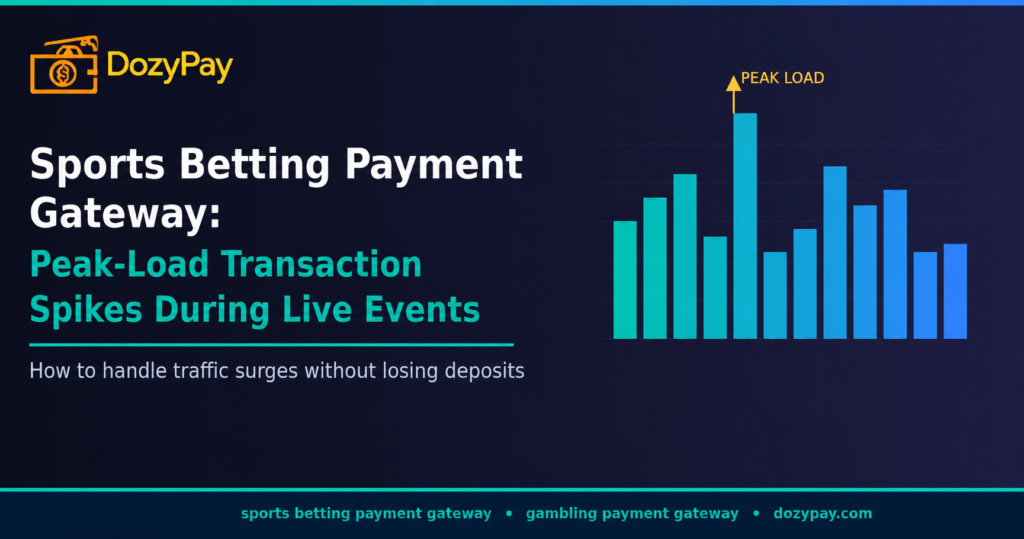
In those seconds, thousands of bettors across your platform do the same thing simultaneously: they rush to place a bet or top up their balance. Your sports betting payment gateway is suddenly handling 10x, 20x, even 50x its baseline transaction volume — in under 60 seconds.
For operators who are not prepared, this is where revenue disappears. Failed transactions. Frozen deposit screens. Timed-out payment sessions. Players who tried to fund their account and could not — and who do not come back.
This guide is specifically for sportsbook operators and igaming platform managers who want to understand the architecture, provider requirements, and tactical steps needed to make sure their sports betting payment gateway provider does not buckle when the crowd surges.
Why Live Events Create Payment Infrastructure Crises?
Most payment infrastructure — including many payment gateways for sports betting services — is sized for average load, not peak load. During regular betting windows, a platform might process 50–200 transactions per minute. During a live event betting window, that same platform could receive 3,000–10,000 transaction requests per minute.
The result is a cascade of failures that most operators only discover when it is already too late:
- Gateway timeout errors: The payment processor cannot respond fast enough and returns a generic error to the player.
- Duplicate transaction risk: Players re-submit payment thinking it failed; the gateway processes it twice.
- Queue overflow rejections: Transactions are dropped rather than queued, resulting in invisible failures.
- Bank-side false declines: High-velocity transactions from one merchant ID trigger fraud detection at the issuing bank.
- Session expiry during processing: The player’s authenticated session times out while the payment is in-flight.
| Industry data point: Research across igaming platforms consistently shows that 35–60% of deposit abandonment during live events is attributable to payment processing failures — not lack of player intent. These are not lost bets. They are lost deposits from players who actively wanted to fund their account. |
The 7 Infrastructure Requirements for Peak-Load Payment Handling
If you are evaluating payment gateways for sportsbook operators or reviewing your current setup, these are the non-negotiable capabilities that separate platforms built for live event traffic from those that are not.
1. Horizontal Auto-Scaling Processing Capacity
Your gateway’s backend processing capacity must automatically scale when transaction volume exceeds thresholds — not after a manual intervention from a support team. Look for providers who offer:
- Auto-scaling transaction processing that activates within seconds of load detection
- Documented TPS (transactions per second) ceilings with verified burst capacity
- Separate processing lanes for deposit and withdrawal requests
- Clear SLA guarantees for uptime and response times during high-load periods
2. Intelligent Queue Management
Not all transactions can be processed instantly at peak load. The right architecture handles overflow through smart queuing rather than rejection:
- First-in-first-out transaction queuing with user-facing status visibility
- Queue depth monitoring with automatic alerts before overflow
- Graceful degradation — players are told their transaction is queued, not that it failed
- Automatic retry logic that prevents duplicate processing from impatient re-submissions
3. Multi-Acquirer Routing
A single acquirer relationship is a single point of failure. The most resilient sports betting payment gateway configurations use intelligent routing across multiple acquiring banks, so that if one bank’s processing lane saturates, transactions are automatically redirected:
- Primary and secondary acquirer relationships for each payment method
- Real-time acquirer health monitoring with automatic failover
- Load balancing across acquirers based on current acceptance rates
- Geographic routing — European players routed to EU acquirers, reducing cross-border latency
4. Predictive Pre-Authentication
Modern sportsbook payment systems can pre-authenticate player deposit methods before the event begins — so that at peak moment, the authentication step is already complete and only the final authorisation is required. This alone can reduce transaction processing time by 40–60%.
5. Real-Time Fraud Scoring That Scales
Traditional fraud scoring models break under peak load because they are computationally expensive. A purpose-built sports betting payment gateway provider uses lightweight, pre-trained fraud models that can score thousands of transactions per second without adding processing latency:
- Velocity checks calibrated for live event betting patterns — not generic e-commerce thresholds
- Player risk scoring that pre-clears known good players at the session level
- Anomaly detection tuned to distinguish legitimate volume spikes from actual fraud
6. Multi-Currency Processing Without Conversion Latency
For operators serving international markets, a multi-currency payment gateway for online games and sports betting must handle currency conversion at scale without that conversion becoming a bottleneck. Key requirements:
- Pre-loaded exchange rates refreshed at fixed intervals rather than real-time API calls per transaction
- Local currency settlement to reduce conversion steps in the processing chain
- Batch currency reconciliation rather than per-transaction conversion during peak windows
7. Instant Deposit Confirmation UX
Even technically successful transactions can feel like failures if the player’s UI does not update immediately. Your online casino payment gateway integration must include:
- Webhook-based real-time confirmation to your platform — not polling
- Sub-2-second balance update after successful deposit authorisation
- Clear payment status messaging: pending, confirmed, failed — with reasons where applicable
- Push notification capability for mobile players whose app may be backgrounded
How to Audit Your Current Setup Before the Next Big Event?
Before you call your sports betting payment gateway provider with demands, run this audit first. Understanding your current constraints helps you ask the right questions and prioritise the right fixes.
| Audit Area | Test Method | Red Flag |
| Gateway TPS ceiling | Request documented burst capacity from provider | No SLA on burst capacity |
| Failover configuration | Ask: what happens if your primary acquirer goes down? | No secondary acquirer on file |
| Queue behaviour at overflow | Load test at 5x baseline TPS | Transactions rejected not queued |
| Fraud model calibration | Review decline rates during past live events | Decline spike > 15% at peak |
| Balance update latency | Time deposit to balance credit | More than 3 seconds post-auth |
| Multi-currency handling | Test EUR/GBP/USD deposits simultaneously | Conversion errors or delays |
| Session handling under load | Test payment completion time vs. session timeout window | Session expires before payment completes |
If more than two of these checks produce red flags, your current setup carries material risk of significant revenue loss at your next major live event.
The True Cost of Getting This Wrong: A Revenue Calculation
Operators frequently underestimate peak-load failure costs because they see failed transactions rather than lost revenue. Let us model a realistic scenario:
| Scenario Variable | Example Value |
| Platform size | 25,000 active bettors |
| % attempting deposit during live event window | 18% (4,500 players) |
| Average deposit attempt value | $85 |
| Total deposit volume at risk | $382,500 |
| Payment failure rate under peak load | 22% (industry observed average) |
| Deposits lost in failed transactions | $84,150 |
| % of failed-deposit players who churn | 38% |
| LTV loss from churned players (at $240 LTV) | $385,560 |
| Total event cost: A single major live event with undertested payment infrastructure can cost a mid-size sportsbook $470,000+ in combined immediate lost deposits and long-term player churn. This is not a technology expense. It is a business continuity risk. |
How to Get a Gaming Merchant Account That Is Built for This?
Most operators ask how to get a gaming merchant account and focus exclusively on approval — getting any account. The more important question is: does this account have the processing architecture to handle my actual traffic patterns?
Here is what to specifically ask providers during the evaluation process:
- What is your documented TPS ceiling and burst TPS capacity? Ask for specific numbers, not vague assurances about ‘scalable infrastructure’.
- How do you handle queue overflow? You need to know whether transactions are rejected or held — the difference is enormous for player experience.
- How many acquiring relationships do you have? A single acquirer is a single point of failure. You need at least primary and secondary routing.
- What is your fraud model’s performance profile at 10x baseline volume? False declines spike under load in unsophisticated systems.
- What is the average authorisation response time under peak load? This directly determines your balance-update latency.
- Do you support multi-currency settlement? Critical for international sportsbooks. A multi-currency payment gateway for online games and betting eliminates conversion as a bottleneck.
- What SLA do you offer for live event transaction processing? Any provider serious about this space should have a documented live event SLA.
Casino Payment Solutions vs. Sportsbook Payment Needs: Key Differences
Many operators assume their casino payment solutions will handle sportsbook traffic without modification. This is a common and expensive mistake.
| Payment Dimension | Casino (Slots/Tables) | Sportsbook (Live Betting) |
| Traffic pattern | Steady, distributed across sessions | Extreme spikes at event start/goal/whistle |
| Transaction size | Varies; often smaller micro-deposits | Larger lump deposits pre-event |
| Timing sensitivity | Low — players deposit when ready | Critical — missed window = lost bet |
| Fraud velocity pattern | Gradual; pattern-based | Rapid; volume spike masks fraud |
| Multi-currency demand | Moderate | High — international sports audiences |
| UX expectations | Flexible — player not time-pressured | Zero tolerance for delay |
The architectural differences mean that payment gateways for sportsbook operators need specific calibration even when built on the same underlying platform as casino processing.
The Low-Fee Question: Can You Get Robust Sportsbook Processing Without Premium Rates?
Cost is a legitimate concern, especially for growth-stage operators. The search for a low fee gambling payment gateway that also handles peak load is achievable — but it requires knowing where to look and what to trade off.
The three-tier model of sportsbook payment pricing:
- Tier 1 (premium): Full peak-load SLA, multi-acquirer failover, dedicated support during events. Rates: 3.5–5.5% + fixed fee. Best for high-volume established platforms.
- Tier 2 (optimised): Multi-acquirer routing, reasonable burst capacity, standard SLA. Rates: 2.5–3.5%. Best for mid-size operators with predictable event calendars.
- Tier 3 (entry): Single acquirer, no peak-load SLA, standard processing. Rates: 1.8–2.5%. Acceptable for low-traffic platforms; high risk during major events.
For most growing sportsbooks, Tier 2 represents the optimal cost-capability balance. DozyPay’s gambling payment gateway for sportsbooks is designed to deliver Tier 2 capability at competitive rates — with options to scale to Tier 1 protection for specific high-value events.
Step-by-Step: How to Prepare Your Payment Stack for a Major Live Event
Practical preparation protocol for sportsbook operators — 7 days out:
7 Days Before the Event
- Notify your payment gateway provider of the event date, expected volume uplift, and any unusual geographic traffic patterns
- Review and expand your transaction velocity limits for the event window — both platform-side and acquirer-side
- Confirm failover routing is active and tested
- Run a load simulation at 3x and 5x baseline if your provider supports it
48 Hours Before
- Enable pre-authentication for logged-in players’ saved payment methods
- Confirm fraud model thresholds have been adjusted for high-velocity legitimate traffic
- Test balance update webhook latency end-to-end
- Brief your customer support team on payment failure messaging protocols
Event Day
- Switch to live monitoring dashboard for real-time transaction acceptance rates
- Set automated alerts for acceptance rate drops below 90%
- Have your gateway provider’s live support contact on standby — not just a ticket system
- Monitor duplicate transaction rates — a spike here indicates players re-submitting failed payments
Post-Event
- Pull transaction log report: acceptance rate, average processing time, failure reasons
- Identify the peak 5-minute window and review what happened in the queue
- Recover failed-deposit players with retargeting — many will be winnable with proactive outreach
- Feed findings back to your provider for infrastructure calibration before the next event
Why DozyPay for Sportsbook Payment Gateway Infrastructure?
DozyPay is purpose-built for high-risk, high-volume gaming payment processing. Whether you are setting up a new sportsbook or reviewing your existing online casino payment gateway integration, our infrastructure addresses each of the challenges covered in this guide:
- Multi-acquirer routing with automatic failover — no single points of payment failure
- Multi-currency payment gateway for online games and sports betting — seamless international deposit processing
- Peak-load burst capacity with documented TPS SLA for live events
- Intelligent fraud scoring calibrated for sportsbook velocity patterns
- Sub-2-second balance credit confirmation via real-time webhooks
- Transparent, competitive rates — a genuine low fee gambling payment gateway without sacrificing resilience
- Support for operators asking how to get a gaming merchant account — from application through integration through go-live
- Dedicated account management including live event support for payment gateways for sportsbook operators on major event days
| Talk to DozyPay: If your sportsbook’s last big event cost you deposits you should have kept, let’s have an honest conversation about your infrastructure. Visit dozypay.com/gambling-payment-gateway-online/ or contact our team directly. |
Related DozyPay Resources
- How to Get a Low-Fee Gambling Payment Gateway?—
- 9 Things to Check Before Choosing a Gambling Payment Gateway
- Top 8 Features of an Online Casino Payment Gateway
- 6 Reasons Your Casino Payment Gateway Is Killing Player Retention
Frequently Asked Questions
Q1. What is a sports betting payment gateway?
A sports betting payment gateway is a payment processing system specifically configured for sportsbook operators — handling the high-velocity, time-sensitive transaction patterns of live betting markets, with built-in compliance for the gambling industry’s KYC and AML requirements.
Q2. How many transactions per second should a sportsbook payment gateway handle?
For mid-size operators (10,000–50,000 active bettors), a gateway should comfortably handle 500–2,000 TPS at baseline with burst capacity of 5,000–15,000 TPS during live event windows. Larger platforms require dedicated discussions with providers about custom TPS ceilings.
Q3. Will my casino payment gateway work for sports betting too?
Often partially, but rarely optimally. Casino and sportsbook traffic patterns differ significantly — sportsbooks require sharper peak-load burst capacity and lower latency on balance confirmations. Review the comparison table in Section 6, or talk to your casino payment solutions provider about sportsbook-specific configuration.
Q4. How do I reduce false declines during live events?
Ask your provider to calibrate fraud velocity thresholds specifically for live event windows. Pre-authenticated players should be pre-cleared for faster processing. Ensure your acquirer is informed of expected volume uplifts in advance to prevent issuer-side fraud triggers.
Q5. Is it possible to get a low-fee gambling payment gateway that also handles peak load?
Yes, with the right provider. DozyPay offers low fee gambling payment gateway solutions designed for igaming operators that include multi-acquirer routing and documented burst capacity — not just baseline processing at discount rates.
Q6. How do I get a gaming merchant account if I am a new sportsbook operator?
The process of how to get a gaming merchant account involves demonstrating your licensing credentials, providing business documentation, and working with a provider experienced in gambling merchant underwriting. DozyPay specialises in gaming merchant account applications — including new operator setups. Contact us through dozypay.com/gambling-payment-gateway-online/ to begin.
Q7. What multi-currency options do sportsbooks need?
At minimum, a multi-currency payment gateway for online games and sports betting should support USD, EUR, GBP, CAD, AUD, and at least two emerging market currencies relevant to your target geography. Crypto support — BTC, ETH, and USDT — is increasingly standard for international operators.