| Quick answer An esports betting payment gateway needs five things before launch. You need a gambling licence for each target market, a merchant account approved for gambling, identity and age checks before the first deposit, infrastructure that survives tournament traffic, and a plan for payouts and chargebacks. Miss one, and acquirers may decline or freeze your account. |
Esports finals can compress heavy demand into a single evening. Deposits arrive in waves. Markets change map by map. Meanwhile, the payment stack has to approve cards, check ages and flag risk in seconds.
Too often, operators build the betting product first and the payment layer last. That order causes most launch delays. Your esports betting payment gateway touches licensing, underwriting, compliance and uptime all at once. Therefore, it deserves a place on the roadmap from day one.
This guide explains what operators need before launch. Along the way, it covers licences, card network rules, underwriting, KYC, traffic spikes and payouts. It also explains where social gaming fits in.
Why Esports Betting Is Different From Traditional Sports Betting?
On paper, esports betting looks like any other live-event wagering. The UK Gambling Commission treats it that way. Betting on human-played matches needs a Remote General Betting (Real Events) licence. Simulated matches fall under a Remote Casino licence.
Still, three traits make esports riskier for payment partners. First, the audience skews young. Second, fixtures run around the clock across many time zones. Third, in-game items blur the line between gaming and gambling.
A 2025 UK government rapid evidence review found that skins gambling is closely tied to esports titles such as Counter-Strike and Dota 2. Its audit of 20 skins gambling sites also found that none checked age at the point of use. As a result, expect underwriters to ask hard questions about how a new esports operator verifies age.
Step 1: Secure the Right Licence for Each Market
No acquirer will approve an unlicensed betting business in a regulated market. Start with your target markets. Then match each one to a regulator.
In Great Britain, any operator serving customers needs a UK Gambling Commission licence, wherever its servers sit. By contrast, Curaçao runs a newer regime. Its National Ordinance for Games of Chance, known as the LOK, is supervised by the Curaçao Gaming Authority. The framework adds a mandatory player dispute portal and tighter anti-money laundering rules.
Furthermore, rules differ sharply by country. In the US, for example, an iGB advertising feature from November 2025 noted that 19 states have no specific esports betting legislation. Therefore, document the legal basis for every market you open, and geo-block the rest. In short, treat licensing as the first gate for your esports betting payment gateway.
How Card Networks Treat an Esports Betting Payment Gateway?
Card networks group betting under merchant category code 7995. Likewise, Visa and Mastercard treat gambling as a restricted category. It needs explicit acquirer approval and dedicated merchant IDs. Many issuing banks also apply blanket declines to this MCC by default, so approval rates can start low.
Visa adds another layer. Its Integrity Risk Program places gambling (MCC 7995) in Tier 1 of its high integrity risk list. Consequently, your acquirer must register you and run extra controls. Strong 3D Secure helps on both fronts, and many jurisdictions require it.
Not every esports product lands in the same bucket. The table below shows how common models are usually treated.
| Product model | Likely classification | What to expect? |
| Real-money esports match betting | MCC 7995, Visa Tier 1 | Gambling licence, KYC, acquirer approval, dedicated merchant ID |
| Virtual or simulated esports betting | MCC 7995, casino-style licence in the UK | Same controls as casino products |
| Paid skill tournaments (card-absent) | May fall under MCC 5816 (Visa Tier 2) or gambling | Depends on market and prize design; acquirer reviews the structure |
| Free-to-play fantasy esports with virtual coins | Social gaming | Different underwriting; no cash-out of prizes |
Because classification depends on your jurisdiction and prize design, ask your acquirer to confirm it in writing.
Esports Betting Merchant Account: What Underwriters Ask For
An esports betting merchant account is a gambling merchant account. Underwriters review it the same way they review a casino file. If you have read about casino merchant account approval, the checklist will look familiar.
First, expect to provide these items:
- Valid gambling licences, or proof of a pending application.
- Corporate documents and full ownership disclosure, including ultimate beneficial owners.
- Written AML, KYC and responsible gambling policies.
- Projected monthly volume, average deposit and expected chargeback rate.
- Clear terms covering withdrawals, bonuses, voided bets and disputes.
- Bank statements and processing history, where available.
Gaps in this list cause most rejections, so close them early. For example, vague terms around voided bets or abandoned matches invite disputes. In addition, a site without deposit limits or self-exclusion tools raises regulatory flags. Fix these gaps before you apply. The casino merchant account approval page covers the same underwriting steps in more detail.
Because this is high-risk payment processing, you may also see reserves, volume caps and closer monitoring in the first months. Plan your cash flow around them.
Build KYC, Age Checks and Responsible Gambling Into the Payment Flow
Compliance is not a separate layer. It sits inside the payment flow. In Great Britain, operators must verify a customer’s name, address and date of birth before the customer can deposit or gamble. Since February 2025, light-touch financial vulnerability checks also apply once net deposits pass £150 in a rolling 30 days.
Moreover, esports audiences make this more urgent. The UK review cites a 2019 survey in which 14% of 11–14-year-olds had bet skins in the past week. Among 22–24-year-olds, the figure was 7%. Age assurance is therefore a core part of KYC for esports betting, not an optional extra.
As a result, build four controls into checkout:
- Identity and age verification before the first deposit.
- Player-set deposit limits that the gateway enforces.
- Self-exclusion that blocks payments across the account.
- Triggers that flag unusual deposit patterns for review.
Design Your Payment Stack for Tournament Traffic
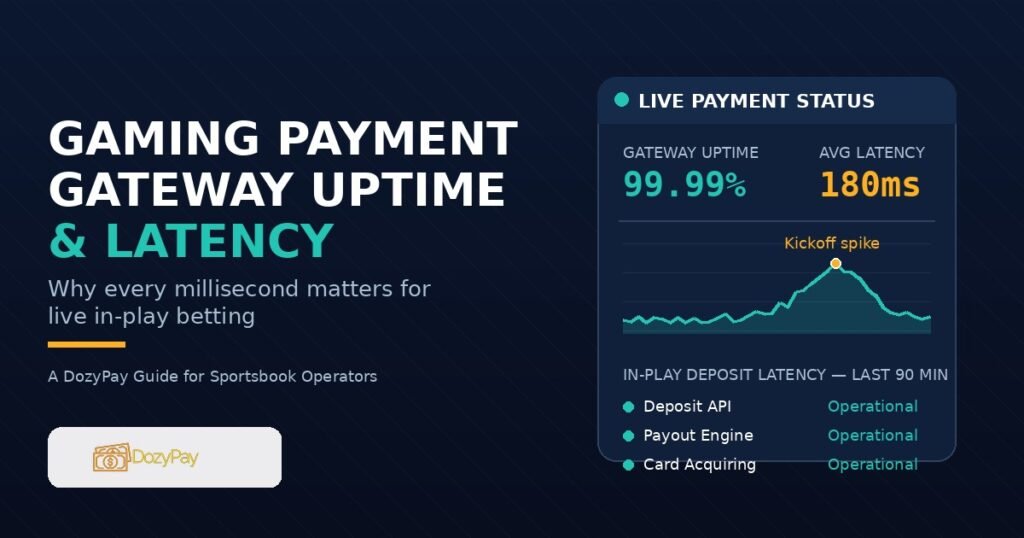
Esports demand is also spiky. A major final can send deposits surging within minutes, and live markets close fast. A slow gateway does not just lose sales. It loses bets at the exact moment players want to place them. For a deeper look, read our guide to payment gateway uptime and latency for live betting.
Next, plan your esports betting payment gateway for peaks long before the first big event. Load test the deposit flow. Then add a backup processor. Keep 3D Secure friction low for returning, verified players. Moreover, separate your deposit and payout queues so one cannot block the other.
Retries are also a common trap. If a player taps “deposit” twice, a naive system may charge twice. An idempotency key prevents this. The sketch below is a generic example, not any provider’s API.
// Illustrative only. Not a specific provider’s API.
async function createDeposit(player, amountMinor, currency, key) {
if (!player.kycVerified || player.selfExcluded || player.depositLimitReached) {
throw new Error(“Deposit blocked by compliance rules”);
}
return fetch(“/api/deposits”, {
method: “POST”,
headers: { “Idempotency-Key”: key, “Content-Type”: “application/json” },
body: JSON.stringify({ playerId: player.id, amount: amountMinor, currency })
});
}
// Create the key once per player action, then reuse it on every retry.
const key = crypto.randomUUID();
Plan Payouts, Chargebacks and Reserves Before Day One
Deposits are the easy half. However, withdrawals create most disputes. Pay winners back to the original method where rules allow, and verify identity before the first payout. In short, esports betting payment processing is only as strong as its cash-out flow.
Chargebacks also run high in gambling. PXP notes that buyer’s remorse and disputed losses push them up. Keep an evidence pack ready for every dispute. It should include KYC records, bet history, session logs and the terms the player accepted.
Finally, avoid a single point of failure. An operator that relies on one processor can face a freeze at the worst moment. A second processor on standby protects live events and your player experience.
When Esports Is Not Betting: Social Gaming and Fantasy Models?
However, not every esports product is a wagering product. Fantasy leagues, prediction games with virtual coins and free-to-play tournaments can sit outside gambling rules. These models often need a social gaming merchant account provider rather than a gambling acquirer. Our comparison of social gaming vs real-money gambling merchant accounts explains the underwriting differences.
However, the line moves quickly. If players can cash out prizes, regulators and card networks may treat the product as gambling. Therefore, confirm the classification before launch. The social gaming merchant account overview shows how that route works.
Esports Betting Payment Gateway Pre-Launch Checklist
Use this table as a final gate before go-live.
| Area | Confirm before launch |
| Licensing | A licence or documented legal basis for every market, plus geo-blocking for the rest |
| Acquirer | Written approval for MCC 7995 and a dedicated merchant ID |
| Underwriting file | Ownership, AML, KYC and responsible gambling policies, plus volume and chargeback forecasts |
| Player checks | Age and identity verification before the first deposit |
| Responsible gambling | Deposit limits, self-exclusion and cool-off tools |
| Infrastructure | Load testing for finals, tuned 3D Secure and a backup processor |
| Payouts | Verified withdrawal flow, with refunds to the original method where allowed |
| Disputes | An evidence pack and clear terms for voided bets |
| Classification | Written confirmation for any skill, fantasy or social products |
Frequently Asked Questions
What is an esports betting payment gateway?
It is the technology that lets players deposit and withdraw money on an esports betting platform. The gateway connects your site to acquirers and card networks. It also enforces checks such as KYC, age verification and deposit limits.
Do I need a gambling licence to accept payments?
In regulated markets, yes. Acquirers generally ask for a valid licence or proof of a pending application. Operating without one in a market that requires it usually leads to a declined or closed account.
Which merchant category code applies to esports betting?
Real-money betting is normally coded under MCC 7995. Skill-based or social models may be coded differently. Your acquirer decides the final classification, so ask for it in writing.
Can I use a standard payment gateway for esports betting?
Usually not. However, many mainstream processors restrict gambling. Card networks require explicit acquirer approval and a dedicated merchant ID for it, so you need a provider that supports gambling merchants.
How long does esports betting merchant account approval take?
Timelines vary by acquirer and by jurisdiction. Incomplete files are the most common cause of delay. A full underwriting pack, with licences, policies and forecasts, shortens the process.
Key Takeaways
- Start with licensing, because every payment partner will ask for it first.
- Expect MCC 7995 treatment, dedicated merchant IDs and extra card network controls.
- Build KYC, age checks and deposit limits into the payment flow itself.
- Load test your esports betting payment gateway for finals, and keep a backup processor ready.
- Confirm in writing how skill, fantasy and social products are classified.
Published by DozyPay, a payment provider for high-risk and gaming merchants. This article is general information, not legal advice. Disclosure: it was written with AI assistance and checked against the sources below.
Sources
- UK esports betting licensing, age checks and 2025 rule changes (Esports Legal News, Dec 2025)
- A rapid evidence review of skins gambling (UK Government, DCMS)
- Visa Integrity Risk Program overview (LegitScript)
- MCC 7995: betting, casino and gambling (PXP)
- Curaçao Gaming Authority and the LOK (Curaçao Chronicle)
- gg steps into educator role as esports betting grows (iGB advertising feature, Nov 2025)