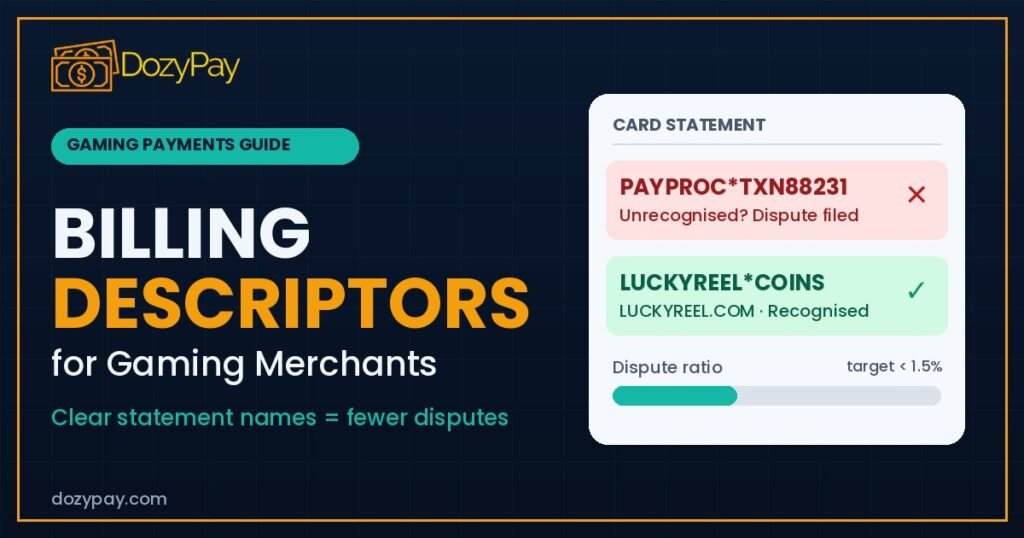
| Quick Answer: Billing descriptors for gaming merchants are the short text strings that appear on a player’s card statement. A clear descriptor uses the brand name players know, adds a support contact, and stays consistent across every site, app and currency. It cuts “I don’t recognise this charge” disputes, which helps keep your dispute ratio under card network limits. |
Picture a player who tops up their account on a Friday night. Two weeks later, the card statement shows a processor name and a string of digits. The player sees nothing familiar, so they call the bank and report fraud. You lose the deposit, pay a dispute fee, and add one more mark to your ratio.
Billing descriptors for gaming merchants decide how often this story repeats. This guide explains how descriptors work, why gaming is exposed, and how to fix yours step by step.
What is a billing descriptor, and why does it matter in gaming?
A billing descriptor is the text that identifies a merchant on a cardholder’s statement. It usually holds a business name and may add a phone number, URL or product note. The goal is simple, because it helps the cardholder recognise the charge.
Visa’s Merchant Data Standards Manual calls the merchant name the most important factor in cardholder recognition. In other words, the name on the statement does more work than any receipt or email. If the name fails, the player has little else to go on.
Gaming makes this harder, because deposits are instant, the product is digital, and the statement entry often appears days later. Therefore, a player can easily forget which site or app took the money.
How do unclear statement names turn into chargebacks?
Most players do not call support first. Instead, they call the bank. Visa no longer has a standalone “transaction not recognised” reason code. As a result, an unrecognised charge is often filed as card-absent fraud, such as Visa 10.4 or Mastercard 4837.
That label matters because fraud disputes are harder to win. They also count against you quickly. The table below shows how a weak descriptor moves through the process.
| What the player sees? | What the player thinks? | What happens next? |
| PAYPROC*TXN88231 | “I never bought this.” | Player calls the issuer, not you |
| Legal holding company name | “Who is this company?” | Dispute filed as unauthorised |
| Clear brand name plus support contact | “That is my game.” | Player contacts you or forgets it |
Visa also lists descriptor confusion as a common driver of friendly fraud. For a deeper look at how to answer these claims, read our guide to friendly fraud in iGaming.
Why are gaming and casino merchants more exposed to descriptor disputes?
Gaming merchants face several risks at once. For example, players often deposit late at night, and family members may use a saved card. Meanwhile, high-risk categories attract close attention from acquirers.
One gaming-payments provider groups the most common gaming chargeback causes into six types. Descriptor confusion sits at the top of that list, next to missing items, family fraud, buyer’s remorse, account takeover and forgotten subscriptions.
The stakes are also higher than before. Visa lowered the merchant Excessive threshold in its VAMP programme to 1.5% in most regions on 1 April 2026. We explain what this means in our guide to Visa VAMP thresholds for gaming merchants.
Meanwhile, operators holding a casino merchant account should treat the descriptor as a risk control, not a formality. A small fix here helps you reduce gaming chargebacks before disputes ever reach your acquirer.
What should billing descriptors for gaming merchants include?
A strong descriptor answers one question in two seconds: “Is this mine?” So use these rules to build one.
- Use your trading name. Chargeback specialists advise Mastercard merchants to use the well-known “doing business as” name rather than a legal or holding company name.
- Match the brand players see. The descriptor should echo the name on your site, app and receipts.
- Add a way to reach you. For card-not-present sales, Visa guidelines call for a customer service phone number, URL or email address.
- Keep it within the limit. Networks and processors differ, but 22 characters is the safest working limit.
- Stay consistent. Use the same descriptor across currencies and card types, so players see one familiar name.
The table below turns these rules into examples. The brand “LuckyReel” is fictional.
| Element | Weak example | Strong example |
| Name | ACME HOLDINGS LTD | LUCKYREEL |
| Product cue | TXN88231 | LUCKYREEL*COINS |
| Contact | (none) | LUCKYREEL.COM |
| Consistency | Different names per currency | One name for every currency |
Static or dynamic: which descriptor type fits a gaming brand?
A static descriptor shows the same text on every charge. It suits a single brand with one product. By contrast, a dynamic descriptor adds transaction-specific text, such as the product or site name.
Many processors use a fixed pattern for dynamic text. For example, one gateway asks for a business name of 3, 7 or 12 characters, then an asterisk, then a product note. The total stays at 22 characters.
Dynamic descriptors help operators who run several brands. Therefore, merchants with multiple websites or apps should make each descriptor match the name of the site where the player paid. Soft descriptors are also strict, so bad characters can cause declines. Always test any new format before you roll it out.
How should social gaming merchants write descriptors for virtual currency?
Social games sell coins, gems and chips, often through mobile apps. However, a player may forget the purchase by the time the statement arrives. A parent may also spot an unfamiliar entry and assume the worst.
One fraud-prevention guide for in-app purchases advises including the app name and type in the descriptor, not just the company name. This tip fits social casino and casual games well. For example, a title-led descriptor tells a parent exactly which game the charge belongs to.
If you are choosing a social gaming merchant account provider, ask direct questions. Can the provider set a descriptor per title or brand? Can it show a support phone number or URL? The same questions apply when you set up a virtual currency merchant account for coins and gems. You can compare options on our social gaming merchant account page.
Can a descriptor be too discreet? The compliance angle
Some operators worry that a casino-style name on a statement may embarrass players. That concern is understandable. However, a descriptor must still identify the merchant honestly. Card networks have rules against deceptive descriptors, such as those that hide the merchant’s identity.
A branded name is fine, provided it is your real trading name. A disguise is not. Clear billing descriptors for gaming merchants stay honest and still protect players’ privacy. Also, make sure your merchant category code matches your business. Real-money gaming rules vary by country, so confirm your licences before you apply for a high-risk merchant account for online gaming.
How can you audit your billing descriptor in seven steps?
Follow this plan once, then repeat it every quarter. Each step builds on the last, so work through them in order. Good gaming payment processing treats the descriptor as part of the player experience.
- See what players see. Make a small live purchase and check how the entry appears on a real statement.
- Read your dispute data. Look for clusters of Visa 10.4 and Mastercard 4837 claims, then read the cardholder statements attached to them.
- Search your own descriptor. A spike in searches that pair your descriptor with words like “scam” or “fraud” signals a problem.
- Rewrite the descriptor. Use your trading name, a product cue and a contact point within 22 characters.
- Align every touchpoint. Make the checkout page, receipt email and app store listing use the same name.
- Staff the support line. A dead phone number or a slow inbox pushes players back to the bank.
- Track the result. Compare unrecognised-charge disputes before and after the change, month by month.
How do descriptors support evidence in a dispute?
A clear descriptor also helps when you fight a claim. In particular, Visa’s Compelling Evidence 3.0 lets merchants show earlier undisputed transactions by the same player. One industry guide notes that the first six characters of the descriptor must match across those transactions.
Because of this, avoid changing your descriptor often. Frequent changes can break the match and weaken your evidence. Plan one careful update instead of many small ones. Then pair the change with 3D Secure, order confirmation emails and fast withdrawals.
What mistakes should gaming merchants avoid?
Some errors repeat across the industry. Therefore, watch for these:
- Leaving the processor’s default name on the statement.
- Using the legal company name instead of the brand.
- Running different descriptors for the same game in different currencies.
- Forgetting to staff the phone number you print.
- Changing the descriptor without testing the new format.
Merchants also forget to review the descriptor after the first setup. As a result, an old name can keep causing disputes for years. Well-built billing descriptors for gaming merchants need a review at least once a year.
Frequently asked questions
What are billing descriptors for gaming merchants?
Billing descriptors for gaming merchants are the text lines that show a merchant’s name on a player’s card statement. A good one names the brand and offers a contact point.
How long can a billing descriptor be?
Limits vary by network and processor. Most guides cite 22 to 25 characters, so 22 is the safe target.
Do billing descriptors really reduce chargebacks?
Yes, they remove one common cause. Unrecognised charges often end up as fraud disputes, so a clear name stops many of them before filing. They work best alongside 3D Secure, quick support and strong evidence.
Should a casino use a discreet descriptor?
Use your real trading name, and avoid anything that hides your identity. Networks prohibit deceptive descriptors. Brand-led names are acceptable.
Can I change my descriptor at any time?
Usually you must ask your acquirer or processor. Change it rarely, because a stable name helps you match evidence in a dispute.
What should I ask a casino merchant account provider about descriptors?
Ask whether you can set dynamic descriptors, add a phone number or URL, and use different names per brand. Also ask how soon a change takes effect.
Final thoughts
Billing descriptors for gaming merchants are one of the cheapest fixes in payments. They cost little to improve, yet they remove a steady stream of avoidable disputes. So start with step one today, and look at what your players actually see.
If you need a gaming-ready setup, talk to the DozyPay team about a merchant account built for casino and social gaming brands.