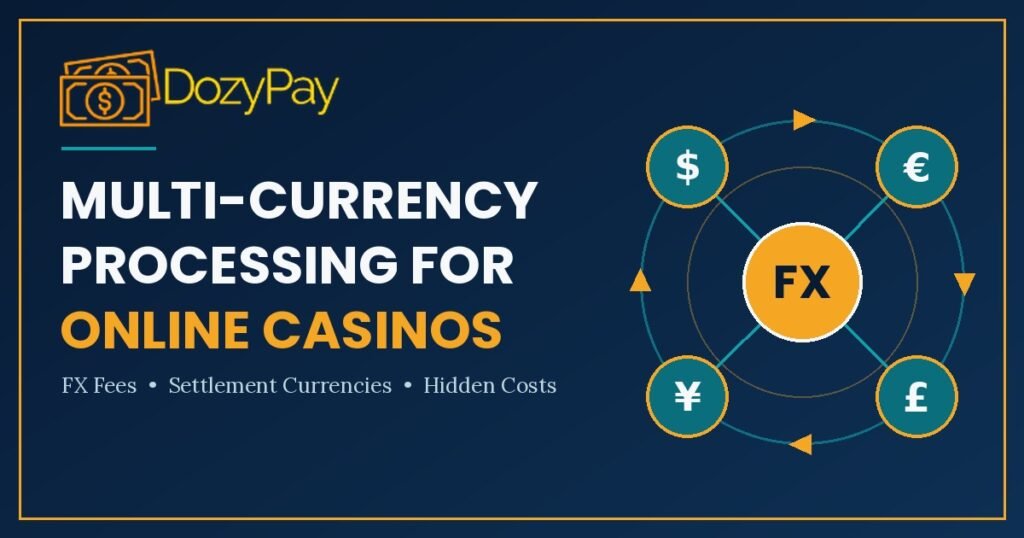
| Quick answer: Multi-currency processing for online casinos lets players pay in their own currency. The operator then settles in one or more chosen currencies. The real cost sits in three places. First, the FX markup hides inside the exchange rate. Second, your settlement currency decides how often money converts. Third, hidden costs such as refund-rate drift and cross-border declines erode margin. To protect revenue, ask for every markup as a percentage over the mid-market rate. Then settle in the currencies you actually spend. |
A player in Brazil deposits in reais, and the operator receives euros. On the surface, that looks simple. In reality, the money passes through several conversion points, and each one can carry a fee. Over a year, those small markups can become a serious line item.
This guide explains how multi-currency processing for online casinos works in practice. You will see where FX fees hide. You will also learn how to choose a settlement currency and which hidden costs catch operators off guard. Along the way, you will also learn what underwriters expect when you apply for an offshore casino merchant account.
Multi-Currency Processing for Online Casinos: The Simple Version
Three currencies matter in every casino payment. Players see the presentment currency at checkout. Their card or bank account uses the billing currency. Your merchant account receives the settlement currency.
When all three match, no conversion happens. When they differ, someone converts the money, and that someone takes a margin. So the goal is not to avoid conversion entirely. The goal is to know who converts, at what rate and at what cost.
| Term | What it means | Who controls it |
| Presentment currency | The price the player sees at checkout | The operator |
| Billing currency | The currency of the player’s card or account | The issuing bank |
| Settlement currency | The currency paid into your merchant account | The acquirer, by contract |
| Payout currency | The currency used for player withdrawals | The operator and payout provider |
How a Multi-Currency Casino Payment Really Flows?
A multi-currency payment gateway for casinos sits between the checkout page and your acquiring bank. It shows prices in local currencies and routes each card payment for authorisation. Then the acquirer settles the net funds to you.
- First, the player picks a currency, or the checkout detects it.
- Next, the gateway sends the authorisation request to the acquirer in that currency.
- The card network routes the request to the issuing bank, which approves or declines it.
- If the billing currency differs, the issuer or a conversion partner converts the amount.
- Then the acquirer converts the funds again if your settlement currency differs.
- Finally, funds reach your merchant account, net of fees and any reserve.
Notice the two conversion points. One sits on the player side, and the other sits on your side. Operators often watch only the second. As a result, the first one quietly hurts deposit conversion when a player sees a foreign-transaction charge on a statement.
FX Fees: Where Multi-Currency Processing for Online Casinos Loses Margin?
Card processing has no single FX fee line. Instead, the markup sits inside the exchange rate. Providers quote a rate, and the gap between that rate and the mid-market rate is their margin. Because it hides inside the rate, it rarely shows on a statement.
Cross-border card costs stack up as well. In the EEA, interchange caps of 0.2% for debit and 0.3% for credit apply only to transactions inside the region. Cards from other regions fall outside those caps. After Brexit, UK to EEA card-not-present interchange rose. One industry explainer puts it at 1.15% for debit and 1.5% for credit.
So how much does a markup cost? The table below shows simple maths on $500,000 of monthly foreign-currency volume. These figures are illustrations, not quotes.
| Markup over mid-market | Monthly cost | Annual cost |
| 0.5% | $2,500 | $30,000 |
| 1.5% | $7,500 | $90,000 |
| 3.0% | $15,000 | $180,000 |
One payments vendor’s guide gives an example of a 2.99% markup. The guide suggests it could drop to about 1.5% through negotiation. Treat that as directional, since vendor guides are promotional. Even so, the lesson holds. Rates are negotiable, especially for stable and well-documented volume.
Fee structure matters beyond FX. Our guide on how to get a low-fee gambling payment gateway compares rates, reserves and conversion terms side by side.
Settlement Currencies: Choosing Where Your Money Lands
Your settlement currency drives working capital. Your display currency drives player conversion. Good multi-currency processing for online casinos treats them as separate decisions. A common pattern is to show prices in a long list of currencies but settle in only a few.
| Option | Best for | Watch out for |
| Settle in each player currency | Operators with real costs in several currencies | More bank accounts, more reconciliation and thin balances in minor currencies |
| Settle in one base currency (USD or EUR) | Lean finance teams with one main cost currency | Every non-base deposit carries a conversion markup |
| Settle in a small basket of 3 to 5 currencies | Growing operators with a few core markets | You need a clear rule for which currency settles where |
Match settlement to your spending. If your licence, staff and suppliers cost euros, settle in euros. Otherwise, you convert twice: once on deposit and again when you pay your bills.
Not every provider supports every currency. Therefore, check the settlement list before you sign. An online gaming merchant account and payment gateway with only two settlement currencies forces extra conversions.
Dynamic Currency Conversion: Handle With Care
Dynamic currency conversion, or DCC, lets a player pay in their home currency at your checkout. A third-party operator converts the amount and usually shares part of the margin with the merchant. On paper, that sounds like free revenue.
In practice, DCC carries risk. Card network rules require clear cardholder consent, and they prohibit conversion without it. Visa also uses a chargeback reason code when a cardholder was not told about DCC. The same code covers players who were denied a local-currency option. Markups can run well above what an issuer charges. One widely cited example showed 2.95% over the wholesale rate.
So treat DCC as an opt-in feature with a clear screen, not a default. Show the rate, show the markup and show the final amount in both currencies. That approach protects player trust and reduces dispute risk.
Hidden Costs in Multi-Currency Processing for Online Casinos
Beyond the visible markup, several quieter costs affect your net revenue. Most of them appear only after the first few months of live volume.
| Hidden cost | Why it happens? | What to do? |
| Refund and chargeback rate drift | Each conversion uses the rate on that day, so a later refund can settle at a different rate than the original deposit | Ask how your provider converts refunds and chargebacks, and model a volatile month |
| Cross-border declines | Issuers decline some foreign-acquired casino transactions, particularly under gambling MCC 7995 | Compare local acquiring options by market and test approval rates, not just fees |
| Reserve currency exposure | A rolling reserve held in one currency can gain or lose value against your costs | Ask which currency holds the reserve and when it releases |
| Payout FX | Withdrawals to players in other currencies trigger another conversion | Price deposits and withdrawals together |
| Bank intermediary fees | Wire settlements can attract correspondent bank charges | Request the fee schedule for each settlement route |
| Rate timing gaps | Rates refresh on a schedule, and weekends can widen spreads | Ask how often rates update and which source feeds them |
Cross-border declines deserve special attention. One payments vendor reports that local acquiring lifts authorisation rates by roughly 5 to 10 percentage points. Treat that figure as a hypothesis to test, not a promise. Still, smart payment routing can recover approvals that a single global route loses.
Transparency Rules You Can Use in Negotiation
European rules give you useful language for contract talks. Regulation (EU) 2019/518 has applied since 15 December 2019. It requires conversion charges on card payments to appear as a percentage markup over the latest ECB euro reference rate. The payer must see that markup before the payment starts.
You do not need to operate only in Europe to borrow this standard. Ask every provider to quote its FX charge the same way: a percentage over a named mid-market source. As a result, you can compare offers on equal terms.
Offshore Casino Merchant Account: Setting Up Multi-Currency Properly
An offshore casino merchant account is a common route for licensed international operators. It can offer multi-currency acquiring that domestic banks often decline to provide for gambling. However, the label offshore does not remove your duties. You still need a valid licence and clean KYC and AML processes. You also need a list of markets where your licence permits play.
Plan your multi-currency processing for online casinos before you apply. List the currencies you will display, settle and use for withdrawals. Then ask each provider to confirm support in writing.
If you are wondering how to get a gaming merchant account that handles several currencies, start with documents. Prepare your licence, corporate records, website, game provider list and expected monthly volume by currency. Clear paperwork shortens the review.
Casino Merchant Account Approval: What Underwriters Check on Currency?
Casino merchant account approval depends on risk, and your currency mix is part of that picture. Underwriters want to know where your players live, which currencies they use and how stable your volume is. They also check whether your target markets allow online gambling.
- Licence and market list: proof that you may serve each country you target.
- Volume by currency: realistic monthly projections per currency, not one blended figure.
- Chargeback and refund history: ratios by market where you have data.
- KYC, AML and age checks: documented processes for every market.
- Payout model: how, and in which currency, you pay winners.
Choose a partner that understands gaming risk, because generic banks often misprice it. DozyPay’s casino merchant account service covers high-risk underwriting, 50+ currencies and gateway support for licensed operators.
Multi-Currency Processing for Online Casinos: Compliance Comes First
Offering a currency does not make a market legal. Licensed operators should accept players only where the law allows it. For example, India’s PROGA 2025 prohibits payment facilitation for real-money online gaming. An INR checkout for real-money casino play is therefore not a compliant option.
Card schemes add another layer. Gambling sits under merchant category code 7995, and some issuers block it. So plan for alternative rails, such as bank transfers and local wallets, in markets where cards fail. Always confirm legality with a qualified lawyer before you launch in a new country.
8 Questions to Ask Your Casino Payment Partner
Use these questions to test any provider’s approach to multi-currency processing for online casinos.
- What is your FX markup, expressed as a percentage over the mid-market rate?
- Which currencies can I present, and which can I settle?
- How often do exchange rates refresh, and from which source?
- How do you convert refunds and chargebacks?
- In which currency is my rolling reserve held, and when does it release?
- Do you support local acquiring in my top markets?
- What bank or wire fees apply to each settlement currency?
- Can I see all fees in one schedule before I sign?
The best casino merchant account for gambling platforms is the one that answers these questions in writing. Vague answers usually signal hidden margin. Likewise, a provider that refuses to disclose its markup is telling you something important.
A specialist high risk casino merchant account provider will also explain reserves, routing and currency support in plain language. That clarity saves months of reconciliation later.
Frequently Asked Questions
What is multi-currency processing for online casinos?
Multi-currency processing for online casinos lets players deposit and withdraw in their local currency. The operator then settles in one or more chosen currencies. A gateway and an acquirer handle the conversion between them.
What is the difference between presentment and settlement currency?
The presentment currency is the one the player sees at checkout. The settlement currency is the one paid into your merchant account. If they differ, a conversion takes place and a markup applies.
How much do FX fees cost online casinos?
There is no fixed rate. Markups vary by currency pair, provider and volume. As a rule of thumb, every 1% of markup costs $10,000 on $1 million of converted volume. Small differences add up.
Should an online casino offer dynamic currency conversion?
Only as a clear opt-in. Card network rules require cardholder consent, and hidden DCC can trigger disputes. Show the rate, the markup and both totals before the player confirms.
Can an offshore casino merchant account settle in several currencies?
Often yes, but support varies by provider. Confirm the exact settlement currency list in writing. Licensed operators must also show that they may serve each target market.
What do underwriters check for casino merchant account approval?
They review your licence, target markets, projected volume by currency and chargeback history. They also check your KYC, AML and payout processes. Clear documents speed up the decision.
Final Thoughts: Make Currency Work for Your Margin
Multi-currency processing for online casinos is a margin decision as much as a technical one. Know your conversion points. Pick settlement currencies that match your costs. Demand every markup in plain numbers, and review those numbers each quarter, because rates and volumes change.
Want a partner that treats currency terms as seriously as approval? Talk to the DozyPay team about your market mix and settlement plan.