| You’ve built a social gaming app that players love. Your engagement metrics are excellent. Then, without warning, your payment processor shuts you down — or Apple and Google flag your app for review. This guide exists so that never happens to you. |
Mobile social gaming is one of the fastest-growing verticals in digital payments, and also one of the most heavily scrutinised. Whether you operate a virtual currency platform, a social casino app, or a competitive mobile game with in-app purchases, the payment infrastructure you choose can determine whether your business scales or stalls.
Throughout this guide, we break down exactly how to set up in-app purchase processing for iOS and Android social gaming apps without triggering account bans, app store violations, or payment processor terminations. We also explain where a specialist social gaming merchant account provider fits in — and why getting this right from day one matters more than you might think.
1. Why Mobile Social Gaming Payments Are in a Category of Their Own?
Before diving into setup steps, it is worth understanding why payment processing for social gaming apps sits in a different category from standard e-commerce or SaaS billing. The reasons are structural — and they directly affect which payment solutions will work for your platform.
The High-Risk Classification Problem
Most mainstream payment processors — Stripe, Square, PayPal — classify social gaming and social casino apps as high-risk. Consequently, even if your app does not involve real-money gambling, the presence of virtual currency, simulated casino mechanics, or loot box features can result in immediate account termination the moment these processors review your merchant category code (MCC).
Furthermore, Apple and Google each maintain their own payment compliance standards that sit on top of your payment processor’s requirements. Therefore, a mobile social gaming app must satisfy three separate compliance layers simultaneously: the app store policies, the payment processor’s terms, and in some jurisdictions, local consumer protection regulations around virtual goods.
The Chargeback Exposure
Social gaming apps attract a disproportionate number of chargebacks compared to other digital goods categories. Players who make impulsive micro-transaction purchases — particularly younger demographics — frequently dispute charges once they see the transaction on a bank statement. Additionally, friendly fraud is statistically higher in this vertical.
As a result, standard processors that tolerate a 0.5%–1% chargeback ratio will terminate accounts that consistently reach the 1.5%–2% range that is common in social gaming. By contrast, a dedicated mobile social gaming merchant account is structured specifically for this chargeback profile, with built-in mitigation tools and thresholds calibrated to the vertical.
| 💡 Key Stat: According to payment industry data, social gaming apps experience chargeback rates 3–4x higher than standard digital goods platforms. This is the primary reason specialist social gaming payment solutions are not optional — they are essential infrastructure. |
2. iOS In-App Purchase Processing: Rules, Risks, and Workarounds
Apple’s App Store operates a tightly controlled payment ecosystem. For most in-app purchases within iOS social gaming apps, Apple’s own StoreKit framework is mandatory. However, understanding the precise boundaries of this requirement — and where alternative payment processing for social gaming apps is legally permitted — is critical for structuring your revenue model correctly.
What Apple Mandates vs What You Can Control?
| Purchase Type | Apple IAP Required? | Your Processor Allowed? |
| Consumable virtual coins (in-app) | Yes — mandatory | No |
| Non-consumable permanent unlocks | Yes — mandatory | No |
| Subscriptions (auto-renewing) | Yes — StoreKit | No |
| External top-up via website | No — web only | Yes ✅ |
| B2B/platform licensing fees | No | Yes ✅ |
| Web-based social casino chip packs | No | Yes ✅ |
The practical implication of this structure is significant. While Apple mandates StoreKit for in-app purchases, you are fully permitted to build a web-based purchase flow where players buy virtual currency packages directly from your website using your own payment processor. Subsequently, these credits are applied to the player’s account inside the app. This hybrid model is widely used by social casino operators and is fully compliant with Apple’s guidelines when implemented correctly.
The iOS Anti-Steering Enforcement Trap
Following the Epic v. Apple ruling in certain markets, some app developers attempted to add in-app links directing users to external purchase pages. However, Apple’s anti-steering enforcement remains strict in most jurisdictions. Importantly, any in-app prompt, button, or message that actively directs iOS users to an external payment page is likely to result in your app being rejected or removed.
Therefore, the compliant approach is to build a fully separate web-based purchase journey — accessible only via your website or a direct link shared outside the app — without embedding any cross-promotional messaging inside the iOS app itself.
| ⚠️ Common Mistake: Adding a ‘Buy More Coins on our Website’ button inside your iOS app. Even if the destination is your own domain, Apple considers this a ToS violation. Keep the web purchase flow entirely separate from the app UI. |
Setting Up StoreKit Correctly for Social Gaming
For consumable in-app purchases on iOS, StoreKit 2 (available from iOS 15+) provides a significantly improved transaction verification framework. Here is the recommended technical setup for social gaming apps:
- Product configuration: Create consumable products in App Store Connect for each virtual currency package. Use clear naming conventions such as ‘Starter Pack — 1,000 Coins’ rather than vague descriptors. Apple’s review team scrutinises product names in social gaming apps more closely than other categories.
- Receipt validation: Always validate receipts server-side, not client-side. Client-side validation is trivially exploitable in social gaming contexts and will increase fraudulent purchase claims.
- Sandbox testing: Test every edge case in the Sandbox environment before submission — including interrupted purchases, network failures mid-transaction, and currency conversion scenarios for international users.
- Refund handling: Implement Apple’s refund notification endpoint so that when Apple issues a refund, your system automatically reverses the virtual currency grant. Failing to do this creates both chargeback exposure and regulatory risk.
3. Android In-App Purchase Processing: Google Play Billing and Beyond
Google Play’s billing policies share structural similarities with Apple’s but offer meaningfully more flexibility in several areas. For operators managing payment processing for social gaming apps on Android, understanding this flexibility is the difference between a single revenue stream and a multi-channel monetisation model.
Google Play Billing: What’s Mandatory
Since the 2022 policy update, Google requires that all apps distributed via the Google Play Store use Google Play Billing for in-app purchases of digital goods. This requirement applies to virtual coins, power-ups, premium features, and similar consumables in social gaming apps. Failure to comply results in app removal — and in repeat cases, developer account termination.
Nevertheless, unlike Apple, Google has made meaningful progress toward supporting alternative billing in select markets under its User Choice Billing (UCB) programme. Moreover, in jurisdictions covered by the South Korean Telecommunications Business Act and similar legislation, alternative payment methods may be offered alongside Google Play Billing. Consult legal counsel for jurisdiction-specific guidance before implementing alternative billing on Android.
Google’s Sensitive Categories and Social Casino Apps
Google Play categorises social casino apps — including apps with simulated slot machines, poker, or roulette mechanics — as Sensitive Content requiring additional declarations. Consequently, if your social gaming app includes any simulated gambling mechanics, you must:
- Complete Google Play’s gambling declaration in the Policy Centre
- Confirm the app does not pay out real money or prizes with monetary value
- Restrict distribution to territories where social casino apps are legally permissible
- Add age-gating that meets Google’s minimum standard for the category
Importantly, these declarations do not prevent you from running a legitimate social gaming business on Android. However, omitting them is one of the fastest routes to an account ban — particularly during the payment setup phase when Google’s automated systems first process your financial account.
Linking Android to a Social Gaming Payment Solution High Risk
For web-based purchases linked to your Android user accounts — the primary channel where a specialist social gaming payment solution high risk processor adds value — the setup mirrors the iOS web flow with one key difference: Android users are less conditioned to use only one payment ecosystem. As a result, conversion rates on web-based purchase pages tend to be higher among Android users, making this channel particularly worth optimising.
Specifically, an effective Android-linked web purchase flow should support multiple payment methods including cards, local payment methods, and e-wallets, since Android’s global install base spans markets where specific local payment methods dramatically outperform card payments.
4. The Web-Based Purchase Layer: Where Your Merchant Account Does the Heavy Lifting?
For most mobile social gaming operators, the web-based purchase layer — the off-app channel where players top up virtual currency using a card or e-wallet — is the highest-revenue and highest-risk component of the payment stack. This is where a dedicated merchant account for social gaming becomes the operational centrepiece of your payment infrastructure.
What a Social Gaming Merchant Account Provider Delivers?
A specialist social gaming merchant account provider offers significantly more than a standard payment gateway. At DozyPay, for instance, the merchant account infrastructure for social gaming clients is specifically architected around the following capabilities:
| Capability | Why It Matters for Social Gaming |
| High-risk MCC classification | Prevents account termination when chargebacks spike |
| Chargeback defence tooling | Automated dispute responses, RDR and CDRN enrolment |
| Multi-currency processing | Converts international players without FX friction |
| Alternative payment methods | Covers markets where cards underperform |
| Velocity fraud controls | Catches micro-transaction fraud in real time |
| Crypto payment support | Serves player segments that prefer digital assets |
| Rapid settlement options | Maintains operator cash flow during high-volume events |
Furthermore, a reputable social gaming merchant account provider will conduct a genuine underwriting review of your platform before onboarding — examining your game mechanics, virtual currency model, chargeback history, and AML compliance posture. While this process requires preparation, it results in a stable, long-term processing relationship rather than the boom-and-bust cycle of relying on standard processors that terminate without warning.
Setting Up Your Web Purchase Flow — Step by Step
Once your merchant account for social gaming is approved, the web purchase flow setup follows this sequence:
- Payment gateway integration: Connect your website to the gateway via API. For social gaming operators, server-to-server integration is strongly preferred over hosted-page solutions because it allows seamless UX within your platform’s visual identity.
- 3DS2 authentication setup: Implement 3D Secure 2 for all card transactions. In addition to reducing chargebacks, 3DS2 provides SCA compliance for European players and shifts liability away from the merchant on authenticated transactions.
- Virtual currency fulfilment webhook: Build a server-side webhook that listens for confirmed payment events and credits the appropriate coin balance to the player account in real time. Never grant currency before payment confirmation.
- Descriptor configuration: Work with your social gaming merchant account provider to configure a clear, recognisable transaction descriptor. Vague descriptors are the single biggest driver of friendly fraud chargebacks in social gaming — players who do not recognise the charge dispute it immediately.
- Spend controls and player limits: Implement configurable purchase limits per player, per period. Beyond compliance, this functionality reduces large single-transaction disputes and improves your chargeback ratio over time.
- Refund policy display: Display your refund policy prominently at the point of purchase. Jurisdictions including the UK, EU, and Australia have specific consumer rights requirements for virtual goods that must be addressed before your merchant account goes live.
| ✅ DozyPay Integration Tip: DozyPay’s social gaming payment solution integrates directly with the most common gaming platforms including Unity, Unreal, and custom-built back-ends via REST API. Typical integration timeline for a new mobile social gaming client is 5–7 business days from merchant account approval. |
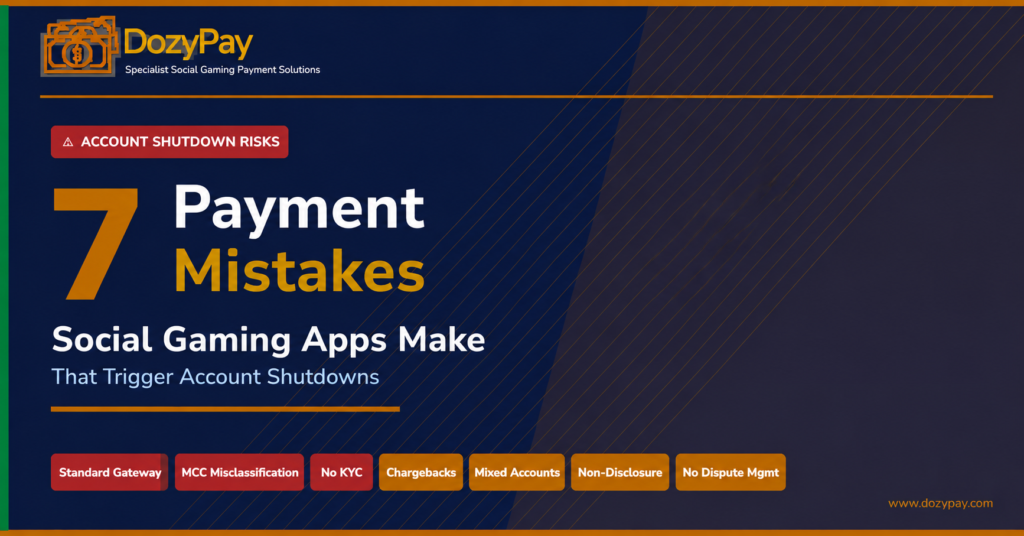
5. The 7 Fastest Ways to Get Banned — and How to Avoid Each One?
Understanding why social gaming operators lose payment processing access is as important as setting it up correctly in the first place. Based on DozyPay’s experience onboarding mobile social gaming merchant account clients, the following patterns account for the majority of terminations and app store bans:
| Ban Trigger | Platform Affected | Prevention |
| Using a standard processor for high-risk MCC | Payment processor | Apply for a specialist social gaming merchant account from day one |
| In-app links to external purchase pages | Apple App Store | Keep web purchase flow entirely off-app |
| Omitting Play Store gambling declarations | Google Play | Complete all policy declarations before first payment goes live |
| Chargeback rate exceeding 1% | Payment processor | Enable chargeback alerts, 3DS2, clear descriptors |
| Granting virtual currency before payment confirmation | All platforms | Always use server-side webhook confirmation before credit |
| Vague transaction descriptor | Banks / cardholders | Set a recognisable descriptor with your brand name |
| No player spend limits or self-exclusion tools | Regulators / stores | Implement configurable limits and responsible gaming features |
Notably, the majority of these failures are entirely preventable with the right infrastructure in place before launch. Moreover, operators who experience a termination and attempt to reapply for payment processing face significantly longer approval timelines and more restrictive terms — making prevention the only commercially sensible strategy.
6. Choosing the Right Social Gaming Merchant Account Provider
Not every high-risk payment provider is equipped to handle the specific requirements of mobile social gaming. When evaluating a social gaming merchant account provider, the following criteria separate genuinely specialist providers from generic high-risk processors simply willing to take the risk:
- Experience in the social gaming vertical specifically: A provider that processes for traditional e-commerce, travel, and nutraceuticals is not the same as one that has underwritten, integrated with, and managed disputes for social gaming apps. Ask for client case studies in the vertical.
- Understanding of both IAP and web payment layers: Your provider should understand how Apple and Google IAP works and how to build the web purchase layer that complements it — not just process cards.
- Dedicated chargeback management tooling: Verify that your social gaming payment solution high risk provider offers active chargeback management — not just reactive dispute filing. RDR (Rapid Dispute Resolution) and CDRN (Collaboration Case Management) enrolment should be standard.
- Multi-currency and alternative payment method support: If more than 20% of your players are outside your home market, currency and payment method coverage is directly correlated with revenue. Confirm which currencies and local methods the provider supports before signing.
- Transparent fee structure: High-risk processing carries premium fees, but those fees should be clearly disclosed. Rolling reserves, monthly minimums, and termination fees should all be negotiated and documented before account approval.
- Responsive compliance support: When Apple or Google changes a policy — which happens with high frequency in the gaming category — your social gaming merchant account provider should proactively notify you of any impacts to your payment setup.
| 🏆 Why DozyPay?: DozyPay specialises in payment processing for social gaming apps and operates dedicated merchant account programmes for mobile social gaming operators. Our clients benefit from pre-negotiated high-risk MCC approval, active chargeback management, and a team that understands the nuances of virtual currency compliance on both iOS and Android. Apply at dozypay.com/social-gaming-merchant-account. |
7. Responsible Gaming and Compliance: Non-Negotiable for Payment Approval
Increasingly, responsible gaming features are not just ethical best practice — they are a prerequisite for merchant account approval and app store compliance in the social gaming category. In addition to satisfying regulators and platform policies, these features directly improve your risk profile in the eyes of payment processors.
Minimum Responsible Gaming Features for Payment Approval
When DozyPay underwrites a new mobile social gaming merchant account, we require the following responsible gaming features as part of the application assessment:
- Age verification mechanism (minimum: date of birth gate; preferred: third-party identity verification for high-value purchase tiers)
- Configurable player spend limits — daily, weekly, and monthly caps
- Self-exclusion or cooling-off period functionality accessible within the app or web account
- Clear disclosure that the app uses virtual currency with no real-money redemption value
- Purchase receipt emails that clearly identify the transaction and provide a support contact
Beyond the minimum requirements, platforms that implement more comprehensive responsible gaming frameworks — including spend analytics dashboards for players, proactive high-spend notifications, and third-party responsible gaming integrations such as GamStop or GamBan exclusion checks — generally receive more favourable underwriting terms and lower reserve requirements.
Regulatory Landscape: What’s Changing in 2026
The regulatory environment for social gaming payments is evolving rapidly. Several jurisdictions are actively developing or implementing specific frameworks for social casino and virtual currency apps that go beyond existing gambling laws:
- United Kingdom: The Gambling Commission has signalled ongoing review of social casino apps with loot-box mechanics. Consequently, UK-focused operators should implement enhanced age verification and spending disclosures in advance of any formal regulation.
- European Union: The Digital Services Act (DSA) includes provisions relevant to platforms with virtual goods targeting younger users. Furthermore, several EU member states are exploring national-level social gaming regulations independently of EU frameworks.
- United States: State-level regulation continues to vary significantly. Nevertheless, operators processing payments through US-based entities should monitor FTC guidance on virtual currency disclosures, which is evolving.
- Australia: The ACMA has expanded scrutiny of social gaming apps. Moreover, Australian consumer protection law requires that virtual goods refund policies meet statutory minimum standards — a requirement that directly affects how your payment descriptor and refund terms must be structured.
8. Payment Stack Architecture: Putting It All Together
For a mobile social gaming operator running on both iOS and Android, the complete compliant payment stack looks like this:
| Layer | Recommended Setup |
| iOS In-App Purchases | StoreKit 2 with server-side receipt validation and refund webhooks |
| Android In-App Purchases | Google Play Billing API with server-side purchase verification |
| Web-Based Top-Ups (primary revenue) | Specialist social gaming merchant account provider (e.g. DozyPay) |
| 3D Secure Authentication | 3DS2 on all card transactions via your gateway |
| Fraud Prevention | Real-time velocity controls + device fingerprinting |
| Chargeback Management | RDR/CDRN enrolment + automated dispute evidence filing |
| Multi-Currency | Dynamic currency conversion at point of web purchase |
| Alternative Payment Methods | Local e-wallets and bank transfer methods by region |
| Virtual Currency Fulfilment | Server-side webhook — credit only after confirmed payment |
| Responsible Gaming Controls | Spend limits, self-exclusion, age verification layer |
This architecture ensures that every payment channel is covered, every compliance requirement is addressed, and every termination risk is mitigated before your first player makes a purchase. Furthermore, it provides the foundation for scaling internationally without rebuilding your payment infrastructure each time you enter a new market.
9. Frequently Asked Questions
Do I need a separate merchant account for iOS and Android payments?
In practice, no. Apple and Google handle in-app billing through their own systems for mandatory IAP categories. Your social gaming merchant account covers the web-based purchase layer, which serves both iOS and Android users regardless of device. Therefore, a single well-structured merchant account for social gaming is typically sufficient for both mobile platforms.
Can I use PayPal or Stripe for a social gaming app?
Both Stripe and PayPal explicitly prohibit social casino apps and virtual currency platforms in their terms of service. While accounts are sometimes approved initially, termination typically follows the first compliance review or chargeback spike. Consequently, applying directly for a specialist social gaming payment solution from a high-risk processor is always the correct approach.
How long does it take to get a social gaming merchant account approved?
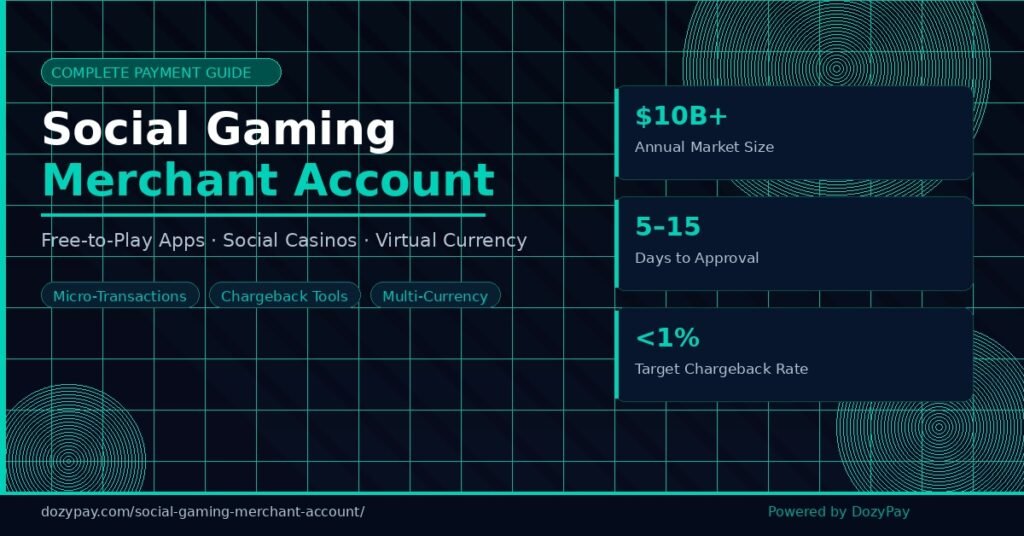
Approval timelines vary by provider and application completeness. At DozyPay, a complete application for a mobile social gaming merchant account — including game mechanics documentation, responsible gaming policy, and chargeback history if applicable — typically processes within 5–10 business days. Incomplete applications extend this timeline significantly.
What chargeback rate will get my account terminated?
Most standard processors terminate at 1% chargeback ratio. However, specialist social gaming payment solution high risk providers operate with higher thresholds — typically 2%–2.5% — and provide active mitigation tools to keep you below them. Nevertheless, even with a high-risk processor, sustained chargeback rates above 2% will eventually result in reserve increases or account review.
Is cryptocurrency a viable payment option for social gaming apps?
Yes, and increasingly so. Crypto payments bypass the app store billing requirements entirely for web-based purchases and are particularly effective for international player bases where card penetration is lower. DozyPay supports cryptocurrency acceptance as part of a social gaming payment solution — and notably, crypto transactions carry significantly lower chargeback exposure than card payments.
Quick Reference: Mobile Social Gaming Payment Setup Checklist
| Setup Item | Status to Confirm Before Launch |
| Apple StoreKit 2 integrated with server-side validation | ✅ Required |
| Google Play Billing API with server-side verification | ✅ Required |
| Social gaming merchant account approved (web layer) | ✅ Required |
| 3DS2 enabled on all web card transactions | ✅ Required |
| Virtual currency only credited after payment webhook confirmation | ✅ Required |
| Transaction descriptor configured — brand name visible | ✅ Required |
| Player spend limits implemented | ✅ Required |
| Age verification in place | ✅ Required |
| Google Play gambling category declared | ✅ Required if social casino mechanics |
| iOS web purchase flow — no in-app links to external page | ✅ Required |
| Chargeback alert service enrolled (RDR/CDRN) | ✅ Strongly recommended |
| Multi-currency and local payment methods active | ✅ Recommended for global apps |
Conclusion
To summarise, setting up compliant, stable in-app purchase processing for a mobile social gaming app requires navigating three distinct compliance environments simultaneously: Apple’s App Store policies, Google Play’s billing framework, and your payment processor’s high-risk underwriting requirements. Operators who treat any one of these as secondary quickly discover how costly that oversight becomes.
The foundation of a sustainable mobile social gaming payment stack is a specialist social gaming merchant account provider that understands the vertical, operates purpose-built infrastructure for high-risk processing, and provides active chargeback management — not just a payment gateway that tolerates the risk.
DozyPay helps mobile social gaming operators build exactly that foundation. Whether you are launching your first app or migrating from a processor that has terminated your account, our team is ready to structure a payment solution that scales with your platform. Get in touch today.
| 📞 Ready to Set Up Your Mobile Social Gaming Payment Stack? Apply for a social gaming merchant account at dozypay.com/social-gaming-merchant-account or contact the DozyPay team directly. Setup typically completes within 5–10 business days. |
📚 Related Blogs: