Acquiring a casino player is expensive. Industry benchmarks place player acquisition costs between $150 and $400 per depositing player. That figure does not include bonusing, affiliate commissions, or paid media.
Therefore, when a player signs up, deposits once, and never returns, that is not just a lost revenue event. It is a direct, measurable loss of capital.
Here is the uncomfortable truth most operators avoid. A large portion of player churn has nothing to do with your game selection or loyalty programme. Instead, it is caused by your online casino payment gateway.
Players do not write support tickets explaining why they left. They do not fill in exit surveys. Consequently, they simply close the tab and open a competitor.
However, payment friction is consistently one of the top three churn drivers in iGaming. Failed deposits, delayed withdrawals, and clunky checkout flows all drive players away silently.
In this article, we identify the six gateway-level failures killing retention on your platform. Furthermore, we explain what a purpose-built, secure casino payment gateway provider should do differently.
| 📊 INDUSTRY STAT | Studies show that 68% of players who experience a failed first deposit never attempt a second. Therefore, payment failure at the deposit stage is the single highest-impact churn event in the player lifecycle. |
Reason 1: Slow or Failed Deposits Break the Player at the Moment of Intent
Why the Deposit Moment Is So Critical?
When a player clicks ‘Deposit’, they are in a peak-intent state. They have chosen your platform. They have selected a game. Moreover, they are ready to play.
This is the highest-value moment in the entire player journey. Unfortunately, it is also the moment a poorly configured gateway destroys.
Casino transactions are flagged as high-risk by most acquiring banks. As a result, a generic payment gateway will route these payments through conservative bank channels. This leads to elevated decline rates.
For example, non-specialist gateways produce 15–35% decline rates on casino card transactions. In contrast, purpose-built casino gateways achieve 85–95% approval rates through direct bank relationships and intelligent retry logic.
What Good Deposit Infrastructure Looks Like?
Every failed deposit is a retention event. The player does not see a routing failure. They simply see a platform that does not work.
Consequently, the association between ‘this site failed me’ and ‘I’m leaving’ forms instantly. Selecting the best payment gateway for online casino startup operators means choosing a provider built to maximise approval rates.
Specifically, a solid online casino payment gateway integration connects your platform to multiple acquiring banks simultaneously. Additionally, it uses intelligent failover to retry a declined transaction through a different route. Furthermore, this happens without any visible disruption to the player.
| 💡 KEY INSIGHT | A well-configured online casino payment gateway integration uses multi-bank routing. Therefore, a single declined transaction does not end the deposit attempt. Instead, it automatically retries through an alternative acquiring route. |
Reason 2: Limited Payment Methods Turn Players Away Before They Deposit Once
The Method Preference Problem
Players have deeply personal relationships with their preferred payment methods. For example, a UK player expects Visa, Mastercard, and a wallet option.
Similarly, a German player expects Sofort or SEPA bank transfer. A player in Southeast Asia, however, expects local bank transfer or regional e-wallets.
Furthermore, a crypto-native player expects Bitcoin or USDT as a first-class option. If your gateway only supports card payments, you are invisible to all of them.
Importantly, they will not educate themselves on why your platform is better. Instead, they will simply find a competitor that accepts their preferred method.
What an Unrestricted Gateway Supports?
A payment gateway for online casino without restriction should support multiple payment types. These include credit and debit cards, e-wallets, bank transfers, prepaid options, and cryptocurrency.
Moreover, all of these should be available through a single integration. Each additional method you add expands your addressable player base. Additionally, it removes a churn trigger before it has a chance to form.
| 💡 MULTI-METHOD IMPACT | Operators who expand from card-only to four or more payment methods report a 23–40% increase in first-deposit conversion rates. Therefore, method availability is as important as approval rates at the deposit stage. |
Reason 3: Withdrawal Delays Destroy Player Trust and Create Vocal Detractors
Why Withdrawals Matter More Than Deposits for Retention?
Here is the retention dynamic most payment discussions miss. Players do not think about your platform when they are depositing. However, they think about it constantly when they are waiting for a withdrawal.
A player who wins £500 and requests a withdrawal on Monday expects to see that money within 24–72 hours. If they are still waiting on Friday, the trust damage is severe. Moreover, it is usually permanent.
Additionally, they tell other players. Casino forums, Reddit threads, and review sites are full of withdrawal delay complaints. Consequently, these erode your platform’s reputation long before you are aware of the problem.
The Technical Root Cause of Slow Payouts
The root cause of most withdrawal delays is not deliberate operator policy. Instead, it is a gateway that lacks direct acquiring relationships. As a result, payouts must route through multiple intermediaries. Each intermediary adds its own processing window.
In contrast, a secure casino payment gateway provider maintains direct bank relationships. Therefore, same-day or next-business-day payout execution becomes achievable for verified players.
In other words, withdrawal speed is not a luxury feature. It is a core retention mechanism. For further detail, see our online casino payment gateway guide at /online-casino-payment-gateway-guide/.
Reason 4: Poor Mobile Payment UX Loses the Majority of Your Player Base
Where Mobile Payment Flows Break Down?
Over 65% of online casino sessions now originate on mobile devices. Nevertheless, many casino payment gateways were designed primarily for desktop.
As a result, players encounter multi-step deposit forms and non-responsive layouts. Furthermore, payment pages often open external browser tabs mid-session. 3DS windows sometimes fail to return the player to the casino after authentication.
Each additional tap or redirect in the deposit flow increases abandonment by approximately 10–15%. Therefore, a three-page deposit form on mobile will cause significant player loss.
Moreover, that abandonment registers as a failed deposit event. Consequently, it triggers the same trust damage as a technical decline.
What Mobile-Native Payment UX Looks Like?
Mobile-native payment UX means a single-screen deposit flow embedded directly in the platform. Additionally, it includes biometric or saved-card authentication for returning players.
Furthermore, 3DS authentication should return the player to the exact game they were about to play. Finally, Apple Pay and Google Pay support allows sub-10-second deposit completion.
| 📱 MOBILE BENCHMARK | Best-in-class casino payment gateways achieve mobile deposit completion in under 15 seconds for returning players. Therefore, if your current gateway takes longer than 30 seconds on mobile, you have a measurable retention problem. |
Reason 5: Over-Aggressive Fraud Flags Block Your Highest-Value Players
Why Casino Player Behaviour Triggers Generic Fraud Systems?
Fraud prevention is essential in casino payments. However, a fraud model built for e-commerce will systematically misclassify casino player behaviour.
For example, high-value casino players deposit large amounts frequently. They also deposit at irregular hours and sometimes from different locations. Furthermore, their velocity patterns look nothing like a standard e-commerce purchase.
Consequently, a generic fraud engine sees this behaviour and flags or blocks it. As a result, your best player experiences a declined deposit or an account freeze. Moreover, they leave for a competitor whose system understands their behaviour.
The Solution: Casino-Specific Fraud Intelligence
The correct online casino payment gateway integration includes an industry-specific fraud model. This model should be trained on casino transaction data — not e-commerce data.
Furthermore, it should distinguish between a legitimate high-frequency depositor and a stolen card attack. It does so using casino-specific behavioural signals, device fingerprinting, and player history.
In contrast, generic velocity rules punish loyal players. Additionally, they do nothing to stop sophisticated fraud. See also our guide on why casino merchant accounts get rejected at /online-casino-merchant-account-rejected/.
| 💡 KEY INSIGHT | A purpose-built secure casino payment gateway provider trains fraud models exclusively on gambling transaction patterns. Therefore, false positives decrease significantly while genuine fraud protection remains strong. |
Reason 6: No Multi-Currency Support Limits Player Lifetime Value
The Hidden Churn Trigger in Currency Conversion
If your casino accepts players from multiple countries but processes in a single currency, you are creating a hidden churn trigger. Moreover, it compounds over time.
For example, players who see unexpected currency conversion charges on their bank statement feel deceived. This is true even if the conversion was technically disclosed at checkout.
Consequently, the feeling of ‘I was charged more than I expected’ is a powerful retention destroyer. Additionally, it generates negative reviews that affect new player acquisition.
What Local Acquiring Does for Retention?
A payment gateway for online casino without restriction accepts and settles deposits in the player’s local currency. Furthermore, it maintains local acquiring relationships in your key markets.
As a result, approval rates increase and conversion friction decreases. Additionally, your platform feels local to every player, regardless of where they are depositing from.
For instance, DozyPay supports 135+ currencies with local acquiring across Europe, North America, Asia-Pacific, and Latin America. Therefore, operators expanding internationally have full multi-market coverage from day one.
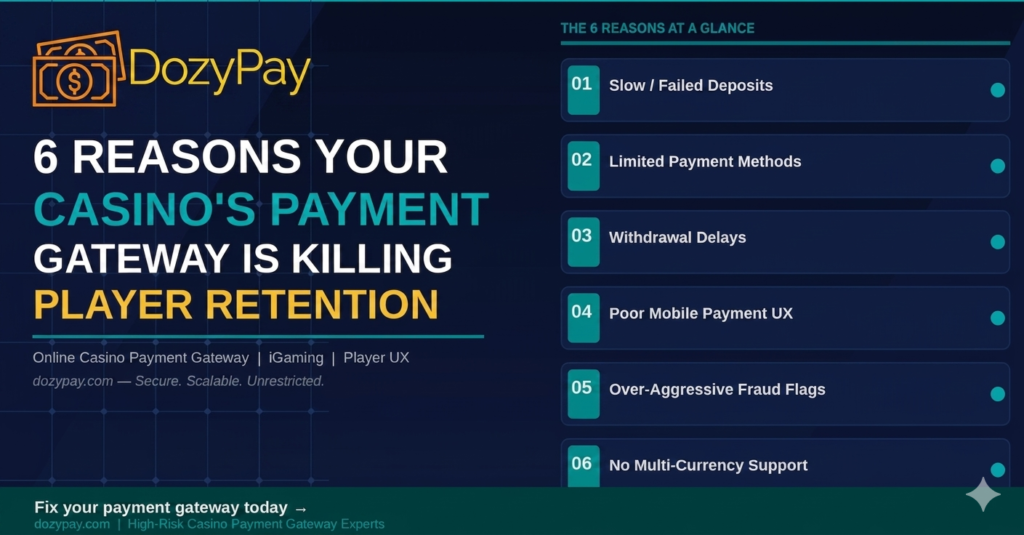
The 6 Retention Killers at a Glance
| # | Reason | Impact on Retention |
| 01 | Slow / Failed Deposits | 68% of players never return after first failure |
| 02 | Limited Payment Methods | 23–40% lower first-deposit conversion |
| 03 | Withdrawal Delays | Trust destruction — creates public detractors |
| 04 | Poor Mobile UX | 10–15% abandonment per extra friction step |
| 05 | Fraud False Positives | Blocks highest-value players first |
| 06 | No Multi-Currency | Unexpected charges, lower international retention |
What the Right Casino Payment Gateway Actually Looks Like?
Fixing these six retention killers is not about patching your existing gateway. Instead, it requires selecting a provider whose architecture was built for casino environments from the ground up.
Furthermore, not all high-risk gateway providers are equal. Therefore, here is what to look for specifically:
- Direct acquiring relationships with banks that actively support gambling — not just tolerate it
- 85–95% card approval rates through intelligent multi-bank routing and automatic failover
- Support for 15+ payment methods including cards, e-wallets, bank transfers, and cryptocurrency
- 24–72 hour withdrawal execution via direct payout rails — not intermediary chains
- Mobile-native deposit UX with embedded 3DS and biometric authentication
- Casino-specific fraud models trained on iGaming data — not e-commerce data
- 135+ currency support with local acquiring for key markets
- Full compliance support for MGA, UKGC, Curaçao, and other major licensing jurisdictions
| 🔗 RELATED READING | How to Integrate a Casino Payment Gateway Top 8 Features to Look for in a Casino Payment Gateway |
Conclusion: Your Payment Gateway Is Either Retaining Players or Losing Them
Player retention in iGaming is fought on many fronts. Game variety, bonusing, and loyalty programmes all play a role. However, every one of those investments is undermined by payment friction.
Furthermore, the six reasons outlined above are not edge cases. Instead, they are systematic, gateway-level failures affecting every operator using generic payment infrastructure.
The good news is that they are entirely solvable. Specifically, they require the right provider — one built exclusively for casino transaction environments.
DozyPay is a secure casino payment gateway provider built for high-risk operators. We provide casino merchant accounts, online casino payment gateway integration, and full payout infrastructure. Moreover, we support platforms at every stage — from startup to enterprise.
Whether you need the best payment gateway for online casino startup operations, or you are scaling into new international markets, DozyPay delivers the approval rates, payment methods, and technical infrastructure your players expect.
| Fix Your Casino’s Payment Gateway Today DozyPay provides casino merchant accounts and payment gateways for online casinos — with direct acquiring, high approval rates, and full compliance support. → dozypay.com/online-casino-payment-gateway Request a free quote | Same-day onboarding review |

DozyPay is a specialist high-risk payment gateway and merchant account provider, helping businesses in 150+ countries accept payments securely and without interruption. Our team includes payment analysts, compliance specialists, and fintech professionals with over a decade of combined experience in high-risk merchant processing — covering industries such as IPTV, adult content, online gaming, forex trading, pharmaceuticals, and travel.
Every article published by DozyPay is researched and written by our in-house payments team, drawing on real underwriting experience, industry data, and direct merchant feedback. Our goal is simple: give high-risk business owners the clear, honest information that banks and mainstream processors won’t.