
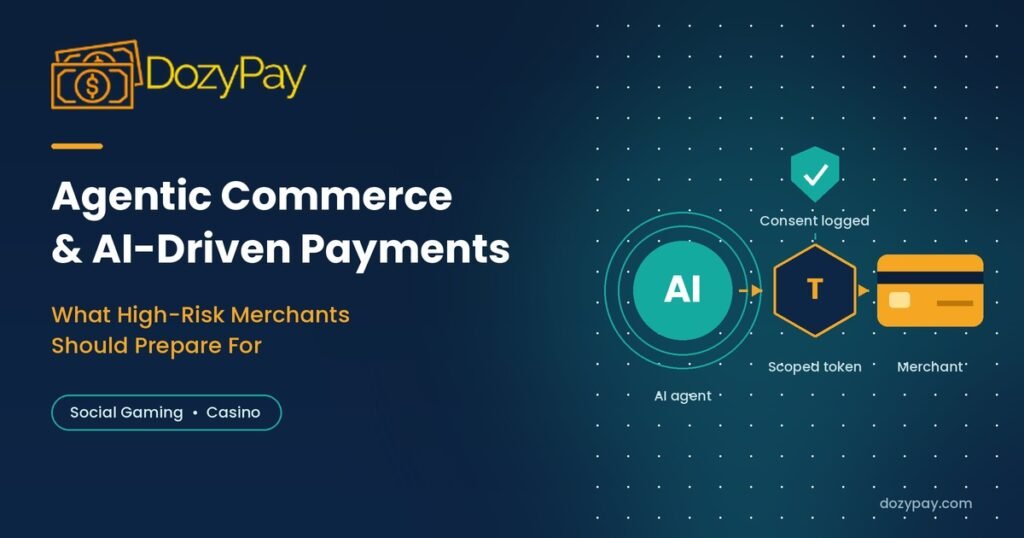
Quick Answer
Agentic commerce for high-risk merchants means preparing for AI agents that shop and pay. Customers set the limits, and the agent does the buying. This brings new bot traffic, new payment tokens and new dispute questions. To prepare, take four steps. Separate good agents from fraud. Store proof of consent for every order. Ask your processor about agent-ready tokens. Keep licensing and KYC controls current.
AI assistants no longer just suggest products. They now compare prices, fill carts and complete payments. Visa, Mastercard, Google, OpenAI and Stripe all run programs for this in 2026. So agentic commerce for high-risk merchants is no longer a distant idea. It is a planning item for the next twelve months.
Maybe you run an online casino, a sportsbook or a social gaming app. You might assume this wave will miss you. After all, card networks already treat your category with extra care. However, your customers use the same AI tools as everyone else. Your processor also sits on the same card rails. Therefore, the rules that shape agent payments will reach you too.
Visa has predicted that millions of shoppers will use AI agents to complete purchases by the 2026 holiday season. That forecast may prove early. Still, the infrastructure is being built now. This guide explains how it works and what to prepare. It is written for operators who already manage MCC 7995 scrutiny, reserves and chargeback pressure.
What Is Agentic Commerce?
In short, agentic commerce is a model where an AI agent acts as the buyer’s proxy. The agent finds products, compares options and completes the purchase. The shopper sets the goal and the limits. Then the agent handles the steps in between.
That differs from a chatbot that only offers advice. An agent can hold a payment credential and spend within rules the customer approved. For example, a player might say, ‘Buy the weekend coin bundle if it costs under $20.’ Then the agent checks the price and pays.
However, forecasts for the market vary widely. McKinsey has put the eventual opportunity at $3 trillion to $5 trillion by 2030. By contrast, one research firm estimated global agentic commerce at under $8 billion in 2025. So the direction is clear, but the timing is not.
How AI-Driven Payments Work Today?
Most agent payments ride on existing card rails. What is new is a layer of identity, tokens and proof of consent. Next, five building blocks matter most.
| Building block | Led by | What it solves? |
| Visa Intelligent Commerce and Trusted Agent Protocol | Visa | Verifies the agent’s identity and issues scoped tokens |
| Mastercard Agent Pay | Mastercard | Agentic Tokens tied to one agent and one spending policy |
| Agentic Commerce Protocol (ACP) | OpenAI and Stripe | Standard checkout between an agent and a merchant |
| Agent Payments Protocol (AP2) | Google and partners | Cryptographic proof that the user authorized the purchase |
| x402 | Coinbase | Stablecoin payments over standard web requests |
Mastercard announced Agent Pay on April 29, 2025. Also, its Agentic Tokens link to a real card but work only for one agent and one set of rules. Mastercard later opened agent payments to all of its US cardholders. In response, Visa launched Intelligent Commerce. It also announced tools such as Agent Score and an Agentic Directory. These help merchants judge whether an agent is approved.
Importantly, card-rail agent payments inherit existing rules. They use the same acquirers, the same merchant relationships and the same chargeback system. No new network has replaced the old one. As a result, your merchant account still decides whether these payments succeed.
Why Agentic Commerce for High-Risk Merchants Matters Now?
Consumer trust is growing, but slowly. A May 2026 Visa and Harris Poll survey found that 23% of US consumers trust generative AI with payments. Separately, Worldpay found that over one-third of 8,000 consumers were open to AI handling some purchases. Juniper Research also named trust as the top barrier to agent commerce in April 2026.
Meanwhile, gaming operators already see agent-like behavior. Worldpay reports that agents can compare odds across operators, place late bets and run arbitrage. Legacy fraud tools often flag good agents as suspicious. At the same time, bad agents slip through. As a result, teams waste hours on manual reviews.
Agentic commerce for high-risk merchants will likely arrive in stages. Expect agent platforms to start with low-risk retail. High-risk categories often wait longer for network and platform approval. That gap gives you a preparation window. Use it before volume arrives.
Five Things High-Risk Merchants Should Prepare For
These five steps put agentic commerce for high-risk merchants into practice. Each one is simple. Together, they protect revenue and approval rates.
1. Tell Good Agents From Bad Bots
Worldpay describes a ‘Know Your Agent’ approach. First, operators assess an agent’s transparency, intent and behavior before it causes harm. In addition, they use trust scores built from behavioral, transactional and device data. Finally, they keep an explanation for every block, because regulators may ask why.
However, market patterns differ. In the UK, about 65% of wagers fall under £50, so agent activity tends to look like rapid, low-value bets. In the US, nearly 7% of wagers exceed $1,000. That makes timing exploits more attractive. Learn more in our guide to AI fraud detection for high-risk payments.
2. Keep Proof of Consent for Every Order
No card network has created a special dispute code for agent purchases. According to Chargeflow’s analysis, the merchant of record usually answers the dispute. Consent also must be shown order by order. A general instruction to an agent does not cover a specific purchase.
Therefore, build an evidence file for each agent order. Include these items:
- Delegation record, including scope, spend cap and expiry
- Approved cart or recorded instruction
- Order details, such as price, account ID and delivery address
- Proof that the product was delivered or the virtual currency was credited
First, device and session data alone is usually weak. It describes the agent, not the buyer. Also track agent orders separately, because they count toward the same monitoring limits as other sales. Chargeflow’s summary notes that Visa’s VAMP program flags merchants at a 1.5% ratio once volume is high enough.
One more change is worth watching. From October 24, 2026, Visa’s Compelling Evidence 3.0 may count agentic payment tokens as evidence in some unauthorized-transaction disputes. However, published summaries differ. So confirm the details with your acquirer.
3. Ask Your Processor About Agent-Ready Tokens
In practice, merchants rarely connect to the networks directly. Visa’s Intelligent Commerce Connect, for example, is built for acquirers, processors and PSPs. So your processor decides how soon you can accept agent payments. Ask these questions:
- Which agent protocols do you support, such as Visa’s, Mastercard’s, ACP or AP2?
- Do agent tokens reach my gateway with a clear flag?
- Can I report approval and dispute rates for agent orders separately?
- Does my high-risk category affect eligibility?
4. Keep Compliance Ahead of Automation
An agent does not change where you can lawfully operate. Licensing, geo-controls, age checks and KYC still apply to the player. A purchase made by an agent does not remove the need to verify the person behind it.
Also, regulators may ask harder questions. Worldpay warns that agents can reduce uncertainty so much that gambling starts to resemble trading. In some markets, rules are tight already. India’s PROGA 2025, for example, restricts payment facilitation for real-money online gaming. Operators with India-facing audiences should stay with compliant social gaming models.
5. Look Beyond Cards
Card rails will likely carry most early agent spend. However, stablecoin protocols such as Coinbase’s x402 add a second path. They let agents pay over the web using stablecoins. Casinos should watch this space closely. Regulatory risk is still high, and many acquirers are cautious. Our article on stablecoin adoption in B2B payments shows how quickly this area is moving.
Choosing a Social Gaming Merchant Account Provider for the Agent Era
Agentic commerce for high-risk merchants also reaches social gaming apps. These apps sell virtual currency in small, repeat purchases. That pattern suits delegated buying. For instance, a player could ask an agent to top up coins every weekend. As a result, your payment stack must handle recurring, low-value orders cleanly.
A capable social gaming merchant account provider should offer:
- Clear rules for virtual currency and in-app purchases
- Support for tokenized payments and new agent protocols as they launch
- Chargeback tools that store consent evidence
- Multi-acquirer routing, so one decline does not stop revenue
- Fast onboarding for new apps and storefronts
Finally, ask for approval-rate data by country. Agents may buy from anywhere, so regional performance matters.
Casino Merchant Account Approval in an AI-Driven Market
Casino merchant account approval still rests on the basics. First, underwriters check your licence, your ownership, your processing history and your risk controls. Agentic commerce for high-risk merchants adds new questions on top.
Expect reviewers to ask how you detect automated traffic. They may also ask how you log customer consent. In addition, they will want proof of KYC, geo-blocking and responsible gaming tools. So, write a short agent policy before you apply. This policy should explain what automation you allow, what you block and how you record consent.
If you are learning how to get a gaming merchant account, start with a clean document pack. Next, gather your licence, company records, bank statements and a clear chargeback plan. Operators with an offshore casino merchant account should also confirm that they serve only permitted markets. The right high risk merchant account for gaming fits your licence, your markets and your growth plan.
Agentic Commerce Readiness Checklist
Use this agentic commerce for high-risk merchants checklist to turn the ideas above into action:
- Audit bot and automation traffic, and separate good agents from bad ones
- Log consent, spend limits and cart details for every automated order
- Tag agent orders in reporting so ratios stay visible
- Ask your processor which agent protocols and tokens it supports
- Review chargeback evidence templates for agent-driven disputes
- Confirm licence, geo and age-check rules for every market you serve
- Write a short policy on automated access and agent purchases
- Keep a backup processor so one rule change does not stop sales
Frequently Asked Questions
What is agentic commerce for high-risk merchants in simple terms?
Agentic commerce means an AI agent shops and pays for a customer. The customer sets the goal and the spending limits. The agent then finds, compares and buys.
Will AI agents pay for casino and gaming purchases?
Not at scale yet. Public announcements so far focus on mainstream retail. Networks and AI platforms set their own category rules, so gambling access is not guaranteed. However, social gaming purchases may arrive sooner than real-money play. Check with your processor before you plan around it.
Who is liable for chargebacks on AI agent purchases?
Usually the merchant of record, according to current analysis. Card networks have no agent-specific dispute code, and consent must be shown for each order. So keep a full evidence file for every agent purchase.
What is an agentic token?
An agentic token is a payment credential tied to a real card. It works only for one AI agent and one spending policy. Mastercard’s Agent Pay uses them. Visa issues similar scoped tokens through Intelligent Commerce.
Does agentic commerce change casino merchant account approval?
Not formally yet. However, underwriters already care about bot traffic, KYC and chargebacks. Clear controls for automated access will strengthen your application.
What should a social gaming merchant account provider support?
Instead, look for tokenized payments, strong chargeback tools, multi-acquirer routing and clear rules for virtual currency.
Prepare Now, Before the Disputes Arrive
Agentic commerce for high-risk merchants will move more slowly than retail. Even so, the groundwork is being laid today. As a result, merchants who log consent, watch automated traffic and choose flexible processors will adapt faster.
DozyPay supports high-risk merchants across gaming, iGaming and social gaming. If you want to review your setup for the agent era, contact our team.