| Quick answer: Settlement timelines for gaming operators show how many business days pass between a player’s deposit and the cash reaching your bank. T+1 means the next business day. T+7 means about a week. Processor-published ranges put established high-risk accounts at T+1 to T+3, while newer accounts can start slower. However, the biggest cash drag often comes from the rolling reserve and the 120-day chargeback window, not from settlement speed alone. |
Cash flow decides whether a gaming business survives a busy month. Settlement timelines for gaming operators sit at the centre of that picture. Players deposit in seconds, yet your bank balance may move days later. Meanwhile, you still pay for licences, game content, marketing and player withdrawals.
This guide explains T+1 and T+7 in plain language. It shows what the gap costs in real dollars. It also gives you a step-by-step plan to protect your working capital. The figures come from published processor ranges and DozyPay’s own guides. Treat them as typical, because every acquirer sets terms case by case.
This guide is for licensed operators in jurisdictions where gaming payments are permitted. Always check local law before you process payments.
What Do T+1 and T+7 Settlement Mean?
The “T” stands for the transaction day. The number counts the days that follow. So T+1 means funds reach your bank on the next business day. T+7 usually means a weekly cycle. Weekends and bank holidays often stretch the real calendar time, so check whether your contract counts business days or calendar days.
A daily cut-off time also applies. A deposit captured after the batch closes joins the next day’s batch. As a result, a Friday evening deposit can land after the weekend.
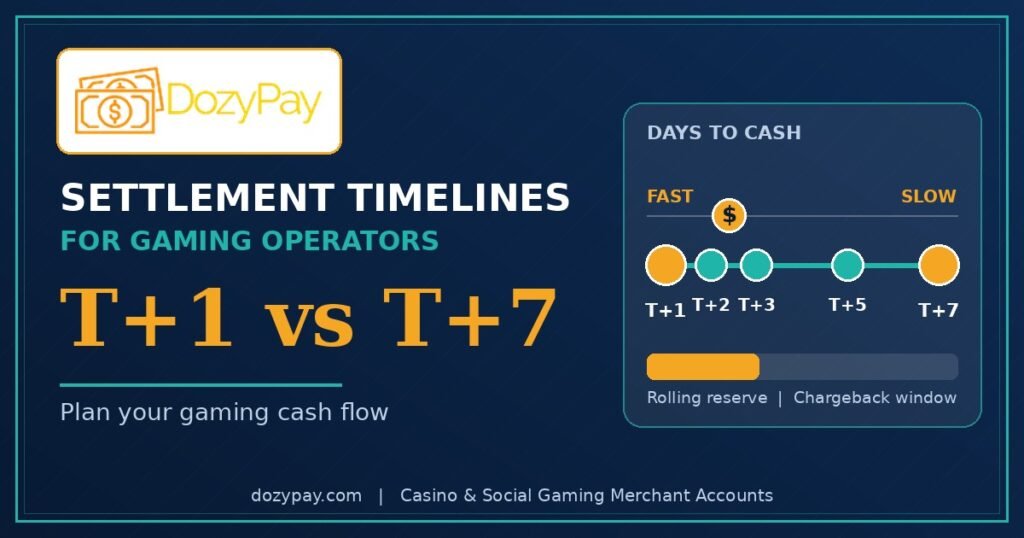
| Cycle | When funds arrive | Typical fit |
| T+1 | Next business day | Established operators with a clean chargeback and payout history |
| T+2 to T+3 | Two to three business days | A common range for high-risk gaming accounts |
| T+5 | About one business week | Some new accounts during their first 90 days |
| T+7 | Weekly cycle | Newly boarded, higher-risk or weekly-batch contracts |
Treat these as typical ranges, not promises. One processor guide puts established high-risk accounts at T+1 to T+3, and some new accounts at T+3 or T+5 during their first 90 days (SeamlessChex). A T+7 cycle sits at the slow end of the range.
Why Gaming Merchants Often Settle Slower Than Retail?
Acquirers price risk, and gaming carries plenty of it. Players can dispute a charge for months. Some disputes are honest, yet others are friendly fraud. Card networks also watch gambling closely through merchant category code 7995. Because of this, banks protect themselves with slower funding and a reserve.
Most operators need a high risk merchant account for gambling business activity. Underwriting is tighter and monitoring is closer than on a standard account. In return, the bank accepts risk that mainstream processors decline. Slower settlement is part of that trade.
The Three Clocks That Control Your Cash
Most operators watch only the settlement clock. However, two other clocks run at the same time. Together, they decide how much cash you can actually use today.
| Clock | Typical range | Effect on cash |
| Settlement | One to three business days; T+5 to T+7 can apply early on | Delays each day’s deposits |
| Rolling reserve | Market examples run 5% to 15%, held for 90 to 180 days | Locks a slice of every payout |
| Chargeback window | Typically 120 days; some disputes run up to 540 days | Keeps your risk and your reserve alive |
Our guide to rolling reserves for gaming merchants explains how to model the reserve as restricted working capital. In most agreements, the reserve does not add days to settlement. Instead, it holds back a share of each payment until the release date.
The chargeback clock explains why reserves last so long. Cardholders typically have 120 days to file a dispute, and some future-delivery disputes can reach 540 days on Visa (ClearSale). So the bank keeps a buffer for months after each sale.
T+1 vs T+7: What the Gap Costs in Real Money
Consider an operator that processes $500,000 in card deposits each month. That equals about $16,700 per day. The table below shows how much cash sits in transit at three settlement speeds. It also adds a 10% rolling reserve held for 90 days.
| Cycle | Cash in transit | Reserve held (10%, 90 days) | Total cash tied up |
| T+1 | About $16,700 | About $150,000 | About $166,700 |
| T+3 | About $50,000 | About $150,000 | About $200,000 |
| T+7 | About $116,700 | About $150,000 | About $266,700 |
At steady state, the reserve holds about $150,000 in every scenario. However, moving from T+1 to T+7 adds roughly $100,000 of cash in transit. That extra $100,000 is working capital you must find somewhere else.
These figures are a simple illustration. They assume even daily volume, a 30-day month and a fully built reserve. Real terms vary, so run the same sum with your own numbers.
What Does Instant Settlement Really Cost?
Some providers sell faster funding as an add-on. One published example prices it at 0.25% to 0.5% per batch. To see the yearly cost, multiply the fee percentage by 365, then divide by the days of float you avoid. For example, 0.25% on a three-day float works out to roughly 30% a year (SeamlessChex). Instant settlement also does not release your reserve. Only the cash left after the reserve moves faster.
The Payout Gap: Players Withdraw Faster Than You Settle
Deposits reach your account on a delay. Withdrawals do not wait. Push-to-card rails such as Visa Direct typically deliver winnings in under 30 minutes, as covered in our guide to instant payouts for iGaming. Instant rails also cannot be reversed. Therefore, you must hold enough cash before you release a payout.
This creates a funding gap. On a busy weekend, players may withdraw thousands of dollars while the matching deposits are still in transit. Many operators therefore keep a dedicated payout float.
The best payment gateway for online gaming business use should also report settlement status clearly. Look for batch cut-off times, settlement reports and reconciliation tools. With those in place, your finance team can forecast cash without guessing.
How to Plan Cash Flow Around Your Settlement Cycle?
A repeatable plan beats guesswork. Use these six steps to turn your settlement terms into a forecast.
- Write down every clock. List your settlement cycle, cut-off time, reserve rate, release date and chargeback window.
- Build a 13-week cash forecast. Shift each week’s deposits by your settlement lag. Then subtract the reserve withholding.
- Size your buffer. Add the peak reserve balance, the cash in transit and a payout float. Then add a margin for chargebacks.
- Mark your peak dates. Big sporting events and holiday weekends lift volume. Funds from a Friday spike may arrive the following week.
- Separate player funds from operating cash. Where your licence requires segregation, keep player balances apart from working capital.
- Review terms on a schedule. Ask for a reserve review at six and twelve months, and bring your chargeback record as evidence.
How to Improve Your Settlement Terms Over Time?
Your terms start at casino merchant account approval. Underwriters review your licence, KYC process, payout controls, fraud monitoring and processing history. A clean file earns better opening terms. You can read how a casino merchant account works at DozyPay before you apply.
After approval, performance does the talking. Keep your chargeback ratio below the 1% level that the industry widely treats as the standard. Respond to disputes quickly with strong evidence. Reconcile every settlement. Over time, a clean record gives you grounds to ask for a lower reserve or faster funding.
An offshore casino merchant account adds another layer. Settlement currency, FX conversion and cross-border banking can each slow funds down. Therefore, confirm the settlement currency and the receiving bank before you sign.
Settlement Planning for Social Gaming Operators
Social games sell virtual coins and in-app items rather than wagers. Underwriters therefore review the model differently. However, refunds, disputes and friendly fraud still shape reserves and settlement speed.
When you compare a social gaming merchant account provider, ask about reserves, refund handling and settlement frequency. Our social gaming merchant account page explains the options for coin packs and in-app purchases.
Payment processing for social gaming apps also depends on traffic patterns. Events, bonus drops and new releases create spikes. Plan your settlement buffer around those spikes, not around your monthly average.
Questions to Ask Before You Sign
If you are researching how to get a gaming merchant account, add these questions to your checklist:
- What is the settlement cycle, and does it count business days or calendar days?
- What is the daily batch cut-off time?
- What reserve rate and release period apply, and is the cap written into the contract?
- When will you review reserve and settlement terms?
- Is faster settlement available, and what does it cost?
- Which payout rails can I use for withdrawals?
- Which currency do you settle in, and who sets the FX rate?
FAQs on Settlement Timelines for Gaming Operators
What does T+1 settlement mean for gaming operators?
T+1 means your processor sends funds to your bank on the next business day after the transaction. It gives you the fastest standard cash cycle. Established operators with clean records are the most likely to qualify.
Is T+7 settlement normal for casino merchants?
It is not the norm for established operators. However, a weekly cycle can appear on newly boarded or higher-risk accounts. Settlement terms are negotiated, so ask your provider when a faster cycle becomes possible.
Do rolling reserves delay settlement?
In most agreements, a reserve does not add days. Instead, it holds back a percentage of each payout for a set period. Market examples run from 5% to 15% for 90 to 180 days, depending on risk.
Can gaming merchants get instant settlement?
Some providers offer it as a paid add-on. Pricing varies, and one published example lists 0.25% to 0.5% per batch. Instant settlement does not release funds held in a reserve.
How long does chargeback risk last?
Cardholders typically have 120 days to file a dispute. Some future-delivery disputes can extend to 540 days on Visa. That is why acquirers hold reserves for months.
How much working capital should a gaming operator hold?
Add up your cash in transit, your peak reserve balance and a payout float. Then add a margin for chargebacks. In the example above, a T+7 operator ties up about $266,700 before any margin.
Final Thoughts
Settlement timelines for gaming operators are a cash flow problem, not just a payments setting. T+1 gives you speed. T+7 widens the cash gap. Either way, the reserve and chargeback clocks decide how much money you can use. Map all three, build a buffer and review your terms often.
Ready to compare settlement options for your casino or social gaming business? Request a quote from the DozyPay team.