Applying for a casino merchant account is, for most iGaming operators, far more complicated than opening a standard business payment account. Consequently, before submitting a single document, most operators arrive with a list of questions they cannot easily answer from a provider’s marketing page — questions about approval timelines, chargeback thresholds, rolling reserves, multiple currencies, and what really happens when a processor labels your business as high risk.
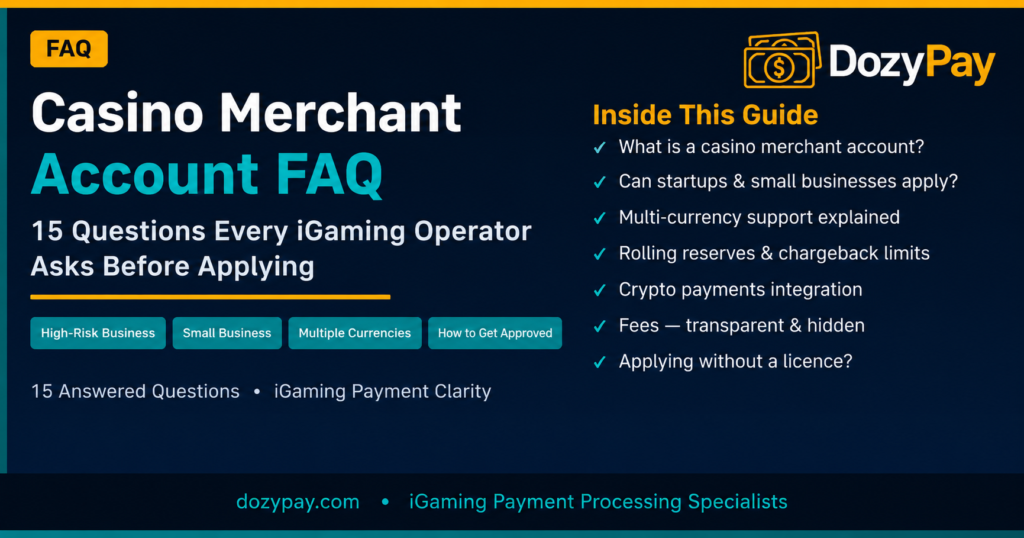
This FAQ page answers the 15 most common questions DozyPay receives from online casino operators, sports betting platforms, social gaming businesses, and iGaming startups before they apply. Moreover, each answer is written to give you actionable clarity — not vague reassurances — so that you walk into the application process fully informed.
If you are ready to move beyond the questions and understand the full picture, start with our complete casino merchant account guide before reading further.
Quick Navigation: All 15 Questions
| # | Question |
| Q1 | What exactly is a casino merchant account and how does it differ from a standard one? |
| Q2 | Why is a casino merchant account classified as high risk? |
| Q3 | Can a small casino business or startup get approved? |
| Q4 | How do I get a casino merchant account — what is the process? |
| Q5 | How long does approval take? |
| Q6 | What documents do I need to apply? |
| Q7 | Does my casino merchant account support multiple currencies? |
| Q8 | What is a rolling reserve and how much will I lose to it? |
| Q9 | What chargeback rate will get my account terminated? |
| Q10 | Can I accept cryptocurrency payments through my merchant account? |
| Q11 | What happens if my casino merchant account gets shut down? |
| Q12 | Do I need a separate account for each market or jurisdiction? |
| Q13 | What fees should I expect — and what fees are hidden? |
| Q14 | Can I get a casino merchant account without a gambling licence? |
| Q15 | How does DozyPay’s casino merchant account differ from other providers? |
Section 1: The Basics — What a Casino Merchant Account Is and Who Qualifies
Q1. What exactly is a casino merchant account and how does it differ from a standard business merchant account?
A casino merchant account is a specialised payment processing account that enables iGaming businesses — online casinos, sports betting platforms, poker rooms, and skill-gaming sites — to accept card payments, bank transfers, and alternative payment methods from players worldwide.
Standard merchant accounts, however, are designed for low-risk retail and service businesses. As a result, the risk models, underwriting criteria, reserve structures, and compliance requirements for a casino merchant account are fundamentally different. In particular, standard processors reject iGaming applications outright because gambling-related chargebacks, regulatory exposure, and transaction volatility fall entirely outside their risk appetite.
Therefore, a casino merchant account operates through high-risk payment processors who have the banking relationships, compliance infrastructure, and chargeback management tools specifically built for the iGaming vertical.
For a full breakdown of how these accounts work in practice, read our online casino payment gateway guide.
Q2. Why is a casino merchant account classified as high risk — and does that label hurt my business?
The high-risk classification exists because of three structural factors that apply to virtually every iGaming business regardless of size or reputation. First, chargeback rates in online gambling consistently run 3–5 times higher than in standard e-commerce — players dispute transactions they remember making, which creates ongoing liability for any processor holding your funds.
Second, the regulatory environment for online gambling is jurisdictionally complex. A transaction that is entirely legal for a player in Malta may be illegal for a player in a restricted market — and the processor carries exposure if it processes that payment without proper controls. Third, the average transaction value and velocity in iGaming creates significant settlement risk.
Nevertheless, the high-risk label does not hurt your business in any meaningful operational sense when you are working with a specialist processor. In fact, the right casino merchant account for a high-risk business is specifically structured to handle all three of these factors through intelligent routing, proactive chargeback management, and jurisdiction-aware payment filtering.
Q3. Can a small casino business or startup get approved for a casino merchant account?
Yes — and this is one of the most common misconceptions in iGaming payments. A casino merchant account for small business operators and startups is absolutely achievable, provided the application is structured correctly.
Specifically, what underwriters evaluate for new operators is not trading history but rather the quality of the compliance framework, the strength of the licensing position (or the roadmap to licensing), the credibility of the ownership team, and the realistic projected transaction volumes. In fact, a well-documented startup with a Gibraltar or Curaçao licence and clean beneficial ownership disclosure is a more attractive underwriting risk than an established operator with a history of chargeback spikes.
Moreover, for operators launching a social gaming or free-to-play platform — which avoids real-money gambling classification in many jurisdictions — the underwriting criteria are more straightforward still, since real-money wagering risk is absent.
Read the detailed guide on getting a casino merchant account for startups and new operators to understand exactly what a new business needs to get approved.
Section 2: The Application Process — How to Get a Casino Merchant Account
Q4. How do I get a casino merchant account — what does the actual process look like?
Understanding how to get a casino merchant account begins with recognising that the process has four distinct stages, each with its own documentation requirements and timelines.
| Stage | Name | Timeframe | What Happens |
| 1 | Pre-qualification | 1–3 days | Provider reviews your business model, jurisdiction, and volumes |
| 2 | Document submission | 3–7 days | You submit KYB, KYC, licence docs, processing history, website |
| 3 | Underwriting review | 5–15 days | Bank and risk team evaluate your full application |
| 4 | Integration & go-live | 3–10 days | API integration, testing, and first live transaction |
Furthermore, the speed of the process depends almost entirely on how complete and well-organised your document pack is at submission. Operators who submit a partial application and respond slowly to underwriter queries routinely add 2–4 weeks to an otherwise straightforward approval.
For the complete step-by-step integration process after approval, read our guide on how to integrate a casino payment gateway.
Q5. How long does it take to get approved for a casino merchant account?
In general, a standard casino merchant account approval takes between 2 and 5 weeks from complete document submission to live processing. However, several factors can accelerate or delay this timeline significantly.
Factors that accelerate approval include: an established EU or UK gambling licence, clean beneficial ownership with no adverse media, a well-documented AML/KYC policy, and realistic transaction volume projections backed by data. Conversely, factors that cause delays include incomplete KYC documents, undisclosed UBOs, jurisdictions that require additional banking compliance sign-off, or a website that is live with content that conflicts with the stated business model.
Therefore, operators who want the fastest possible approval should prepare their complete document pack — including a fully drafted AML policy, certified ID for all UBOs above 10% ownership, and either active processing statements or a credible business plan — before making first contact with a processor.
Q6. What documents do I need to apply for a casino merchant account?
The exact document list varies by jurisdiction and processor, but the following checklist covers what virtually every underwriter will request:
Company Documents
- Certificate of Incorporation and Memorandum & Articles of Association
- Certificate of Good Standing (dated within 6 months)
- Gambling licence (or licence application in progress with supporting evidence)
- Proof of registered business address
UBO / Director KYC
- Government-issued photo ID for all directors and UBOs above 10% ownership
- Proof of residential address (utility bill or bank statement, dated within 3 months)
- Curriculum vitae for key management (processor may request this)
Operational Documents
- AML / KYC Policy document
- Responsible Gambling Policy
- Terms and Conditions and Privacy Policy (live on website)
- Processing history statements (minimum 3 months, if available)
- Projected monthly volumes and average transaction values
In addition, your payment page and website must be live and functional at the time of submission — underwriters will review the entire player journey, including deposit flows, withdrawal processes, and bonus terms.
Section 3: Operational Questions — Currencies, Reserves, and Chargebacks
Q7. Does a casino merchant account support multiple currencies — and how does multi-currency processing actually work?
Casino merchant account multiple currencies support is not just a convenience feature — for any iGaming operator targeting players across more than one market, it is a fundamental requirement that directly affects player conversion rates and revenue.
In practice, multi-currency processing through a casino merchant account works in one of two ways. Dynamic Currency Conversion (DCC) displays the transaction in the player’s local currency at checkout, while settlement occurs in your designated base currency — meaning your accounting is simple but players see local pricing. Alternatively, multi-currency settlement allows you to hold and settle funds in multiple currencies simultaneously, which is particularly valuable for operators who pay out player winnings in the same currency they deposited.
Furthermore, currency coverage matters as much as the feature itself. DozyPay’s casino merchant account multiple currencies infrastructure supports 40+ currencies across European, Asian, and Latin American markets — including local payment methods that card-only processors cannot access.
| Feature | DCC Model | Multi-Currency Settlement |
| Player sees | Local currency | Local currency |
| You settle in | Single base currency | Multiple currencies |
| FX risk | Processor absorbs | You manage or hedge |
| Best for | Simplified accounting | Multi-market operators |
Q8. What is a rolling reserve and how much will I lose to it?
A rolling reserve is a risk management mechanism used by processors to protect against chargebacks, fraud losses, and sudden account terminations. Specifically, a percentage of every transaction — typically between 5% and 10% — is withheld from your settlement and held in reserve for a fixed period, usually 90 to 180 days, before being released back to you.
However, the important nuance is that you do not lose the reserve — it is released on a rolling basis after the hold period. The practical impact is a cash flow gap during your first 3–6 months of processing, after which incoming reserve releases offset new withholdings and the net cash flow impact normalises.
Moreover, rolling reserve percentages are negotiable and typically decrease as your processing history demonstrates low chargeback rates and stable volumes. New operators should model their cash flow with a 10% reserve assumption and plan accordingly, while established operators with clean processing history can often negotiate this down to 5%.
Q9. What chargeback rate will get my casino merchant account terminated?
The industry threshold that most processors use as a hard termination trigger is 2% of monthly transaction volume. In practice, however, the warning signs begin far earlier. Most processors issue a formal notification when chargebacks reach 1% and begin enhanced monitoring at 1.5% — so by the time you hit 2%, you are already in a remediation conversation.
Furthermore, it is worth understanding that chargeback thresholds are calculated monthly, not annually — a single bad month with a high dispute rate can trigger account review even if your 12-month average is well below 1%.
Therefore, the most effective approach is proactive chargeback prevention rather than reactive remediation. This means implementing 3DS2 authentication on all card transactions, maintaining transparent bonus terms that reduce friendly fraud, and monitoring your dispute ratio weekly rather than monthly.
Read the detailed guide on how to reduce chargebacks on your casino merchant account before your first month of live processing.
Section 4: Advanced Questions — Crypto, Shutdowns, Licences, and Fees
Q10. Can I accept cryptocurrency payments through my casino merchant account?
Yes — and increasingly, crypto acceptance is not a premium add-on but a baseline expectation for operators targeting specific player demographics, particularly in Asian and Eastern European markets where card acceptance rates are lower and crypto adoption is higher.
A casino merchant account with crypto support typically handles Bitcoin (BTC), Ethereum (ETH), Tether (USDT), and Litecoin (LTC) as the minimum viable stack. More comprehensive offerings extend to a broader stablecoin range, which is particularly valuable for operators who want to eliminate FX volatility on their treasury operations.
In addition, crypto processing eliminates chargebacks entirely — blockchain transactions are irreversible — which directly reduces your chargeback ratio and consequently makes your account more stable in the eyes of your card processor.
For the full breakdown of crypto options, read our guide on casino payment gateway cryptocurrency — Bitcoin, Ethereum, and stablecoins.
Q11. What happens if my casino merchant account gets shut down — and how do I avoid it?
Account termination is the scenario every iGaming operator fears most, and understanding the causes is the most effective form of prevention. The most common reasons casino merchant accounts are terminated include: sustained chargeback rates above 2%, processing transactions in jurisdictions explicitly excluded in the merchant agreement, significant discrepancies between stated and actual transaction volumes, failed AML audits, and regulatory actions against the operator’s licence.
However, the crucial point is that processor terminations are almost never sudden or without warning. In practice, there is typically a sequence of notifications — informal chargeback alerts, a formal cure letter, a reserve increase, and then suspension — that gives operators multiple opportunities to remediate before termination becomes final.
Consequently, the most important protection is maintaining a secondary casino merchant account with a different processor before you need it. Operators who run with a single processor are one bad month away from having zero payment processing — a risk that is entirely avoidable with proper redundancy.
Read the detailed guide on what happens when your online casino merchant account gets rejected and how to recover.
Q12. Do I need a separate casino merchant account for each market or jurisdiction I operate in?
Not necessarily — but the answer depends on your licensing structure and the payment method coverage you need in each market. A single casino merchant account with multi-jurisdiction card processing capabilities can cover most European, North American, and Asian markets from a single integration, provided your gambling licence covers those jurisdictions.
Where separate accounts become necessary is when you need local payment methods that are not available through a global processor — for instance, a Brazil-specific Pix integration, a German SOFORT flow, or a Netherlands iDEAL setup. In those cases, a blended architecture — one primary card processing account plus targeted local payment method integrations — is more efficient than maintaining separate merchant accounts per market.
Furthermore, multi-currency settlement (discussed in Q7) allows you to manage multi-market revenues through a single account without the operational complexity of reconciling multiple processor relationships.
For offshore-specific considerations, read our guide on the offshore casino merchant account and how jurisdiction selection affects your processing options.
Q13. What fees should I expect — and are there hidden fees I need to watch for?
Casino merchant account fees fall into two categories: transparent fees that every processor discloses upfront, and structural costs that are technically disclosed but rarely highlighted in sales conversations.
Transparent Fees
- Transaction processing rate: typically 3–6% for card transactions in iGaming (versus 1–2% in standard e-commerce)
- Monthly account fee: £200–£800/month depending on processor and tier
- Setup / underwriting fee: £500–£2,500 one-time
- Chargeback fee per dispute: £15–£35 per chargeback received
Fees to Watch For
- FX conversion margin: typically 1.5–3% above mid-market rate — not always disclosed as a line item
- Reserve withholding: 5–10% withheld from every settlement, returned after 90–180 days
- Minimum monthly volume fee: charged if you fall below a stated monthly processing volume
- PCI DSS compliance fee: £50–£150/month if you are not managing your own compliance
- Early termination fee: can reach 3–6 months of projected fees if you exit before contract end
Therefore, when evaluating any casino merchant account proposal, always request a full fee schedule in writing and model your effective net rate against projected monthly volumes before signing.
For strategies to reduce your processing costs, read our guide on how to get a low-fee gambling payment gateway.
Q14. Can I get a casino merchant account without a gambling licence?
This is the question with the most nuanced answer in iGaming payments, and the answer varies significantly depending on what type of platform you are operating.
For real-money gambling operators — online casinos, sports betting, poker — a gambling licence is not optional. In practice, no regulated bank or serious high-risk processor will underwrite a real-money iGaming business without confirmed licensing. Attempting to process real-money gambling transactions without a licence is not only an underwriting non-starter — it exposes the operator to criminal liability in most jurisdictions.
However, for social gaming, sweepstakes, and skill-gaming platforms, the situation is different. These business models operate in regulatory spaces that, in many jurisdictions, do not require a gambling licence because no real-money wagering occurs. Consequently, processors can underwrite social gaming merchant accounts under standard high-risk commercial criteria without a gambling licence requirement.
Read the full comparison of social gaming vs real-money gambling merchant accounts to understand which underwriting pathway applies to your platform.
Q15. How does DozyPay’s casino merchant account differ from other high-risk processors?
Most high-risk processors treat iGaming as one vertical among many — alongside nutraceuticals, adult content, and travel. As a result, their iGaming product is a generic high-risk account with slightly higher fees rather than a solution built around the specific operational demands of online gambling.
DozyPay, by contrast, focuses exclusively on the iGaming and payment processing vertical. In practice, this means the underwriting team understands chargeback dynamics specific to casino deposits and withdrawals, the risk models account for the volatility patterns that characterise iGaming transaction flows, and the integration stack includes iGaming-specific features — cascading payment routing, player-level fraud scoring, and multi-currency settlement — that generic processors simply do not offer.
Furthermore, DozyPay’s network of banking relationships is specifically maintained for iGaming businesses, which means approval rates are higher for casino operators and the reserve structures are calibrated to iGaming risk rather than generic high-risk assumptions.
Explore all casino merchant account features to see the full capability stack, or review our online casino payment gateway guide for the technical integration picture.
Quick-Reference Summary: Casino Merchant Account Key Facts
| Question | Quick Answer |
| Approval timeline | 2–5 weeks from complete document submission |
| Startup / small business approval | Yes — licence + clean KYC is the key requirement |
| Rolling reserve | 5–10%, returned after 90–180 days |
| Chargeback limit before termination | 2% monthly — warning signs begin at 1% |
| Multi-currency support | Yes — 40+ currencies with DCC or multi-currency settlement |
| Crypto payments | Yes — BTC, ETH, USDT, LTC and more |
| Licence required | Yes for real-money gambling; not always for social gaming |
| Processing rate | 3–6% for card transactions (iGaming standard) |
Ready to Apply? What to Do Next
The 15 questions above cover the majority of concerns operators raise before submitting a casino merchant account application. Furthermore, the most important insight that emerges from all of them is the same: preparation determines outcome. Operators who arrive at the underwriting table with a complete document pack, a clean compliance framework, and realistic volume projections get approved faster, negotiate better terms, and experience fewer post-approval operational issues.
In addition, operators who understand the fee structure, chargeback thresholds, and reserve mechanics before going live are far less likely to encounter the cash flow surprises that catch underprepared iGaming businesses in their first six months.
To take the next step, review DozyPay’s casino merchant account page for current underwriting criteria and application requirements, or explore the gambling payment gateway options if you need broader payment infrastructure beyond card processing.
If your platform is a social or free-to-play gaming product, the pathway is different — and considerably faster. In that case, the
social gaming merchant account page outlines the specific underwriting track for non-gambling iGaming businesses.
Related Reading:
Casino Merchant Account: Complete Guide
Casino Merchant Account Features
Payment Gateway vs Merchant Account — Online Casino
Top 8 Features of an Online Casino Payment Gateway
9 Things to Check Before Choosing a Gambling Payment Gateway
How to Reduce Chargebacks on Your Casino Merchant Account
Best Payment Gateway for Online Casino Startup 2026